Key Takeaways
- Santa Monica’s fight over building height is really about parking: how many stalls a building gets moves the cost more than how deep they are dug.
- Renters near Santa Monica’s E Line stations average about one car per household, so “one car or less per apartment” describes how they already live.
- State law has removed parking minimums near transit and separated parking from rent, but it does not say what to build instead.
- Separate the mobility court at the front door from the parking and fleet level, and design the court as a pull-through so no vehicle ever reverses.
- Let each building decide whether fleet cars charge in its open-air mobility court overnight, ready at the door for residents’ morning trips, and send bulk fleet staging to enclosed city garages that run at about half capacity.
Thirty-two apartments, eight parking spaces
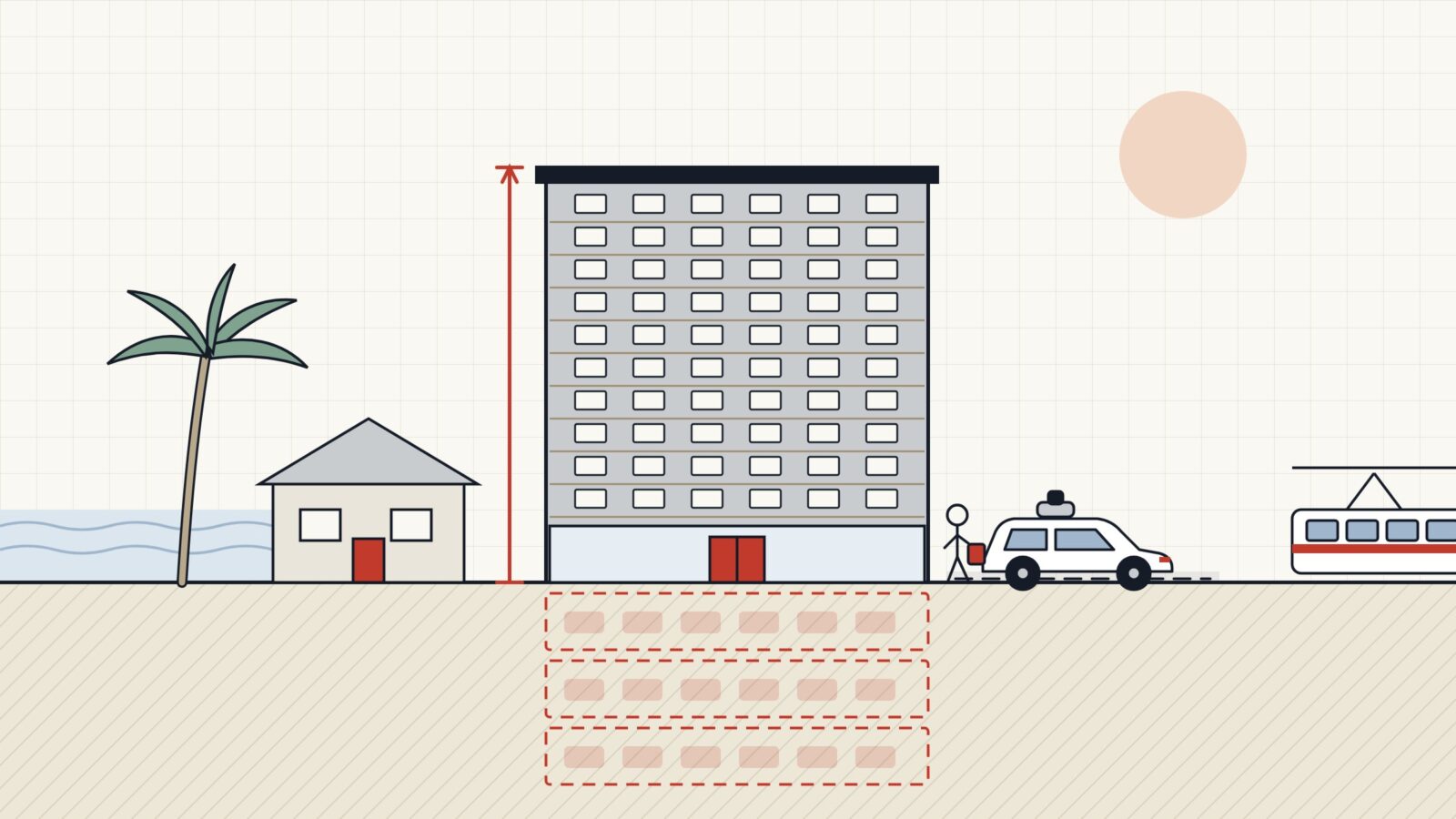
On August 14, Bruce Adler filed a preliminary application with the City of Santa Monica for a twelve-story, 138-foot residential building at 1517 15th Street, on a 7,500-square-foot lot zoned for two-family use and currently holding one single-family house.1 The building would contain 32 one- and two-bedroom apartments, six of them deed-restricted affordable. It sits next to the E Line’s 17th Street/SMC station, which means no local parking minimum applies. The plans show between four and eight optional spaces, reached from the alley.2
Call it a quarter of a stall per apartment, at the generous end.
1517 15th Street, by the numbers
The filing came thirteen days before Santa Monica’s SB 79 exclusion ordinance took effect on August 27. That ordinance pauses the state’s transit-oriented upzoning in every Santa Monica transit zone except Expo/Bundy, and Expo/Bundy joins the pause on October 23.34 Whether a project filed in that thirteen-day window keeps the state standards is a question the city has not publicly answered. The prevailing legal reading of SB 330 is that a complete preliminary application locks in the rules in effect on the day it is filed, but no court or state agency has ruled on this exact gap.5 The city has received three preliminary SB 79 applications.4
Whatever one thinks of a twelve-story building on a two-family lot, the parking number is the part worth sitting with. Santa Monica is having a loud public argument about building height. The applicant at 1517 15th Street has quietly answered a different question, and that answer changes the height argument more than any waiver will.
Where this view comes from
I spent years owning and operating a 1,300-space garage at Baltimore’s Inner Harbor, and I now design and integrate parking access and revenue control systems for owners, cities and airports as part of my work as a parking consultant. I live in Los Angeles. Working with Fernando Sanchez, DBIA, I am finishing a white paper on how cities should prepare their curbs, garages and codes for autonomous vehicles. I say this up front so the argument that follows is read correctly: it comes from someone who has spent a career making structured parking work, not from someone who wants it gone.
The op-ed that framed the fight
In August, Loren Bloch, a former Santa Monica Housing Commissioner who now leads The Neighborhood Taskforce, published a thoughtful piece in the Santa Monica Daily Press arguing that existential change is coming to the city’s built environment.6 He welcomes more housing and more height downtown. His concern is implementation. He raises three points worth taking seriously.
First, affordability: the city is on pace for its market-rate housing targets but well behind on deed-restricted affordable units. The scale of that obligation is real. Of the 8,895 homes the state assigned Santa Monica for this housing cycle, 6,168, or about 69 percent, must be affordable at moderate income or below.7 Second, height: staff has signaled willingness to grant height waivers when developers could instead lower their buildings by moving above-grade parking into subterranean garages. Third, geography: density belongs near the Expo line, jobs and commerce downtown, where it reduces driving citywide. He also predicts that traffic and demand for on-street parking will rise sharply.
Every one of those pressures is real. Read closely, every one of them is also a parking question.
How the laws stack
Five state laws now shape what gets built near Santa Monica’s transit. Read together, they have quietly rewritten the parking question.
AB 2097 (2022) bars cities from imposing or enforcing minimum parking requirements on most projects within a half mile of a major transit stop. Four E Line stations serve the city, and a 2024 amendment loosened the bus test to routes running every 20 minutes at peak, so much of Santa Monica sits inside that radius. A city can reinstate minimums only with written findings of a substantial negative impact, and it cannot use that escape hatch at all for housing with at least 20 percent affordable units or fewer than 20 homes. Two details matter for what follows. AB 2097 does not cancel requirements for EV charging or accessible spaces. And when a developer builds parking voluntarily, the city may require that those spaces include car-share stalls, be shared with the public, or be priced.8
The Density Bonus Law grants up to 50 percent more homes than zoning allows in exchange for deed-restricted affordable units, and a 2023 amendment lets developers stack a second bonus that can bring the total to 100 percent. A city must waive development standards that would physically prevent the bonus project, and may refuse only on narrow grounds such as a specific, unmitigable health or safety impact. The law also carries its own parking caps: near a major transit stop, a qualifying project cannot be required to provide more than half a space per apartment.9
SB 79, operative July 1, 2026, sets state floors for height, density and floor area near qualifying transit stops. It does not contain its own parking rules; near transit, parking relief comes from AB 2097 and the Density Bonus Law.10 Santa Monica’s exclusion ordinance pauses SB 79 in every transit zone except Expo/Bundy, which the city is shielding starting October 23 by upzoning 89 nearby single-family lots. The pause runs until about a year after the city adopts its next housing element, likely around 2030.4
AB 1317 requires buildings of 16 or more rental units, certified for occupancy since January 2025 in ten counties including Los Angeles, to lease parking separately from rent for the life of the building. Tenants get first refusal on the spaces. Spaces tenants do not take may be leased month to month to other residential users on or off the site. Fully affordable and tax-credit projects are exempt.11
AB 894 (2023) requires cities to let owners with underused parking share it with the public, public agencies or other entities through a shared parking agreement, and to count those shared spaces toward parking requirements for uses within 2,000 feet.12
The stack
Five laws that changed the parking question near transit
What none of them say: what to build in place of the parking they no longer require. Summaries simplified; see sources 8 to 12.
Put together: the state has separated parking from zoning, separated parking from rent, and created formal routes for surplus stalls to serve someone other than the building’s own tenants. What it has not done is tell anyone what to build in place of the parking it no longer requires.
The ratio matters more than the depth
Take the height argument at face value. Move the parking underground and the building gets shorter. That is true as geometry. It is expensive as arithmetic.
A February 2026 report from UCLA’s Institute of Transportation Studies put 2025 construction costs at about $73,000 per underground space and $52,000 per above-ground space, averaged across 17 U.S. cities and excluding land. Required parking, the report found, “can add roughly $50,000 to $100,000 per unit” to the cost of an apartment. Its Los Angeles figures came in lower, at about $64,000 underground and $45,000 above ground.13
Treat all of these as yardsticks, not bids. They are regional averages, and no Santa Monica site is average. A narrow lot loses more of its garage to ramps. Digging beside occupied neighbors means more shoring. Groundwater closer to the coast can mean dewatering and waterproofing. On a tight beach-city parcel, the real cost of a subterranean stall is more likely to land above the Los Angeles average than below it.
The argument does not depend on the exact figure, though. Run a simple, illustrative 100-unit building at the 17-city averages. At 1.5 stalls per unit, the default the Density Bonus Law allows for two- and three-bedroom units, that is 150 stalls: about $10.95 million underground, or $7.8 million above ground. At one stall per unit, about $7.3 million underground. At half a stall, about $3.65 million.
Dropping from 1.5 stalls per unit to one saves about $3.65 million. Keeping 1.5 but building above ground instead of below saves about $3.15 million. Go to half a stall and the savings reach $7.3 million. Raise or lower the per-stall price and those totals move, but the pattern holds: cutting stalls saves the full cost of every stall removed, while moving them upstairs saves only the difference between two prices. If the goal is shorter buildings and cheaper rents at the same time, the bigger lever is not how deep the garage goes. It is how many stalls go in it.
Interactive
Height or count? Try the trade yourself
This is the starting point: 1.5 stalls per apartment, all underground.
Illustrative 100-apartment building: about 40 stalls per parking level and nine residential floors. The cost slider starts at the UCLA 17-city 2025 average for an underground stall; the above-grade price moves with it at the report’s average ratio (52 to 73). Slide it right to test tighter Santa Monica conditions. Costs exclude land. Source: UCLA ITS (2026).13
What Santa Monica renters actually drive
The obvious objection is that Santa Monicans drive, and that lower ratios will simply push cars onto the street. It is a fair objection, and it can be checked.
The Census Bureau’s American Community Survey counts vehicles available by household and by tenure. Citywide, 71 percent of Santa Monica households rent. Those renter households average about 1.2 vehicles. Seventy-one percent of them have one car or none, and 15 percent have none at all. Homeowners, by comparison, average about 1.7.14
Near the train, the numbers drop further. In the census tract that contains both the 17th Street/SMC station and 1517 15th Street, renter households average about 1.1 vehicles, and roughly three in four have one car or none. In the downtown tract around the E Line terminus, renters average about 0.9 vehicles, and nearly a third have no car. Across the three Santa Monica station tracts combined, renter households average about 1.06 vehicles. Tract-level survey estimates carry wide margins of error, often 10 to 20 percent, but all three station tracts point the same direction.
Census data
Near the train, one car or none is the norm
Homeownerscitywide
Renterscitywide
Renters17th St/SMC station tract
Rentersdowntown station tract
Each dot is one in 100 households. American Community Survey 2019 to 2023 five-year estimates, table B25044; tracts 7017.02 and 7019.02. The third station tract (26th St/Bergamot, 7018.01) averages 1.27. Tract estimates carry margins of error of roughly 10 to 20 percent; averages count five or more vehicles as five.14
“One car or less per apartment” is not an aspiration. It is roughly what renters near Santa Monica’s stations already do.
The same data cuts the other way, and honesty requires saying so. At about 1.1 cars per renter household, 32 apartments at 1517 15th Street would come with something like 36 cars. Four to eight stalls will not hold them. Residents who choose a building with almost no parking will likely own fewer cars than their neighbors, and unbundled parking pushes the same way, but the op-ed’s worry about on-street demand is not imaginary at a quarter stall per unit. The gap between one per apartment and one per four apartments has to be closed by something, and that is where the design conversation should start.
Two spaces, two jobs
If the building holds fewer cars, it has to handle more arrivals and departures of cars it does not hold: ride-hail, delivery, car share, and increasingly driverless vehicles. That requires separating two things buildings have always blurred.
The mobility court is the front door. It sits at the building entrance, at street level, typically uncovered, designed for quick and easy access. Its job is moving people, not storing vehicles. The organizing principle, which Fernando and I develop in the white paper, is simple: cars at the edge, people through the middle, meeting only at the vehicle door. For apartments, it is sized for dwell rather than throughput, because residents arrive with groceries, luggage, strollers and parcels.
The parking level is separate, behind or below the court. Its job is holding residents’ cars, at one stall or fewer per unit. The court can take on a second job after dark: if the owner chooses, a few fleet vehicles can park and charge there overnight.
Keeping them apart matters. Mix them, and the building recreates the unmanaged curb on its own property. Keep them apart, and one rule governs both: active service always preempts a resting vehicle.
The separation also suits the private car that is coming. Self-parking is already approved for commercial use: since late 2022, certain Mercedes-Benz models fitted with a Bosch system can drop their drivers at a designated zone in a Stuttgart Airport garage, drive themselves to a stall, and come back when summoned by app, guided by sensors installed in the garage.15 Today that is one garage and a few luxury models. But the routine it sets is exactly what a mobility court is built for: the owner steps out at the front door, the car parks itself, and it returns to the door when called.
Live schematic
Same lot, two layouts: count the backup alarms
Schematic, not to scale. In the court, curbed bays are angled toward the building. Each car pulls in nose first from the entry lane, the rider walks out along the platform and gets in (or steps out and walks in), and the car keeps going forward through a marked crossing in the platform to an exit lane along the building. People and cars cross only at marked points, and no car ever reverses. Federal rules require an electric vehicle to sound an alert in reverse and at low forward speeds, so a pull-through court removes the backup alert but not the low-speed hum.16 The white paper’s court uses 9 by 16 foot transfer stalls, 9 by 20 foot trunk stalls and an 8-foot pedestrian spine.
Designed so nothing backs up
Santa Monica already knows what happens when fleet operations are dropped next to homes without a design. Waymo began using two charging lots on Broadway, operated with its charging partner Voltera, in November 2024.17 By late 2025 the city had logged more than 40 complaints through its 311 line from neighbors describing a droning hum, glare, backup beeping, car alarms, workers talking through the night, and vehicles stacked in the alley; on one November night they blocked emergency access for about 20 minutes.181920
The City Council voted unanimously in November 2025 to order overnight operations stopped, and the city attorney demanded a halt from 11 p.m. to 6 a.m.18 Waymo sued the city in December, and the city countersued a week later. In July 2026 a Superior Court judge enjoined overnight operations.20 In August the Court of Appeal temporarily stayed that order and Waymo resumed overnight operations; on September 15 the stay was extended for the length of the appeal.2117 A status conference on remediation is set for October 23.
Timeline
Broadway, from the first charger to the appeal
- Nov 2024Waymo
Waymo begins charging and staging at 1222 and 1310 Broadway, with charging partner Voltera.
- Jan 2025Neighbors
First 311 complaints. More than 40 by late 2025, over noise, glare, alarms and alley traffic.
- Jul 2025Waymo
Waymo lowers the reverse sound inside its secured lot after consulting federal regulators.
- Nov 2, 2025Neighbors
Vehicles stacked in the alley block emergency access for about 20 minutes.
- Nov 18, 2025City
Council votes unanimously to order overnight operations stopped; the city attorney sets 11 p.m. to 6 a.m.
- Dec 17, 2025Waymo
Waymo sues the city. The city countersues a week later.
- Jul 27, 2026Courts
Superior Court enjoins overnight operations at both lots.
- Aug 14, 2026Courts
Court of Appeal temporarily stays the order. Overnight operations resume.
- Sep 15, 2026Courts
The stay is extended for the length of the appeal.
- Oct 23, 2026Courts
Status conference on remediation at the sites.
Sources 17 to 22.
Nobody in that dispute is the villain. The fleet has to rest and charge somewhere. An open surface lot beside bedrooms, run around the clock, was the wrong container.
Design can remove part of the problem, and it is worth being exact about which part. Federal safety rules require electric vehicles to make a sound whenever they are in reverse, and also when moving forward below about 19 miles per hour.16 Waymo lowered the reverse sound inside its secured lot after consulting regulators, but the alert remains on public streets.22 A pull-through mobility court never puts a vehicle in reverse: each car pulls nose first into a curbed, angled bay, boards its rider, and drives forward through a marked crossing to an exit lane, so the backup alert never sounds. People and cars do cross, but only at marked points, at walking pace, and never with a car backing up. The low-speed forward sound remains, but only while a car is moving through the court; a car charging in a bay sits in park, and the rules require no sound from a parked car. Lighting and charging equipment can be shielded and specified for quiet operation, and the court needs enough on-site queuing that waiting vehicles never spill into the alley. With those in place, a pull-through court can do what an open lot beside bedrooms could not: hold a few fleet cars overnight without the backup alarms that kept Broadway awake.
Less parking, not no parking
The optimistic version of the autonomous future says parking disappears. It does not. A fleet sized for the morning and evening peaks has surplus vehicles between them, and those vehicles have to wait somewhere. Demand does not vanish. It changes shape, from thousands of private stalls holding one commuter’s car for nine hours to fewer places where fleet vehicles stage, charge and get cleaned.
The fleet-services industry that handles this is already forming. Avis runs depot operations, charging and maintenance for Waymo in Dallas.23 Moove builds depots and manages the fleet in Phoenix and Miami.24 Lyft’s Flexdrive is opening an 80,000-square-foot facility for Waymo in Nashville this fall.25 Uber provides cleaning, repair and depot operations for Waymo in Austin and Atlanta.26 Voltera, the operator of the Broadway lots, sells charging to fleets as a service.27
There are two ways to rest a fleet. One is a few large depots, which pull every empty vehicle through long trips to and from the places people actually live. The other is a distributed network of small nodes, hosted by buildings at the hours they would otherwise sit underused, letting vehicles wait near the next fare. Same demand, fewer empty miles.
Live simulation
Two ways to rest a fleet
One large depot at the edge
Six small nodes in the buildings riders live in
Illustrative simulation on an abstract grid, not a model of Santa Monica. Ride requests start at six residential clusters (dashed circles) and end anywhere; both panels get the identical sequence, and the nearest empty vehicle answers each one. Blue dots carry a rider, grey dots run empty, red squares are where vehicles rest. The meters compare total empty travel.
The building as fleet host
Here is the proposal. Santa Monica should reward new buildings, multifamily included, that put charging in their mobility courts and open it to shared and autonomous fleet vehicles off-peak, with each owner deciding whether to take part, at what hours and for how many cars. The payoff goes beyond rent. A fleet car that charged overnight in the court is already at the door when the first resident heads out in the morning.
To be clear about where the market stands: no robotaxi operator has yet announced a deal to stage vehicles in an existing garage or apartment building, and no one has published what fleets pay for depot space or charging. The leases reported so far are industrial and flex buildings.28 This is a proposal, not a trend report. What does exist is the business model. Charging-as-a-service operators already contract with fleets, and the fleet-services firms above already handle cleaning and routine maintenance under contract. A building that offers a few court bays with charging and a maintenance crew already on site is offering the same service at a smaller scale. That revenue would help the mobility court and the fleet level pencil out, and in a city struggling to deliver affordable units, a new revenue line attached to a residential building is not a small thing.
Two principles keep this from going wrong. First, scale. A node of a few stalls in an apartment building is not a hub. Depot chargers today mostly run around 60 to 100 kilowatts per stall: Uber’s planned Houston depot puts 40 fast chargers on more than four megawatts, and Voltera’s latest expansion adds 294 stalls on 28 megawatts.2927 Large robotaxi depots are being planned at 4 to 12 megawatts.30 No apartment building has that service, and none should try. Apartment nodes use slower charging across long idle windows. Fast charging and overnight bulk staging belong in hubs. Second, price. Reward the building for providing the stalls, and let the fleet pay market rates to use them. A city that subsidizes cheap fleet parking simply rewards empty miles.
Open air, not under the bedrooms
One more constraint shapes where fleet charging goes, and it comes from fire research rather than parking policy. In August, the UL Fire Safety Research Institute released findings from 18 full-scale vehicle fire experiments. It found “no evidence” that EVs “burn hotter, or last longer” than gasoline cars, and it cites insurance data showing gasoline versions of the same models filing slightly more non-crash fire claims. The hazard it does flag is confinement. A battery in thermal runaway can vent flammable gas without flame, and the report tells responders to treat that as an imminent fire “with the potential to escalate to flash fire or explosion” when the vehicle is in a confined area such as a residential or commercial parking garage. It sets a critical distance of about 16 feet for heat exposure and for quarantining damaged EVs.31
The worst recent example is the August 2024 fire in an apartment complex’s underground garage in Incheon, South Korea, where a Mercedes EQE ignited, about two dozen people were hospitalized, roughly 40 cars burned and about 140 were damaged. Fire officials found the sprinkler system’s control valve had been shut off.32
That argues against clustering fleet charging in an enclosed podium beneath apartments. The better location is already in the design: charging stalls in the open-air mobility court or on open-sided levels. Where fleet stalls do sit in an enclosed podium, they need working sprinklers, separation, and a cap on how many vehicles charge at once.
Timing: who sleeps where, and when
Residential and fleet demand interlock more neatly than they collide. Industry parking data show apartment garages are fullest between midnight and 4 a.m. and fall to roughly half of that peak around midday.33 Ride-hail demand follows a different curve: San Francisco’s transportation authority found weekday trips concentrated in the morning and evening commutes, peaking around 6:30 to 7 p.m., with sustained but lower volume through midday, and weekends building into the evening and late night.34
That makes the weekday midday valley a reasonable window for apartment nodes: the court is quiet between the morning and evening rushes, ride demand dips, and vehicles can top up within a few blocks of their next fare. It does not make midday a lull every day; on weekends it is not. The deepest lull in ride demand is overnight, when residential garages are fullest. That is no obstacle for a building that keeps fleet charging in its court rather than its garage. If the owner opts in, a few fleet cars can charge in the open-air court overnight, parked and quiet, and be waiting at the door when residents start their day. The larger job, staging the dozens of vehicles a fleet needs somewhere in the city overnight, belongs in enclosed decks with spare capacity.
Twenty-four hours
Twenty-four hours of room at an apartment building
Bars show weekday parking occupancy at mid-rise apartment buildings as a share of the overnight peak (ITE Parking Generation, 5th edition, Land Use 221).33 Ride-hail peak from San Francisco weekday data (SFCTA, 2017).34 The two windows are Parkonomics recommendations. Hover a bar for its value.
Downtown already owns the hub
Which brings us back to the op-ed’s third point. Downtown is exactly where density should go, and downtown is where the City of Santa Monica already owns a system of parking structures. When the city renovated Parking Structure 6, it added about 400 spaces to account for the loss of Parking Structure 3, whose 337 spaces came down in 2022.35 The PS3 site is slated for 122 affordable homes, backed by a $50 million state grant, with construction expected to begin in 2027.36 The city also already sells monthly permits in its structures to downtown residents whose buildings have no onsite parking.37 That is a district parking system for low-parking buildings, operating today, waiting to be recognized as one.
It also has room. When the City Council voted 7-0 in August 2025 to restructure parking rates, the city’s own framing was that downtown structures were operating at about half capacity. Parking supplies 7.7 percent of the city’s general fund,38 in a city that declared a state of fiscal distress in September 202539 and this spring cut downtown structure parking to $1 for the first 90 minutes to lure visitors back to a downtown with stubbornly high retail vacancy.40 Overnight fleet charging and staging contracts inside enclosed decks, with hours, lighting and noise terms written into the agreements, are revenue these structures do not have now.
Downtown’s spare garage
Sources 35 to 38.
The quiet home for Santa Monica’s overnight robotaxis may already be a city garage.
Require or reward?
Should Santa Monica require fleet-ready buildings? Probably not, and probably it cannot. A requirement to provide stalls near transit likely runs into AB 2097’s ban on parking mandates, and the Density Bonus Law sharply limits a city’s ability to deny waivers.
It does not need to. Three tools already exist. First, AB 2097 itself: when a developer chooses to build parking, the city may require those spaces to include car-share stalls, be shared with the public, or be priced.8 Second, the city’s EV charger reach code, which AB 2097 leaves intact: the 2022 code required 60 percent of new multifamily spaces to be EV ready and 5 percent to have chargers installed, and a 2024 update proposed raising installed chargers to 15 percent.4142 Fleet readiness is a short step from there. Third, incentives: fee credits, expedited review, tiers in a future transit-oriented alternative plan, and credit toward objective design standards for a code-compliant mobility court.
The zoning code needs housekeeping to make this work. Santa Monica’s use classifications cover minor vehicle repair, vehicle washing, and alternative fuels and recharging facilities, but they treat those as stand-alone commercial uses: in the mixed-use boulevard districts, minor repair and recharging facilities generally need a conditional use permit, and downtown they are limited to legally existing sites. There is no category for a fleet node, meaning a handful of shared-vehicle stalls in a residential building, charged and lightly serviced as an accessory use.43 Name it, set standards for it, and the market can build it.
The curb needs a decision too. If buildings near transit are built with little or no parking, the city has to decide whether their residents can buy preferential street permits. Los Angeles, under a 2024 state law, and Beverly Hills, by ordinance, now bar permits for residents of parking-exempt projects, with exceptions for deed-restricted units.4445 Santa Monica has no such rule. Whatever the city chooses, it should choose deliberately, because that decision determines whether the op-ed’s spillover concern comes true.
A playbook for Santa Monica, and anyone else building near transit
- Count resident parking per apartment, not per adult. One stall or fewer per unit within the E Line and frequent-bus radius, all unbundled. The census says renters near the stations already live that way.
- Put a pull-through mobility court at the front door, separate from parking. Street level, quick access, sized for dwell, designed so no vehicle ever needs to reverse.
- Prepare the garage for cars that park themselves. A building approved today will stand for decades, and how its residents park will change long before it comes down. Maybe not tomorrow, but within 20 years, and quite possibly sooner, most cars, even ones that cannot otherwise drive themselves, will more than likely be able to drop their owners at the mobility court, park themselves, and return when summoned. The market is already heading there: driverless valet parking has been approved for everyday use in at least one public garage, and the sensors that make it work are becoming standard equipment on new cars. Plan for that day: clear routes from the court to the stalls, sensors and connectivity the cars can navigate by, and an access system that knows which car is coming back. The same provisions would let the building host fleet cars later, if the owner ever chooses to. And they cost little to design in now. Conduit, clearances and drive-aisle layout are cheap to change on paper and expensive to change a decade after the concrete has been poured.
- Charge in the open. Put fleet charging in the open-air court, where a building can choose to host fleet cars overnight. Where charging sits in an enclosed podium, require working sprinklers, separation, and a limit on simultaneous charging.
- Let each building choose its shifts. Weekday middays and overnight both suit fleet charging in the court, at the owner’s option, and an overnight charge puts a car at the door for the morning. Bulk staging goes to enclosed decks with spare capacity.
- Future-proof for ten years, not thirty. Size electrical service and conduit for the ten-year load with headroom, preserve clear heights and sightlines for sensors and license plate recognition, and plan for hands-free charging, because no driver will be there to handle the cable.
- Start the utility conversation now. For multi-megawatt sites, interconnection commonly takes 18 months to several years.4647 Power, not floor area, is the binding constraint.
- Price fleet access at market. Staging, charging and servicing fees paid by the operator, with hours, lighting and noise terms in the contract.
- Treat city structures as the district hub. Expand monthly permits for residents of low-parking buildings and write overnight fleet contracts for enclosed decks.
- Decide the curb on purpose. Settle preferential permit eligibility for residents of parking-exempt buildings before the buildings open, not after.
- Specify the access and revenue architecture before the concrete. Resident and fleet accounts, scheduled access windows, summons for self-parking cars, dispatch integration that honors service preemption, and data sharing with the city. Hardware does not run a mobility court. Software does.
What we still do not know
- Whether residents of near-zero-parking buildings will own fewer cars than today’s station-area renters, and by how much.
- What fleet operators will pay to stage and charge at small, distributed sites. No prices have been published, and no fleet has announced a garage or apartment hosting deal.
- Whether hands-free charging will be ready for small sites on a Santa Monica timeline, and how quickly self-parking spreads beyond a few luxury models and specially equipped garages.
- How far AB 2097, the Density Bonus Law and SB 79 let a city reward fleet-ready buildings, and whether projects filed before the exclusion ordinance keep SB 79 standards.
- How much spare capacity downtown’s structures hold today, structure by structure and hour by hour.
- How the Broadway case ends, and whether it becomes the template for where fleets are allowed to sleep.
The real decision
Santa Monica is arguing about height because height is visible. Parking is not. But the parking decision is the one that sets the height, the rent, the traffic on the street and the noise in the alley. The city’s renters near the train already live at about one car per household. State law already lets buildings stop building stalls nobody needs, and gives the city tools to put the rest to shared use. What is missing is a design standard that says where vehicles pick people up, where they rest, and what they pay. Write that, and the height fight gets a great deal quieter.
Frequently asked questions
Does Santa Monica require parking for new apartments near the E Line?
Generally no. AB 2097 bars California cities from imposing minimum parking requirements on most projects within a half mile of a major transit stop. If a developer builds parking anyway, the city can require car-share spaces, public sharing or pricing.
How many cars do Santa Monica renters own?
Census estimates for 2019 to 2023 put Santa Monica renter households at about 1.2 vehicles on average, and about 1.06 in the three census tracts around the city’s E Line stations. Roughly three in four station-area renter households have one car or none.
What is a mobility court?
A mobility court is a street-level pick-up and drop-off zone at a building’s front door, separate from its parking. Cars run a one-way loop at the edge, people walk through the middle, and the two meet only at the vehicle door, so no vehicle has to reverse.
Can robotaxis charge at apartment buildings overnight?
Under this proposal, yes, if the building owner chooses. In a pull-through mobility court fleet cars never reverse, so they never trigger backup alarms, and a car charging in park makes no required sound. A fleet car that charges overnight in the court is waiting at the door for residents’ morning trips. Charging belongs in the open-air court rather than an enclosed podium, and bulk fleet staging belongs in enclosed decks such as city garages.
Should new garages plan for cars that park themselves?
Yes. A new building will stand for decades, and driverless valet parking is already approved in at least one public garage. Clear routes from the court to the stalls, sensors and connectivity, and an access system that knows which car is returning cost little to design in now and a great deal to retrofit later.
Andrew Sachs, PTMP, is president of Gateway Parking Services, a parking consultancy and systems integrator, and co-founder and editor of Parkonomics. He lives in Los Angeles.
Sources
- Santa Monica Daily Press, “City already has two SB 79 developments replacing single-family homes,” Sept. 22, 2026. www.smdp.com
- Urbanize LA, “12-story residential building pitched for 1517 15th St. in Santa Monica,” Aug. 27, 2026. la.urbanize.city
- Westside Current, “New state housing rules paused in most Santa Monica transit areas,” Sept. 3, 2026. www.westsidecurrent.com
- Santa Monica Daily Press, “Santa Monica council upzones 89 Pico-area lots to shield transit zone from state housing law,” Sept. 25, 2026. www.smdp.com
- Allen Matkins, “Governor Newsom approves SB 79: high-density transit-oriented housing development projects”; Cal. Gov. Code 65589.5(o). www.allenmatkins.com
- Loren Bloch, “Existential Change is Coming to Santa Monica’s Built Environment,” Santa Monica Daily Press, Aug. 4, 2026. www.smdp.com
- Santa Monica Lookout, “Santa Monica housing target finalized,” Mar. 4, 2021. surfsantamonica.com
- California Department of Housing and Community Development, AB 2097 technical assistance; Cal. Gov. Code 65863.2. www.hcd.ca.gov
- Cal. Gov. Code 65915, subdivisions (e), (f), (p) and (v); Cox Castle, “AB 1287: Legislature creates an additional density bonus.” coxcastle.com
- SB 79 (Wiener), Ch. 512, Stats. 2025, chaptered text. legiscan.com
- AB 1317 (Carrillo), Ch. 757, Stats. 2023; Cal. Civil Code 1947.1. legiscan.com
- AB 894 (Friedman), 2023; Cal. Gov. Code 65863.1. legiscan.com
- Ellen Schwartz, “No Such Thing as Free Parking: Construction Costs in 17 U.S. Cities,” UCLA Institute of Transportation Studies, Feb. 2026. rosap.ntl.bts.gov
- U.S. Census Bureau, American Community Survey 2019 to 2023 five-year estimates, table B25044, Santa Monica city and tracts 7017.02, 7018.01 and 7019.02. Parkonomics calculation. data.census.gov
- Bosch and Mercedes-Benz, “World first: Bosch and Mercedes-Benz’s driverless parking system approved for commercial use,” Nov. 30, 2022. www.bosch-presse.de
- Federal Motor Vehicle Safety Standard No. 141, 49 CFR 571.141, S5.1.1 to S5.1.4. www.ecfr.gov
- Santa Monica Daily Press, “Latest in Waymo case favors rideshare company over the city,” Sept. 15, 2026. www.smdp.com
- Santa Monica Daily Press, “Waymo has until Nov. 26 to cease overnight operations at Santa Monica lots,” Nov. 2025. smdp.com
- Los Angeles Times, “Santa Monica orders Waymo to stop noisy overnight operations at charging stations,” Nov. 2025 (via AOL). www.aol.com
- CBS Los Angeles, “Court halts overnight Waymo charging at Santa Monica Broadway lots,” July 28, 2026. www.cbsnews.com
- Westside Current, “Waymo gets overnight access back at Santa Monica charging lots,” Aug. 17, 2026. www.westsidecurrent.com
- Spectrum News 1, “Waymo cuts beeping at Santa Monica charging depot,” July 29, 2025. spectrumnews1.com
- TechCrunch, “Waymo taps Avis to manage robotaxi fleet in Dallas,” July 28, 2025. techcrunch.com
- TechCrunch, “Waymo outsources fleet operations to Moove in Phoenix and Miami,” Dec. 5, 2024. techcrunch.com
- Lyft, “Flexdrive and Lyft AV fleet operations in Nashville,” Apr. 15, 2026. www.lyft.com
- Uber, “Uber and Waymo expand partnership to bring autonomous ride-hailing to Austin and Atlanta,” Sept. 13, 2024. investor.uber.com
- CCJ, “Voltera opens new charging facilities,” Apr. 24, 2025. www.ccjdigital.com
- Bisnow, “Robotaxi firms quietly growing real estate footprint,” 2026. www.bisnow.com
- Transport Topics, “Uber robotaxis: Houston depot.” www.ttnews.com
- Axios, “Robotaxi depots, land and charging infrastructure,” Apr. 29, 2026. axios.com
- UL Fire Safety Research Institute, evidence-based EV battery fire response considerations, Aug. 4, 2026. fsri.org
- Korea JoongAng Daily, “Damage after EV explosion caused by deactivated sprinkler system, fire authorities say,” Aug. 2024. www.koreajoongangdaily.com
- Institute of Transportation Engineers, Parking Generation, 5th ed., Land Use 221, weekday time-of-day distribution, as reproduced in the Paisley Lofts parking reduction memo, City of Arlington, Wash. arlingtonwa.gov
- San Francisco County Transportation Authority, TNCs Today, 2017. www.sfcta.org
- Santa Monica Daily Press, “Contract for parking structure demolition up for debate.” smdp.com
- Santa Monica Next, “City earns $50 million state grant for affordable housing at former site of Parking Structure 3,” Dec. 2025. santamonicanext.org
- City of Santa Monica, “How residents and employees can obtain downtown monthly structure parking.” www.santamonica.gov
- Santa Monica Daily Press, “Santa Monica City Council approves parking rate increases with compromise on free period,” Aug. 22, 2025. www.smdp.com
- FOX 11 Los Angeles, “Santa Monica declares fiscal emergency,” Sept. 2025. www.foxla.com
- Santa Monica Daily Press, “Santa Monica launches sweeping economic recovery package as downtown struggles to rebound,” Mar. 27, 2026. www.smdp.com
- Santa Monica Daily Press, “Santa Monica adopts zero emission building code and EV charger reach code,” Sept. 2022. www.smdp.com
- City of Santa Monica, 2024 EV Charger Reach Code staff report. santamonica.gov
- Santa Monica Municipal Code, Tables 9.10.040 and 9.11.020, land use regulations. ecode360.com
- AB 2712 (2024), preferential parking privileges near transit, City of Los Angeles. calmatters.digitaldemocracy.org
- Beverly Press, “Beverly Hills will restrict parking for new affordable housing,” Oct. 2025. beverlypress.com
- Environmental Defense Fund, New York and New Jersey medium- and heavy-duty fleet workshop report. www.edf.org
- CALSTART, California HVIP Infrastructure Planning Guide. californiahvip.org
 A
A