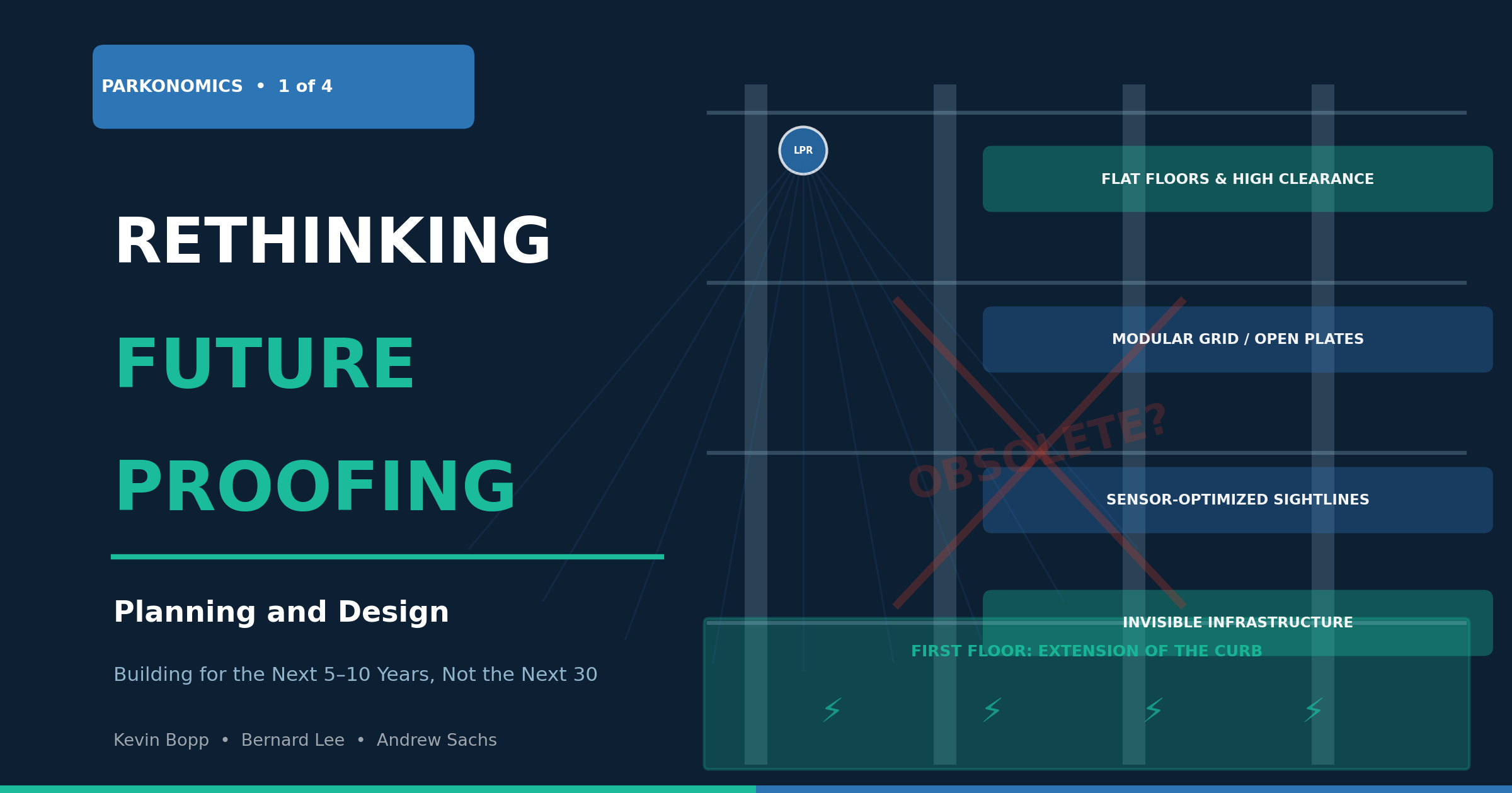
Redefining the Problem: The Right Horizon for Future-Proofing
What if a brand-new, state-of-the-art building constructed today could be functionally obsolete in less than a decade? This prediction is not far-fetched — it is the emerging reality in a world where technology and user expectations are evolving at a breakneck pace. And nowhere is it more apparent than in the world of parking.
For too long, the concept of future-proofing a parking garage has been narrowly defined, often limited to the idea of eventual adaptive reuse. Developers and designers have focused on creating structures with flat floors and high ceilings, with the vague notion that one day the garage might be converted into apartments, offices, or retail space. Although such consideration is not unworthy, it misses the immediate and critical dimension of future-proofing: designing for the profound operational and technological shifts that are already reshaping the parking industry.
Future-proofing is about ensuring that parking can function effectively and profitably in the next 5 to 10 years, not the next 30. The two are different design problems with different solutions.
It is about anticipating the rise of digital credentials, the integration of electric vehicles, and the dawn of autonomous mobility. It is about creating dynamic, adaptable assets that can evolve with user needs and the surrounding urban environment. The foundation of a truly future-proof facility is laid long before construction begins — in the planning and design stage, with a strategic shift in mindset from creating a static container for cars to building a flexible, adaptable mobility hub.
The traditional approach to parking design has often prioritized maximizing the number of spaces at the lowest possible cost. This thinking led to a proliferation of structures with sloped floors and tight clearances — efficient for self-parking but presenting significant barriers to future adaptation. A forward-thinking approach requires a different set of priorities.
The First Floor as a Mobility Node
When we apply flat floors and higher ceiling clearances to the first floor specifically, we create an opportunity that goes well beyond the vague promise of someday converting the building. A first floor designed as an extension of the curb creates immediate, monetizable value.
Configuring the first floor for TNC (Uber/Lyft/taxi) staging zones and UPS/FedEx last-mile delivery hubs does something important: it diverts high-turnover, disruptive traffic off the busy street and into the parking structure, where it can be organized and monetized at reasonable rates. This improves ROI on the incremental construction cost while simultaneously freeing up high-value curb space for better uses — bike lanes, parklets, or simply less congested traffic flow.
The revenue arithmetic is meaningful. A well-configured TNC zone captures income from activity that otherwise generates nothing. A delivery hub creates a new B2B revenue line from logistics operators who actively need organized last-mile infrastructure and are increasingly willing to pay for it. The incremental construction cost of building this flexibility in — primarily the clearance differential and structural reinforcement for a flat plate at grade — is significantly lower than the long-term opportunity cost of a first floor that can only serve self-parking.
Modular Thinking and Long-Span Construction
Modular design enhances adaptability by allowing for a more versatile space. Using a modular grid — a consistent, repeating pattern of structural elements — makes repurposing simpler. Incorporating long-span construction over cast-in-place reduces the number of interior columns, resulting in open and flexible floor plates that can accommodate a broader range of future uses and vehicle types.
This matters for autonomous vehicles in particular. AVs require clear, unobstructed pathways for navigation — column density is an active constraint on AV operations, not just an aesthetic preference. Long-span construction removes that constraint from the outset.
The forethought also significantly eases the eventual retrofitting of power and data infrastructure, which is often prohibitively expensive and disruptive in less adaptable structures. The upfront premium for long-span construction typically runs 8 to 15% above conventional framing. Over a 20-year asset life, this differential is modest relative to the cumulative cost of working around structural constraints that limit technology deployment and complicate future adaptation.
Sightlines: The Most Underestimated Variable
Other design considerations that often go unnoticed are sightlines within parking structures. Most asset owners and architects pay careful attention to floor-to-ceiling heights because they allow for better illumination — a feeling of safety that directly affects whether a facility retains parkers. But ceiling height also contributes to the efficacy of emerging technologies in ways that are rarely addressed in a design brief.
Cameras require good sightlines and are the backbone of license plate recognition software, which enables many bespoke parking features. Systems designed to help monitor permitted parking, special-use and reserved spaces, enforcement, and fleet vehicle zones are all dependent on easy detection of license plates. As we look further down the road, many self-driving vehicle systems will be dependent on a strong V2X (vehicle-to-everything) platform, which will incorporate numerous data feeds and reliable vision throughout a parking deck.
The design implications are concrete: minimum 12-foot clear heights at sensing points, reduced column density at entry and exit transitions, and lighting plans designed around sensor performance rather than lumens alone. None of these requirements are expensive to build in. All of them are expensive to retrofit.
The Digital Backbone
In the modern parking facility, the most critical infrastructure is often invisible. The conduits, cables, and fiber that run through the concrete skeleton are the lifelines that will power the next generation of parking technology. Planning for this digital backbone from day one is not just a good idea — it is an economic imperative.
Retrofitting an existing structure with the necessary power and data infrastructure can be prohibitively expensive and disruptive, as it often requires extensive demolition and reconstruction. Foresight dictates that facilities are built with ample, adequately sized conduits for future cable pulls — enabling easy expansion, for example, from 20 EV charging stations to 100 in the years ahead, or accommodating unforeseen data demands in the future. Ensuring physical space in electrical closets and an easily expandable electrical system, even if full capacity is not needed initially, is crucial for integrating new equipment without costly overhauls down the line.
The correct approach is sizing conduit for anticipated load plus significant headroom — at minimum 40 to 50% — with pull strings left in place for future cable additions. The transformer and main service panel should be sized for the facility’s anticipated long-term electrical load, not its opening-day load. EV charging alone will more than double the electrical demand of most facilities within 10 years. That demand curve should be baked into the initial electrical design.
This foundational readiness is particularly vital as we navigate the evolving landscape of electric vehicles and autonomous mobility — both of which depend heavily on the digital infrastructure established at the design stage. The facilities being designed today are not inheriting a stable technology environment. The degree to which they can adapt affordably will be determined in large part by decisions made now, long before occupancy.
 A
A