Field Notes • Urban Development • Technology
The term gets used loosely. The concept, applied correctly, represents a fundamental rethinking of what a parking asset is for.
Spend any time in parking and mobility circles right now and you will hear “mobility hub” used to describe everything from a transit-oriented garage in downtown Denver to a surface lot with a bike rack bolted to the fence. The term is being stretched past the point of meaning.
That is worth paying attention to — not because the concept is wrong, but because when a powerful idea gets diluted by overuse, the practitioners who apply it correctly gain a significant competitive advantage over those who apply it in name only.
Frank Ching, Deputy Executive Officer at LA Metro, put it plainly in a recent conversation: “Mobility hub is something interesting. I have agencies tell me — parking is a mobility hub, just relabel parking into mobility hub. No, that’s not true.”
Three Stages, Not One
Ching’s framework for mobility hubs is a useful corrective. He identifies three stages that a genuine mobility hub must progress through:
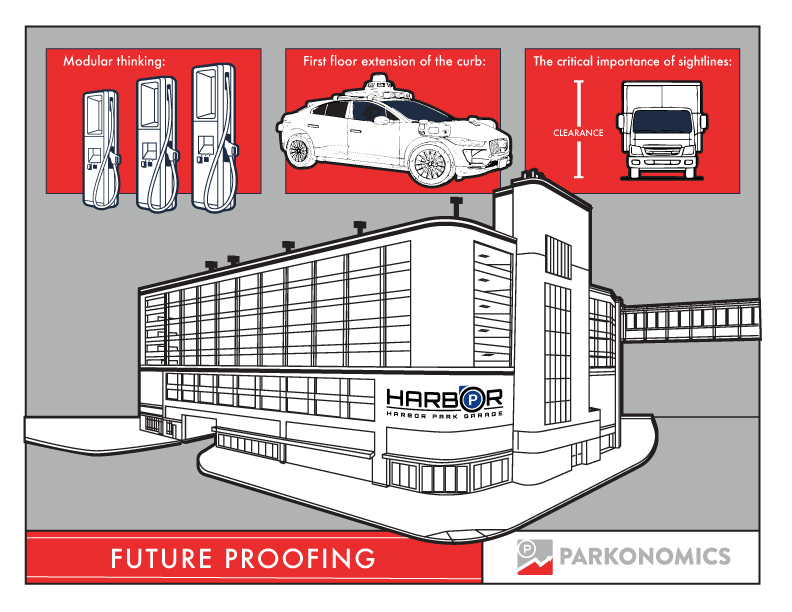
- Stage 1 — Infrastructure. The physical construction. Flat floors, higher clearances, EV charging rough-in, TNC and delivery zones built into the first floor, micro-mobility docking, accessible wayfinding. This is the stage most facilities stop at — and call themselves done.
- Stage 2 — Programming. What services actually go in. Which transit connections are activated. Whether the bike share operator shows up. Whether the last-mile logistics use case is built into the lease structure or left as a vague intention. Programming is where most “mobility hubs” quietly fail.
- Stage 3 — Operations. Sustained service delivery over time. A digital platform that ties the modes together. Real-time data that makes using the hub genuinely easier than driving alone. This is the stage that creates behavior change — and the one that requires ongoing commitment rather than a one-time capital investment.
The majority of facilities marketed as mobility hubs have completed Stage 1 and declared victory. The ones that will define the asset class over the next decade are working through Stages 2 and 3.
The Design Decision You Can’t Walk Back
For developers and owners breaking ground today, the mobility hub question is not abstract — it is a series of concrete design decisions made before the first pour of concrete. In our Future Proofing series with the Urban Land Institute, we explored what those decisions look like at the planning and design stage.
The most consequential and least appreciated is what we called the first floor extension of the curb. A first floor designed with flat floor plates and higher clearances does more than enable eventual adaptive reuse — it creates the operational flexibility to accommodate TNC zones, last-mile delivery staging, and micro-mobility docking today. It diverts high-turnover traffic off the street and into the structure, where it can be monetized and managed. It frees up curb space for higher-value uses. And it lays the physical foundation for Stage 2 and Stage 3 of the mobility hub framework without requiring a costly retrofit later.
This is the design decision that separates a future mobility hub from a parking garage with aspirational signage. Once built to conventional spec, the path to genuine mobility hub functionality becomes significantly more expensive — and in many cases, financially impractical.
The Practical Takeaway
If you are evaluating an existing facility, the question is whether Stage 1 infrastructure is present or retrofittable at a reasonable cost. If it is not, the “mobility hub” designation is marketing. If it is, the real work — programming and operations — is still ahead of you.
If you are at the design stage, the first floor decision is not a feature. It is the foundation. Build it right and the mobility hub evolves naturally as the surrounding transportation ecosystem matures. Build it wrong and you will be managing the consequences for the life of the asset.
The parking garage is not disappearing. It is being asked to do more. The facilities that answer that ask correctly will hold and grow their value. The ones that answer it with a new sign on an old structure will not.
 A
A