Two Deals, Same Committee
A regional bank’s credit committee approves two parking loans on the same Tuesday. Same sponsor pedigree, same loan size, same general region.
The first is a new-construction above-grade deck in suburban Atlanta. The second is a major retrofit of a 1980s-vintage facility in downtown Boston: structural upgrades for EV weight, full EV infrastructure deployment, PARCS modernization, mobility-hub integration.
The committee uses the same framework for both. Both deals clear the standard tests: occupancy, DSCR, sponsor experience, regional macro. Both close at similar terms.
Three years later, one is performing materially better than expected. The other is not. The committee’s mistake wasn’t in either deal individually. The mistake was using a single frame to evaluate two fundamentally different assets.
What the Old Frame Measured
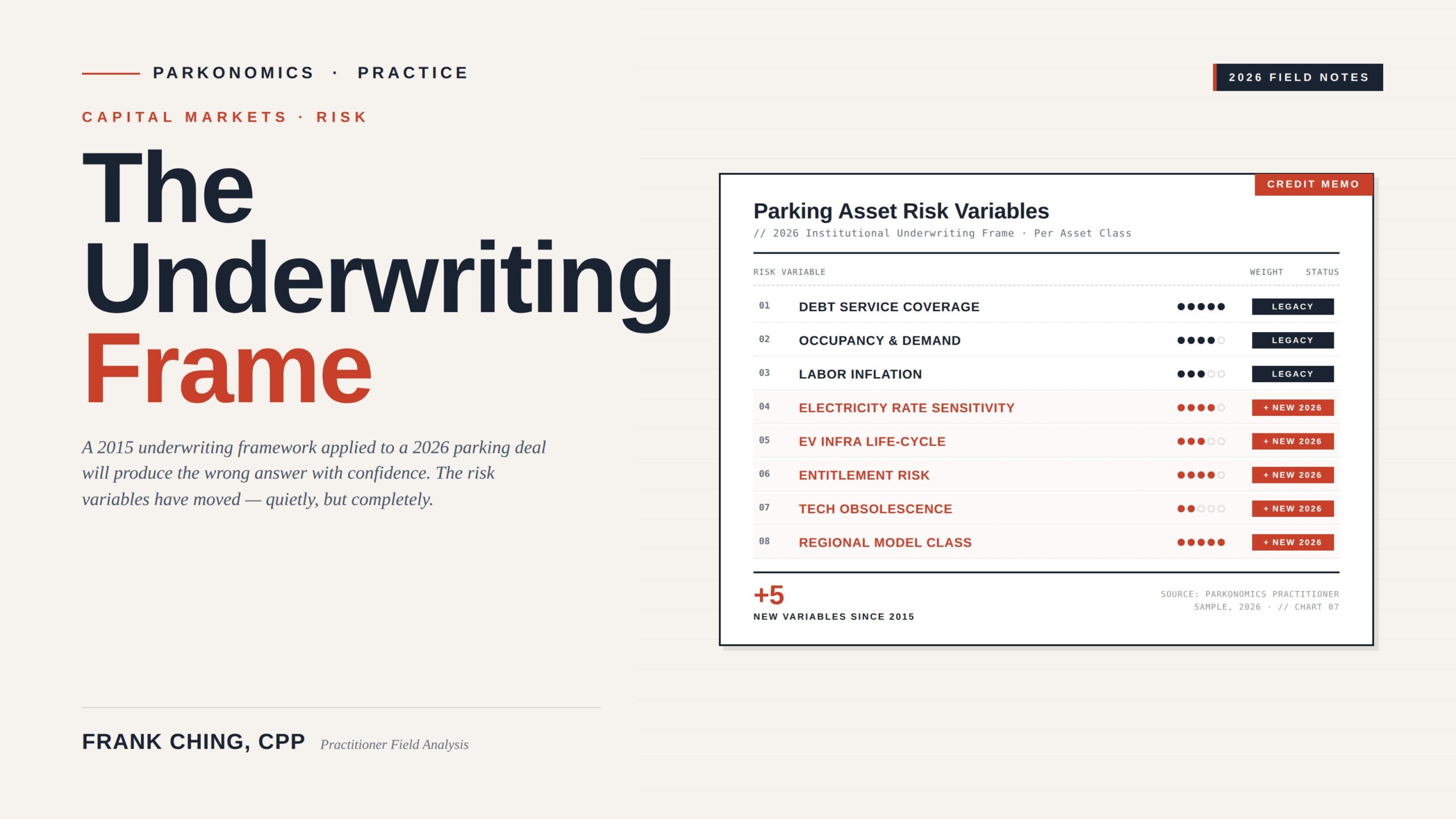
Traditional parking underwriting, refined over thirty years of institutional practice, optimized for three primary risk variables.
Labor inflation was treated as the dominant operating cost risk. Stress tests assumed wage inflation of 2 to 4 percent annually over the loan term. NOI sensitivity was modeled against staffing escalation. Operators with strong labor productivity were rewarded; operators with high labor exposure were priced cautiously.
Occupancy and demand was the second pillar. Underwriting modeled stabilized utilization against parking demand assumptions tied to office occupancy, retail foot traffic, residential density, and event programming. Demand was generally treated as stable and slowly growing, with structured downside cases tied to recession scenarios.
Debt service coverage was the third pillar and the binding constraint. DSCR thresholds, often in the 1.30x to 1.50x range for institutional parking debt, served as the quantitative gate. Stress cases verified DSCR held above 1.10x under adverse scenarios.
That framework worked. For thirty years of relatively stable parking economics, it produced reasonable outcomes most of the time. The framework is not wrong. It is incomplete.
What the New Frame Must Add
The 2026 parking asset carries five risk variables that the 2015 frame either ignored or treated as footnotes. Each of them is now consequential.
Electricity rate sensitivity is the first addition. As documented in the operating cost analysis, electricity has overtaken labor as the largest operating expense category in EV-heavy facilities. A deal with substantial EV exposure that is stress-tested only on labor inflation is being stress-tested on the wrong variable. Modern underwriting requires dual-scenario stress testing on both wage and utility rate inflation, with explicit modeling of demand-charge exposure and time-of-use rate-design risk.
EV infrastructure life-cycle is the second. The electrical infrastructure installed at construction has a 20-year-plus useful life and is essentially a permanent capital commitment. The chargers installed on top of that infrastructure have a 5-to-8-year life cycle and will need replacement multiple times across the loan term. The frame must distinguish between infrastructure capex (durable) and equipment capex (recurring) when modeling cash flow.
Entitlement risk is the third. For projects still in pre-development, the entitlement framing, traditional parking, mobility hub, EV retrofit, transit-oriented infill, affects everything from schedule risk to construction cost certainty to lender confidence in the closing timeline. Deals that haven’t worked through this question carry a different risk profile than deals that have.
Technology obsolescence is the fourth. PARCS platforms, charging hardware, automated parking systems, and management software are evolving rapidly. The frame must account for the probability that some technology choices made at the moment of construction will be deprecated within the loan term, requiring capital expenditure not contemplated in the original underwriting.
Regional model classification is the fifth and most consequential. As documented in the regional bifurcation analysis, the U.S. parking sector now contains two distinct industries that share a name. A coastal underground/automated asset and a Sun Belt above-grade asset carry fundamentally different risk profiles even when the operating numbers look superficially similar. The frame must explicitly classify the asset within its actual industry and apply industry-specific weightings.
New Construction vs Retrofit: Two Risk Profiles
Perhaps the most consequential refinement is the recognition that new construction and retrofit deals carry materially different risk profiles on most of the seven primary variables. Applying a single framework to both produces systematic mispricing.
Construction completion risk sits squarely on new-construction projects and is functionally absent in retrofits of operating facilities. Retrofits can carry construction-disruption risk to in-place revenue, but the binary completion-failure scenario is far smaller in scope.
Entitlement risk is heavily concentrated in new construction and substantially compressed in retrofits, particularly EV-focused retrofits that benefit from statutory streamlining pathways. A new-build pre-development project may carry 12 to 24 months of entitlement uncertainty. The equivalent retrofit may clear environmental review in two to six months.
Operating ramp-up risk is concentrated in new construction. New facilities require lease-up periods, demand-formation periods, and operational stabilization. Retrofits typically operate against established demand and existing revenue history: a far less uncertain underwriting input.
Technology and infrastructure risk can run in either direction. New construction allows clean-sheet infrastructure design at lower marginal cost, building for 2035 EV penetration at the moment of pour. Retrofits face the cost premium documented in the EV-readiness analysis: 2x to 4x per-stall cost for the same capability when delivered post-construction.
Regulatory risk increasingly favors retrofits over new construction. Climate-aligned regulatory frameworks, VMT review, and entitlement streamlining all point toward adaptive reuse and away from new-build parking on greenfield sites.
What Sophisticated Lenders Are Actually Doing
The leading institutional parking lenders are not rebuilding the frame from scratch. They are augmenting it with discipline.
The frame still starts with the three traditional pillars: labor exposure, occupancy demand, debt service coverage. These remain primary and binding. What has changed is the addition of explicit sensitivity analysis on the new variables, with documented stress cases that quantify NOI risk against each.
The most sophisticated 2026 credit memos contain dedicated sections on utility rate sensitivity (with stress cases at 4 and 6 percent annual escalation), EV infrastructure capital reserve adequacy (modeled across charger replacement cycles), entitlement status confirmation (with documented streamlining pathways), technology platform durability assessment, and explicit regional model classification with industry-specific cap rate benchmarking.
The committee question is no longer just “does this deal clear DSCR.” It is “does this deal clear DSCR under the right stress scenarios for this kind of asset.” The difference is operationally significant. A coastal automated facility and a Sun Belt above-grade deck are not stress-tested against the same scenarios, because they are not the same kind of asset.
Lenders using the old frame are creating winners and losers by accident. Sponsors who understand the new frame are capturing better terms on purpose.
What This Means for Sponsors
For project sponsors, the practical implication is that the deal package itself has to evolve. A 2026 underwriting submission is no longer just a financial model and a sponsor narrative. The committee expects, and increasingly demands, explicit treatment of the new variables.
Sophisticated sponsors are providing utility rate sensitivity analysis as a standard exhibit. Including EV infrastructure depreciation schedules separated from equipment depreciation. Documenting entitlement pathway explicitly with regulatory exhibits. Providing technology platform durability assessments. Classifying the asset within its regional industry and benchmarking against industry-appropriate comps.
Sponsors who lead with these exhibits are clearing committee faster, with better terms, and on tighter timelines. Sponsors who omit them are increasingly being asked to produce them after the fact, or being declined for incompleteness.
The signaling effect is real. A submission that anticipates the modern frame demonstrates sponsor sophistication. A submission that doesn’t implicitly signals that the sponsor is operating with a 2015 mental model. That is not a small distinction. Committees notice.
Where This Is Heading
Two trajectories are visible.
The first is continued frame evolution. The primary variables added since 2015 will not be the last additions. The next decade will likely add variables tied to insurance and climate resilience risk (already emerging in coastal markets), cybersecurity exposure on increasingly connected PARCS and automation platforms, battery storage and on-site generation revenue offset, and autonomous vehicle integration capacity. The frame will keep moving.
The second is the continued bifurcation between lenders who keep up and lenders who don’t. The institutional lenders investing in updated underwriting infrastructure are systematically writing better paper. The lenders that haven’t updated are writing paper that performs unpredictably, sometimes better than expected, sometimes worse, often without the lender being able to articulate why.
The practitioner conclusion is structural. The underwriting frame for parking has fundamentally evolved. The sponsors, lenders, and equity partners who recognize the new variables and structure their analysis around them will quietly outperform on selection, terms, and outcomes. The ones who continue operating with the 2015 mental model will, on average, miss in both directions, over-pricing risk they shouldn’t worry about and under-pricing risk they should.
 F
F