Executive Summary
The U.S. parking structure industry is undergoing one of the most significant transformations in its history. Historically viewed as passive real estate infrastructure designed primarily for vehicle storage, parking structures are rapidly evolving into sophisticated mobility ecosystems integrating transportation technology, electrification, logistics, sustainability, public policy, and intelligent urban infrastructure.
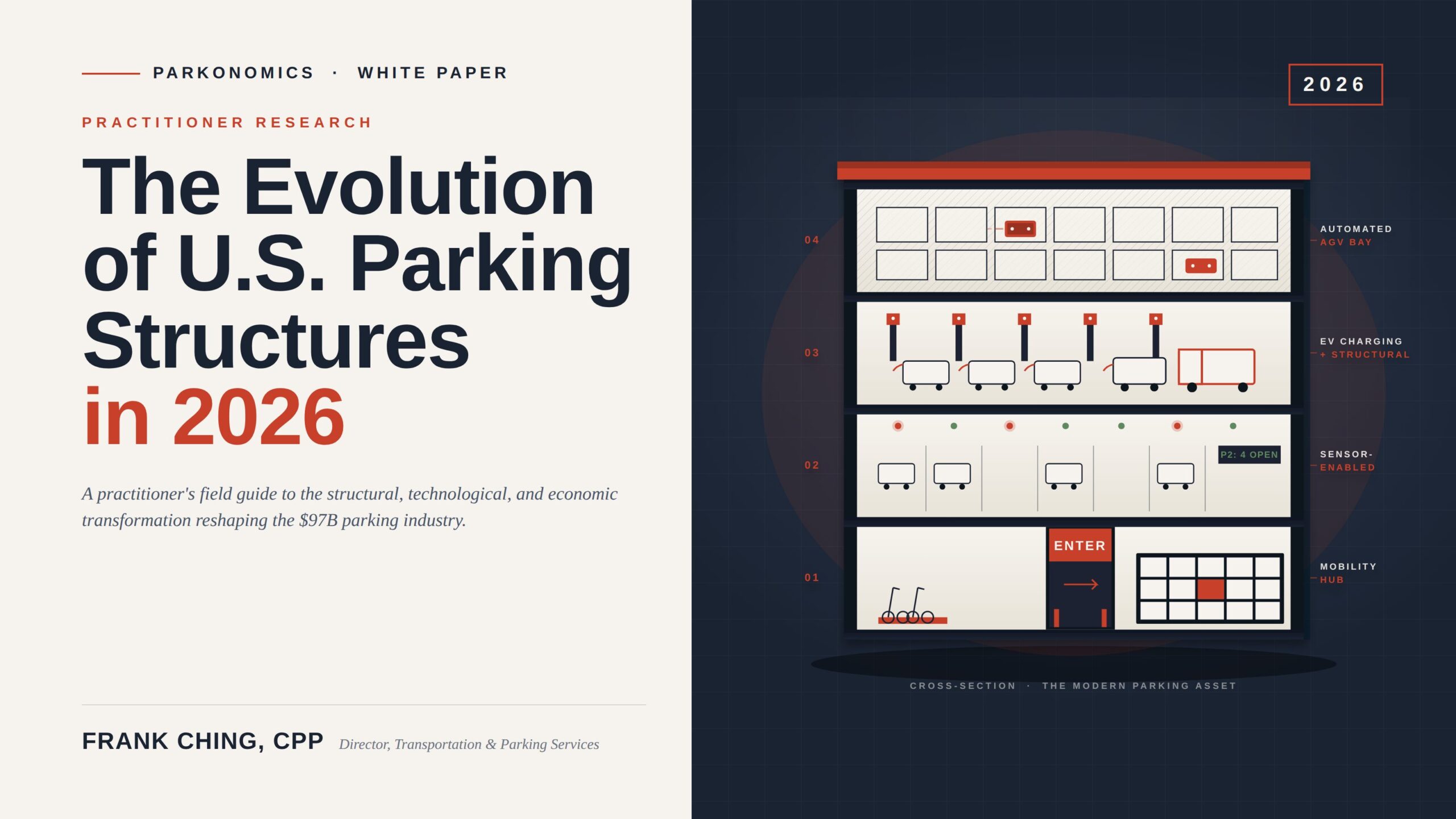
In 2026, parking facilities are no longer planned merely around stall counts and traffic circulation. Instead, they are increasingly designed, financed, and operated as multi-functional mobility platforms capable of supporting electric vehicle charging, frictionless parking systems, automated parking technologies, micromobility integration, logistics staging, rideshare operations, and long-term adaptive reuse.
At the same time, the industry is confronting a convergence of disruptive forces:
Electric vehicles are substantially heavier than traditional internal combustion vehicles, fundamentally changing structural engineering assumptions.
NFPA 88A and evolving fire protection standards have transformed suppression, ventilation, and thermal event mitigation requirements.
Construction costs remain historically elevated due to labor shortages, material inflation, and increasingly complex infrastructure integration.
Parking Access and Revenue Control Systems (PARCS) are transitioning from hardware-heavy gated systems to cloud-based, AI-driven mobility platforms.
Federal and state funding programs increasingly prioritize multimodal mobility hubs, sustainability, transit integration, and equitable transportation access.
Insurance carriers are demanding more sophisticated risk mitigation strategies tied to structural monitoring, fire protection, and climate resilience.
Environmental review frameworks are increasingly centered around Vehicle Miles Traveled (VMT), carbon reduction, transit-supportive development, and adaptive reuse.
As a result, the parking structure industry in 2026 no longer functions as a standalone transportation utility. It has become a hybrid intersection of mobility, technology, infrastructure, logistics, sustainability, and real estate strategy. In many markets, the parking structure itself is no longer the product. The mobility experience, operational intelligence, and long-term adaptability of the asset are increasingly becoming the true measures of value.
This article provides a comprehensive national discussion and strategic analysis of the trends, economics, technologies, engineering considerations, operational realities, financing structures, and policy frameworks shaping the future of U.S. parking infrastructure.
Part 01 / Industry StateThe Parking Industry Has Entered a New Era
The parking industry has historically been treated as a supporting utility within broader urban and transportation systems. Parking garages were designed primarily as concrete storage structures focused on maximizing stall counts, accommodating circulation patterns, and generating parking revenue.
That model is rapidly changing. For decades, parking was often treated as a necessary but passive utility within the built environment. Today, it is increasingly viewed as a strategic mobility platform capable of influencing transportation behavior, supporting sustainability objectives, generating operational data, and shaping the overall customer experience within cities, campuses, airports, and mixed-use developments.
In 2026, parking structures are increasingly viewed as strategic mobility assets integrated into mixed-use development, urban logistics systems, electrification strategies, and transportation demand management initiatives.
The U.S. parking ecosystem now exceeds approximately $97.3 billion in total market value when accounting for parking services, structured parking development, mobility technologies, parking management systems, EV charging infrastructure, and related transportation technologies.
The parking services sector alone is estimated to exceed $30 billion nationally in 2026, while parking technology platforms continue growing at significantly faster rates than physical parking construction itself.
Table 1 – National Parking Market Overview (2026)
| Market Indicator | 2026 Estimate |
|---|---|
| Total U.S. Parking Ecosystem | $97.3 Billion |
| Parking Services Market | $30 Billion |
| Market Growth Rate | 3.6% CAGR |
| Parking Technology CAGR | 16.2% CAGR |
| Private Ownership Share | 57% |
| Industry Optimism | 82% Positive Outlook |
| Construction Labor Shortage | 349,000+ Workers |
The growth of the industry is increasingly driven not by the expansion of traditional parking inventory, but by “premiumization.”
Premiumization refers to the evolution of parking facilities into high-value mobility assets integrating:
Parking facilities are increasingly evaluated based on their technological sophistication, revenue diversification capability, operational flexibility, and long-term redevelopment potential.
Part 02 / Regional StrategyMacro-Economic & Regional Market Dynamics
The U.S. parking structure market in 2026 has effectively bifurcated into two dominant national development models.
Model One: High-Density Urban Mobility Hubs
Major coastal and Tier-1 urban markets—including New York, San Francisco, Boston, Seattle, Miami, and portions of Los Angeles—are increasingly emphasizing:
In many of these markets, land values now exceed $300–$500 per square foot, making traditional surface parking economically obsolete.
In these environments, developers are increasingly pursuing:
Model Two: Sun Belt Expansion & Lifestyle Development
In contrast, high-growth Sun Belt markets—including Texas, Arizona, Florida, Nevada, and the Carolinas—continue emphasizing:
These markets prioritize rapid construction delivery, scalability, EV readiness, and integrated mixed-use planning. Interestingly, while urban cores continue pursuing automation and high-density mobility integration, many suburban growth markets are simultaneously experiencing record demand for structured parking tied to lifestyle centers, sports and entertainment districts, healthcare expansion, and airport growth. The result is a parking industry expanding in complexity rather than simply contracting in response to changing mobility trends.
Table 2 – Regional Construction Strategies (2026)
| Region | Dominant Strategy | Cost Per Stall |
|---|---|---|
| Northeast | Underground / Automated | $50k–$75k+ |
| West Coast | Mobility Hubs & EV Integration | $45k–$65k+ |
| Sun Belt | Massive Above-Grade Decks | $22k–$38k |
| Midwest | Adaptive Reuse & Retrofits | $25k–$35k |
| Southeast | Lifestyle Center Expansion | $22k–$32k |
The national labor shortage continues to significantly affect project delivery.
With an estimated shortage exceeding 349,000 construction workers nationally, developers are increasingly adopting:
Pre-cast concrete systems
Modular steel systems
Off-site fabrication
AI-assisted project management
Accelerated sequencing techniques
Robotics-assisted construction technologies
As a result, project delivery schedules for above-grade parking structures now commonly range between 9 and 15 months depending on project scale and complexity.
Part 03 / Demand ForecastingThe parking structure itself is no longer the product. The mobility experience, operational intelligence, and long‑term adaptability of the asset are increasingly the true measures of value.
— Frank Ching, CPP
Parking Demand Forecasting, Utilization Modeling & Functional Planning
Parking demand forecasting has entered a period of fundamental transformation.
For decades, parking structures were largely planned using static zoning formulas, generalized parking ratios, and peak-demand assumptions that often prioritized oversupply rather than operational efficiency. Traditional parking planning models frequently relied on simplified calculations tied to:
In 2026, those methodologies are increasingly being challenged by rapidly changing mobility behavior, evolving transportation technologies, hybrid work patterns, transportation demand management strategies, and growing uncertainty regarding the future of urban mobility.
The era of static parking ratios is rapidly giving way to dynamic utilization modeling informed by real-world mobility behavior.
Modern parking demand forecasting increasingly incorporates:
As a result, parking structures are no longer designed solely around maximum parking capacity. They are increasingly planned around operational flexibility, multimodal integration, peak-demand management, and long-term adaptability.
The Decline of Traditional Parking Ratios
Historically, parking demand calculations were heavily influenced by conventional zoning standards and Institute of Transportation Engineers (ITE) parking generation models.
Typical planning assumptions often included:
Office: 3–5 spaces per 1,000 square feet
Retail: 4–6 spaces per 1,000 square feet
Residential: 1.5–2.5 spaces per unit
Hotels: 0.75–1.25 spaces per key
Universities: fixed ratios tied to enrollment
Healthcare: fixed patient and employee ratios
While these methodologies provided standardized planning frameworks, they frequently resulted in:
In many urban markets today, parking utilization studies increasingly reveal that traditional parking minimums substantially exceed actual operational demand.
This shift has accelerated national trends toward:
Many cities now require developers to justify parking supply through operational utilization analysis rather than relying solely on historical zoning formulas.
Parking Demand Is Highly Dependent on Functional Land Use
One of the most important realities shaping modern parking planning is that parking demand is highly dependent on the operational function of the facility being served.
Different land uses generate dramatically different:
As a result, parking demand forecasting has become significantly more operationally sophisticated.
Universities & Higher Education
University parking demand is influenced by:
Large commencement ceremonies can temporarily generate parking and traffic demand levels comparable to major regional sporting events.
At the same time, many universities are aggressively pursuing Transportation Demand Management (TDM) goals designed to reduce single-occupancy vehicle usage.
This creates a uniquely dynamic operational environment where parking supply planning must balance:
Airports
Airport parking demand modeling is heavily influenced by:
Unlike traditional commercial parking environments, airport parking demand often fluctuates dramatically throughout the day based on terminal activity and flight banking patterns.
Modern airports increasingly utilize:
to optimize utilization and reduce congestion.
Healthcare Campuses
Healthcare parking demand is operationally unique because:
Healthcare parking forecasting increasingly focuses on:
Unlike many commercial parking environments, healthcare parking demand modeling prioritizes operational efficiency and customer experience over revenue optimization.
Mixed-Use Developments
Mixed-use projects represent some of the most sophisticated parking demand environments because different land uses generate offsetting peak demand periods.
Examples include:
Office demand peaking during daytime hours
Residential demand peaking overnight
Entertainment demand peaking evenings/weekends
Retail demand fluctuating throughout the day
Hotel demand varying seasonally
This creates opportunities for:
Shared parking analysis has become one of the most important tools in modern parking planning.
Peak Demand Management Is Becoming More Important Than Total Inventory
Historically, parking structures were often designed around maximum theoretical demand.
Today, operators increasingly recognize that parking performance is more dependent on:
than simply the total number of stalls provided.
In many environments, operational bottlenecks occur not because of insufficient parking inventory, but because of:
As a result, modern parking forecasting increasingly incorporates:
Parking planning is becoming increasingly operational rather than purely mathematical.
Shared Parking & Utilization Optimization
Shared parking has become one of the most important strategies for improving parking efficiency and reducing unnecessary construction.
Modern shared parking models analyze:
Properly designed shared parking systems can significantly reduce total parking demand while maintaining operational performance.
Benefits include:
Many municipalities now actively encourage shared parking strategies as part of broader sustainability and smart-growth initiatives.
Transportation Demand Management (TDM) Is Reshaping Parking Demand
Transportation Demand Management strategies are increasingly influencing long-term parking forecasting assumptions.
TDM programs may include:
The rise of hybrid work has further complicated parking forecasting models.
Many office developments now experience:
Traditional five-day commuter assumptions are rapidly becoming obsolete.
Parking demand forecasting increasingly requires continuous operational recalibration rather than static long-term assumptions.
AI & Predictive Parking Forecasting
Artificial Intelligence is rapidly transforming parking demand forecasting.
Modern AI-driven parking systems increasingly integrate:
Machine learning algorithms can now forecast:
with significantly greater accuracy than traditional forecasting models.
Digital twin technology further enhances forecasting capabilities by allowing operators to simulate:
Parking demand forecasting is rapidly evolving from a static planning exercise into a continuous real-time operational management system.
Uncertainty, Flexibility & the Future of Parking Planning
One of the defining challenges facing parking planners in 2026 is uncertainty.
Long-term parking demand is increasingly influenced by:
As a result, parking structures increasingly need to be designed around flexibility rather than rigid long-term assumptions.
Future-focused parking facilities increasingly incorporate:
The challenge for modern parking planners is no longer simply determining how much parking to build.
The challenge is designing parking infrastructure flexible enough to adapt as mobility behavior continues evolving over the next several decades.
Bottom of Form
Part 04 / Construction EconomicsConstruction Economics & Capital Planning
Parking structure economics have fundamentally changed over the last decade. In many projects today, the parking structure has quietly become one of the most technologically complex and infrastructure-intensive components within the entire development program. What was once primarily a concrete and circulation exercise now requires deep coordination between structural engineering, electrical systems, fire protection, data infrastructure, sustainability planning, mobility operations, and long-term asset management strategy.
Historically, parking structures were primarily evaluated based on cost-per-stall efficiency.
In 2026, however, developers must now account for multiple additional infrastructure layers including:
Table 3 – Parking Construction Cost Breakdown (2026)
| Structure Type | Cost Per Stall | Cost Per Sq. Ft. |
|---|---|---|
| Surface Parking | $3k–$8k | $15–$35 |
| Above-Grade Garage | $18k–$35k | $70–$120 |
| High-Rise Garage | $45k–$80k | $120–$250 |
| Underground Garage | $30k–$120k | $150–$350 |
| Automated Parking | $16k–$150k | $200–$400 |
Professional soft costs now commonly consume 8%–15% of total project budgets.
These include:
EV infrastructure integration further increases project costs.
Table 4 – EV Infrastructure Cost Impacts
| EV Infrastructure Component | Estimated Cost |
|---|---|
| Level 2 Charger Installation | $2,500–$6,000 per stall |
| Utility Transformer Upgrade | $50k–$150k |
| ALMS Integration | $10k–$50k |
| EV Ready Conduit Infrastructure | $1,500+ per stall |
Many jurisdictions now mandate substantial EV-ready infrastructure requirements.
California, for example, now effectively requires:
100% EV-ready assigned residential parking
65% EV-ready hotel parking
Expanded accessible EV charging capacity
These requirements are rapidly influencing national standards.
Part 05 / Structural EngineeringThe EV Weight Gap & Structural Engineering Evolution
Perhaps the most disruptive engineering challenge facing parking structures in 2026 is the rapid increase in vehicle weight resulting from electric vehicle adoption. Many owners and operators are only beginning to recognize that the transition to heavier EV fleets may ultimately become one of the largest deferred infrastructure liabilities facing older parking assets over the next decade.
Modern EVs are materially heavier than the internal combustion vehicles parking structures were historically designed around.
Table 5 – EV Weight Comparison
| Vehicle Type | ICE Weight | EV Weight | Increase |
|---|---|---|---|
| Sedan | 3,500 lbs. | 4,100 lbs. | +17% |
| Full-Size SUV | 5,500 lbs. | 7,000 lbs. | +27% |
| Pickup Truck | 4,500 lbs. | 6,500+ lbs. | +44% |
| Heavy Duty EV | N/A | 9,000+ lbs. | Extreme |
While many building codes technically continue allowing 40 psf live-load standards, the practical institutional-grade industry standard has increasingly shifted toward 50 psf.
This shift is driven by concerns regarding:
Many parking structures built prior to 2010 are now undergoing structural reassessment programs.
Some owners are implementing EV zoning strategies that concentrate heavier EV parking on slab-on-grade levels to reduce stress on elevated decks.
Barrier systems are also evolving.
Many engineering firms and jurisdictions now recommend designing barriers around 6,000-pound impact standards rather than historical 5,000-pound assumptions.
Automated Parking Structural Precision
Automated and robotic parking systems further complicate structural engineering requirements.
These systems require:
Traditional “Class C” garages with warped or uneven slabs are often incompatible with robotic systems.
Steel framing systems are increasingly favored in high-end robotic facilities because they can maintain precision tolerances within 2–5mm.
Part 06 / Fire SafetyFire Safety: The NFPA 88A Transformation
Fire safety represents the single largest regulatory transformation affecting parking structures in 2026.
The emergence of lithium-ion battery fires has fundamentally changed national fire protection standards.
EV fires burn:
Under NFPA 88A and related standards:
Open-air sprinkler exemptions have largely disappeared.
Automatic sprinklers are increasingly required in virtually all parking structures.
Parking structures are increasingly classified as OH2 or higher.
Mechanical smoke control systems are becoming mandatory.
Thermal event modeling is increasingly required.
Table 6 – Fire Safety Changes (2026)
| Requirement | 2026 Trend |
|---|---|
| Automatic Sprinklers | Virtually universal |
| Hazard Classification | OH1 → OH2 |
| Smoke Control | Mechanical mixing systems |
| Thermal Detection | Off-gas + thermal imaging |
| Structural Hardening | Fiber-reinforced concrete |
| Barrier Design | 6,000 lb. impact resistance |
Mechanical smoke-control systems are now commonly designed to ensure that no more than approximately 10% of a structure contains stagnant air during a thermal runaway event.
Many projects now integrate:
Fire protection costs are materially increasing total project budgets.
Additional requirements often include:
Fire safety is now directly tied to:
Fire protection is no longer simply a code compliance issue for parking facilities. It is rapidly becoming a core underwriting, insurability, and long-term asset preservation issue that will materially influence future investment decisions across the industry.
Part 07 / PARCS TechnologyParking Technology & Frictionless Mobility
Parking Access and Revenue Control Systems (PARCS) are rapidly evolving from hardware-heavy gate systems into software-centric frictionless ecosystems.
The dominant operational platform in 2026 is License Plate Recognition (LPR).
Table 7 – PARCS Technology Cost Estimates
| Technology | Cost Estimate |
|---|---|
| LPR Hardware | $2,500–$6,000 per lane |
| Integration | $3,000–$7,000 per lane |
| SaaS Fees | $150–$500 monthly |
| Space Guidance | $400–$900 per stall |
| Mobile Pay Setup | $1,000–$5,000 |
| EV Billing Integration | $5,000–$15,000 |
Modern frictionless parking systems provide:
Many operators now prefer gateless parking models because physical gates are increasingly viewed as:
Congestion generators
Mechanical failure points
High-maintenance infrastructure
Space guidance systems are also rapidly expanding.
Ceiling-mounted sensors and camera systems monitor individual stalls and guide drivers directly to open spaces.
These systems can reduce parking search time by approximately 30%–50%.
Parking facilities are increasingly becoming real-time mobility data platforms. The parking industry is entering a period where data, operational intelligence, and customer experience may ultimately become more valuable than the parking transaction itself.
Part 08 / AutomationAutomated Parking Systems & Robotics
Automated parking systems are transitioning from niche luxury applications into viable urban infrastructure solutions.
The economics are especially compelling in markets where land values exceed $400 per square foot.
Table 8 – Automated Parking System Costs (2026)
| System Type | Cost Per Stall | Best Use |
|---|---|---|
| Simple Stackers | $8k–$15k | Residential Retrofits |
| Puzzle Systems | $12k–$22k | Urban Infill |
| Automated Towers | $25k–$45k | High-Density Sites |
| AGV Robotic Systems | $40k–$80k | Luxury / Commercial |
Automated parking systems can reduce parking footprints by 40%–60% compared to traditional ramped structures.
This creates substantial development value by freeing square footage for:
AGV robotic systems represent the fastest-growing segment because they:
Additional benefits include:
However, these systems also require:
Annual maintenance can range between $500–$1,500 per stall depending on complexity.
Part 09 / SustainabilitySustainability, Parksmart & Adaptive Reuse
Sustainability has evolved from a branding exercise into a core operational, financial, and entitlement strategy.
Parking structures are increasingly evaluated based on:
Table 9 – Sustainability Features & ROI
| Sustainability Feature | Primary Benefit | Cost Impact |
|---|---|---|
| Solar Panels | Energy generation | +15%–25% |
| LED + Sensors | 70% energy reduction | <2% |
| Living Walls | Cooling / aesthetics | $50–$150 sq. ft. |
| EV Ready Infrastructure | Future-proofing | $2k–$5k per stall |
| Carbon-Reduced Concrete | Lower emissions | Moderate premium |
Parking structures increasingly incorporate:
Adaptive Reuse
One of the most important design trends in 2026 is adaptive reuse flexibility. In many institutional and urban environments, the ability to convert parking structures into future occupiable space may eventually become one of the most important long-term valuation drivers in the entire parking asset class.
Developers increasingly design parking structures with:
These features preserve future conversion potential into:
Many investors now assign valuation premiums to parking assets capable of future adaptive reuse.
Part 10 / Mobility HubsMulti-Modal Mobility Hubs
The modern parking structure is increasingly being rebranded as a Multi-Modal Mobility Hub.
These facilities are designed not simply to store vehicles, but to function as transportation switching stations integrating multiple mobility modes.
Common Mobility Hub Elements
Table 10 – Mobility Hub Revenue Opportunities
| Mobility Element | Operational Benefit | Revenue Opportunity |
|---|---|---|
| Parcel Lockers | Logistics integration | Stable lease revenue |
| Micromobility Docks | High user turnover | Transit partnerships |
| TNC Staging Zones | Reduced congestion | Premium pickup fees |
| Transit Kiosks | Grant eligibility | Public funding support |
| EV Charging | Longer dwell time | Charging margins |
Ground-floor “dark space” monetization is becoming a major revenue category.
Many facilities now lease logistics space to:
Federal funding increasingly favors multimodal projects.
Programs tied to:
Federally funded projects associated with RAISE grants, Community Project Funding, Justice40 initiatives, active transportation programs, and sustainability infrastructure funding are increasingly supporting mobility hub development.
The most successful mobility hubs moving forward will likely be those capable of balancing transportation functionality, customer convenience, operational flexibility, revenue diversification, and community integration simultaneously.
Part 11 / Institutional OperationsInstitutional & Public Sector Parking Operations
Universities, Transit Systems, Airports, Healthcare Campuses & Civic Infrastructure
Institutional and public-sector parking environments represent some of the most operationally complex, politically sensitive, and strategically important segments within the parking industry. Unlike traditional commercial parking assets primarily focused on revenue generation and customer turnover, institutional parking systems must balance transportation access, operational continuity, public accountability, mobility management, sustainability goals, customer experience, and long-term infrastructure planning simultaneously.
Universities, transit agencies, airports, healthcare campuses, municipalities, and major civic venues increasingly operate as highly dynamic transportation ecosystems where parking infrastructure functions as only one component within a broader mobility network.
In many institutional environments, parking operations are no longer evaluated solely based on occupancy or revenue performance. They are increasingly measured by:
As transportation systems become increasingly interconnected, institutional parking operators are effectively evolving into mobility managers responsible for coordinating complex transportation ecosystems rather than simply managing parking inventory.
Universities & Higher Education Campuses
Higher education campuses represent one of the most operationally unique parking environments in the country.
Modern university transportation systems frequently resemble small municipalities, requiring the coordination of:
Parking demand on university campuses is highly variable and influenced by:
Large commencement ceremonies, for example, can generate parking and traffic demand levels comparable to major regional sporting events. Universities increasingly require sophisticated operational planning models capable of coordinating:
Many campuses are also aggressively pursuing sustainability and transportation demand management goals, creating operational tension between:
This dynamic has fundamentally changed the role of university parking departments.
In many institutions, transportation and parking departments now function as integrated mobility organizations overseeing:
The shift toward integrated campus mobility is accelerating rapidly.
Transit Agency Parking & Mobility Integration
Transit agency parking operations have also evolved significantly over the past decade.
Historically, park-and-ride facilities were designed primarily to support commuter access to rail and bus systems. In 2026, however, transit parking facilities are increasingly functioning as multimodal mobility hubs integrating:
Transit agencies increasingly view parking not simply as a support utility, but as a strategic tool capable of:
Supportive transit parking strategies are also becoming more sophisticated.
Many agencies now utilize:
Parking operations are increasingly integrated into broader Transportation Demand Management (TDM) programs focused on:
Transit parking is no longer simply about storing vehicles. It is increasingly about optimizing regional mobility behavior.
Airport Parking Operations
Airport parking systems remain among the largest and most financially significant parking operations in the United States.
In many airports, parking revenue represents one of the single largest non-aeronautical revenue sources supporting airport operations and capital programs.
Airport parking operations are uniquely complex because they must simultaneously manage:
Modern airports increasingly rely on:
Airports are also aggressively pursuing frictionless parking ecosystems to reduce customer stress and improve throughput efficiency.
One of the fastest-growing operational challenges for airports is curbside congestion management.
The explosive growth of:
has fundamentally reshaped airport ground transportation planning.
As a result, many airports are redesigning parking and curbside infrastructure around:
Airport parking operations increasingly function as integrated mobility management systems rather than standalone parking businesses.
Healthcare & Medical Campus Parking
Healthcare parking environments are operationally distinct because parking directly affects:
Unlike commercial parking environments, healthcare parking demand is often:
Parking challenges in healthcare environments increasingly include:
Healthcare systems are increasingly investing in:
Parking customer experience is especially critical within healthcare environments because parking often forms the patient’s first and last interaction with the medical system.
Operational efficiency and customer convenience therefore become core healthcare service issues—not simply parking issues.
Municipal Parking Systems & Urban Mobility
Municipal parking systems continue evolving rapidly in response to changing urban mobility patterns.
Cities increasingly face competing pressures related to:
As a result, curb management is becoming one of the most strategically important components of urban transportation policy.
Many cities are increasingly deploying:
Municipal parking policy is also increasingly integrated with:
Parking systems are increasingly viewed not only as revenue programs, but as transportation management tools capable of influencing broader urban behavior.
Event, Stadium & Civic Venue Operations
Sports venues, entertainment districts, convention centers, and civic campuses represent some of the highest-intensity parking operating environments in the industry.
These facilities must often manage:
Major events increasingly require integrated mobility strategies involving:
Large-scale global events—including FIFA World Cup activities, Olympic operations, and major entertainment events—are further accelerating industry innovation around:
Event mobility operations are increasingly functioning as highly coordinated regional transportation exercises rather than isolated parking operations.
Public Sector Challenges Moving Forward
Public-sector parking systems face several emerging long-term challenges:
Aging parking infrastructure
Deferred maintenance
Electrification mandates
Sustainability requirements
Budget limitations
Labor shortages
Political pressure
Changing commuting behavior
Technology modernization needs
Public expectations for frictionless mobility
At the same time, public-sector agencies are increasingly expected to:
Balancing these competing objectives will remain one of the defining operational challenges facing public-sector parking organizations over the next decade.
The Institutional Parking Operator of the Future
The institutional parking professional of the future will likely operate far differently than in previous generations.
Tomorrow’s parking leaders will increasingly require expertise in:
The modern parking department is rapidly evolving into a mobility management organization.
And in many public-sector environments, parking infrastructure itself is becoming one of the most visible and operationally critical components of the broader transportation ecosystem.
Part 12 / OperationsOperating Costs, Maintenance & Structural Care
Parking structures are no longer low-maintenance concrete assets.
Modern facilities are increasingly technology-intensive “living machines” requiring sophisticated operational management.
Table 11 – Operating Cost Analysis (2026)
| Expense Category | Annual Cost Per Stall |
|---|---|
| Structural Maintenance | $400–$600 |
| Utilities | $300–$800 |
| Technology & SaaS | $150–$400 |
| Labor & Security | $150–$350 |
| Insurance & Administration | $100–$250 |
| Total Baseline OpEx | $850–$1,800+ |
Electricity has overtaken labor as the largest operating expense category in many EV-heavy facilities.
Structural maintenance increasingly focuses on:
Preventive maintenance is now critical.
Industry studies increasingly demonstrate that every $1 spent on preventive structural care can avoid approximately $6–$10 in future structural rehabilitation costs.
Predictive Maintenance
2026 facilities increasingly incorporate:
These technologies allow owners to identify problems before visible structural failures occur.
Part 13 / Risk ManagementIn many EV‑heavy facilities, electricity has overtaken labor as the largest operating expense category — a fundamental reordering of the parking P&L.
— Frank Ching, CPP
Insurance, Liability & Risk Management
Insurance markets are increasingly bifurcating between technologically modern assets and legacy facilities.
Modern facilities with:
are receiving more favorable underwriting treatment.
Older facilities are increasingly facing:
Climate resilience has become particularly important in:
The rise of “nuclear verdicts” and litigation pressure have also materially affected casualty insurance pricing.
Part 14 / Capital MarketsFinancing & Underwriting
Underwriting parking structures in 2026 requires a dramatically different valuation approach than in previous decades.
Lenders increasingly evaluate:
Table 12 – New Construction vs Retrofit Underwriting
| Metric | New Construction | Retrofit |
|---|---|---|
| Cap Rate | 5.5%–7.0% | 6.5%–8.5% |
| Loan-to-Value | 60%–70% | 50%–65% |
| DSCR | 1.25x–1.35x | 1.35x–1.45x |
| Primary Value Driver | Adaptive reuse | Cash flow + hardening |
Green Financing
Green financing has become a major component of parking capital stacks.
These include:
Retrofits often provide:
Faster revenue realization
Lower entitlement risk
Higher short-term cash-on-cash returns
New construction provides:
Long-term flexibility
Higher institutional valuation
Future-proofing advantages
Environmental Review & Entitlement Strategy
Environmental review has become one of the largest schedule risks in parking development.
Modern EIR and CEQA reviews increasingly focus on:
Table 13 – EIR Comparison (New vs Retrofit)
| Project Type | Timeline | Risk Level |
|---|---|---|
| Traditional New Build | 12–24 months | High |
| Mobility Hub | 6–9 months | Moderate |
| EV Retrofit | 2–6 months | Low |
| Transit-Oriented Infill | Streamlined | Lower |
Retrofits increasingly benefit from:
Many developers now strategically frame projects as:
rather than traditional parking garages.
Part 16 / OutlookThe Future of Parking Infrastructure
The parking industry is no longer defined solely by stall count and concrete construction.
Parking structures in 2026 are simultaneously functioning as:
The most successful parking facilities moving forward will be those designed around:
The era of the static parking garage is ending.
The future belongs to intelligent mobility infrastructure.
Part 17 / Artificial IntelligenceThe era of the static parking garage is ending. The future belongs to intelligent, connected, AI‑enabled mobility infrastructure.
— Frank Ching, CPP
Artificial Intelligence, Predictive Analytics & the Future of Smart Parking Infrastructure
Artificial Intelligence (AI) has the potential to become for parking operations what building automation systems became for commercial real estate: a foundational operational layer that quietly optimizes performance, efficiency, safety, maintenance, and customer experience in the background of everyday operations. AI is also rapidly becoming one of the most transformative forces shaping the future of parking infrastructure, mobility operations, and transportation management. While the parking industry has historically relied on reactive operational models centered around access control, revenue collection, and enforcement, the next generation of parking systems is increasingly being built around predictive analytics, automation, real-time data processing, and machine-learning-driven operational intelligence.
In 2026, AI is no longer viewed as an experimental enhancement layer within parking operations. It is becoming foundational infrastructure.
The modern parking structure is evolving into a real-time data ecosystem capable of continuously monitoring occupancy, predicting demand, optimizing pricing, reducing congestion, improving customer experience, enhancing enforcement, and integrating with broader urban mobility systems.
The Shift from Reactive to Predictive Operations
Historically, parking systems operated reactively:
Operators responded to congestion after it occurred.
Enforcement officers manually identified violations.
Pricing models were adjusted periodically based on historical trends.
Maintenance issues were addressed after visible failures emerged.
Staffing models relied heavily on static schedules.
AI fundamentally changes this operating philosophy.
Modern parking systems increasingly utilize machine learning and predictive analytics to:
Parking facilities are increasingly functioning as intelligent operational environments rather than passive infrastructure assets.
AI-Powered Occupancy & Demand Forecasting
One of the most significant AI applications in parking operations is predictive occupancy modeling.
Modern parking systems now aggregate:
Using AI-driven forecasting engines, operators can increasingly predict parking demand with high levels of accuracy.
Examples of Predictive Applications
Universities forecasting commencement and athletic event demand
Airports predicting terminal-specific occupancy patterns
Transit agencies forecasting park-and-ride utilization
Municipalities dynamically managing curb turnover
Mixed-use developments optimizing shared parking allocation
Predictive occupancy systems allow operators to proactively manage demand before congestion occurs.
This represents a fundamental operational shift for the industry.
Dynamic Pricing & Revenue Optimization
Dynamic pricing is becoming increasingly sophisticated through AI-driven analytics platforms.
Traditional parking pricing models often relied on:
AI-driven pricing engines now continuously analyze:
This allows parking operators to:
The airport and entertainment sectors are particularly aggressive adopters of dynamic pricing technologies because of highly volatile demand conditions.
Over time, AI-driven pricing models are expected to become increasingly integrated with:
Computer Vision & Intelligent Enforcement
Computer vision is rapidly replacing traditional parking enforcement methodologies.
AI-enabled camera systems can now:
These systems significantly reduce the need for manual patrol enforcement while improving consistency and operational efficiency.
AI-powered curb management systems are becoming especially important in dense urban environments where curb space has effectively become one of the most valuable transportation assets in the city.
Many municipalities are increasingly utilizing AI to:
Digital Twins & Intelligent Facility Management
Digital twin technology is emerging as one of the most sophisticated AI applications within parking infrastructure.
A digital twin is a real-time virtual model of a parking structure that continuously receives operational data from sensors, cameras, mechanical systems, and infrastructure components.
Digital twins can monitor:
This allows operators to simulate:
Large airports, smart cities, and institutional campuses are expected to become early adopters of digital twin parking environments.
AI & Predictive Maintenance
AI-assisted predictive maintenance is becoming increasingly important as parking structures become more technologically sophisticated and structurally stressed by heavier EV fleets.
Embedded sensors can now monitor:
Machine learning algorithms can identify early warning signs long before visible failures occur.
This allows operators to:
The long-term financial implications are substantial.
Industry studies increasingly demonstrate that predictive maintenance programs can reduce lifecycle infrastructure costs by 15%–30% compared to reactive maintenance strategies.
AI & Customer Experience
The parking customer experience is also being reshaped by AI-driven personalization.
Future parking systems increasingly support:
AI-enabled mobility platforms are increasingly integrating:
into unified customer-facing mobility ecosystems.
In many markets, the parking transaction itself is no longer the primary customer objective.
The objective is frictionless mobility.
AI, Cybersecurity & Data Governance
As parking systems become increasingly cloud-connected and AI-driven, cybersecurity risks are becoming a major operational concern.
Modern parking systems now process:
As a result, operators are increasingly investing in:
Cybersecurity is rapidly becoming as important to parking operations as physical security.
The Long-Term Outlook
The next generation of parking infrastructure will likely operate less like traditional parking and more like intelligent mobility management systems.
Future facilities will increasingly utilize AI to:
Over the next decade, AI is expected to become deeply integrated into:
The parking industry is entering an era where data, automation, and predictive intelligence may ultimately become as important as the physical structure itself. In many future developments, the true value of the parking asset may no longer reside solely in the concrete infrastructure, but in the operational intelligence layered on top of it.
Appendix A – Strategic Industry Reference Guide
This appendix provides a concise strategic reference guide summarizing key technical, financial, regulatory, and operational considerations shaping parking structure development and investment in 2026. The appendix is intended to supplement the broader white paper discussion with executive-level reference tables and quick-look market benchmarks. The information below synthesizes national market observations, infrastructure trends, and evolving mobility hub strategies relevant to municipalities, universities, transit agencies, developers, operators, and institutional investors.
A.1 Market Dynamics & National Valuation
The U.S. parking services and construction market is estimated at approximately $30 billion in 2026, while the broader parking and mobility ecosystem continues expanding rapidly due to electrification, smart parking technologies, and mobility integration. Investment has increasingly shifted toward “premiumization,” where EV readiness, intelligent infrastructure, and revenue diversification materially improve long-term asset valuation and underwriting performance.
| Region | Construction Strategy | Avg. Cost / Space |
|---|---|---|
| Northeast / West Coast | Subterranean & Automated | $45,000 – $100,000+ |
| Sun Belt TX,FL,AZ | Massive Above-Grade Pre-cast | $22,000 – $35,000 |
| Midwest | Adaptive Reuse / Retrofits | $5,000 – $15,000 Retrofit |
The national market continues moving away from traditional single-purpose parking facilities toward mixed-use mobility infrastructure integrating EV charging, logistics operations, multimodal transportation, and adaptive reuse capability.
A.2 Structural & Weight Load Specifications
The rise of heavier electric vehicles has fundamentally altered parking structure engineering assumptions nationwide. Many institutional-grade facilities are now being designed above minimum code standards to future-proof assets against increasing EV penetration.
Key Structural Trends
Live-load design standards have effectively shifted from 40 psf toward 50 psf.
Barrier rail resistance standards are increasingly designed around 6,000-pound impact loads.
Polypropylene fiber-reinforced concrete is becoming more common to mitigate explosive spalling risks during lithium-ion thermal runaway events.
Structural reassessment programs are expanding for facilities built prior to 2010.
Table A-2 – EV Structural Impacts
| Engineering Factor | 2026 Industry Direction |
|---|---|
| Live Load Design | 50 psf preferred institutional standard |
| Barrier Impact Resistance | 6,000 lbs. |
| Concrete Systems | Fiber-reinforced for thermal resilience |
| Structural Audits | Increasingly common for legacy facilities |
A.3 Financial Pro-Forma: New Construction vs. Retrofit
Parking underwriting has become increasingly sophisticated in 2026. Investors and lenders now place greater emphasis on diversified revenue streams, mobility integration, climate resilience, adaptive reuse capability, and EV readiness.
Table A-3 – Comparative Underwriting Metrics
| Metric | New Construction | Retrofit SmartHub |
|---|---|---|
| CAPEX per Space | $40,000 – $45,000 | $5,000 – $12,000 |
| Annual O&M per Space | $1,200 | $950 |
| Revenue Diversification | High Logistics+Retail | Medium Parking+EV |
| Target Cap Rate | 5.5% – 7.0% | 6.5% – 8.5% |
Retrofits often provide faster deployment schedules, reduced entitlement risk, and improved short-term returns, while new construction provides stronger long-term flexibility and institutional asset positioning.
A.4 The Multi-Modal Mobility Hub Concept
Future parking structures are increasingly designed as integrated mobility hubs capable of supporting multiple transportation and logistics functions simultaneously.
Key Mobility Hub Components
Micromobility docks for e-bikes and scooters
Last-mile logistics and parcel lockers
Rideshare and TNC staging zones
MaaS integration and open API systems
EV charging infrastructure
Transit-oriented connectivity
One traditional parking stall can now accommodate approximately 15 scooters or bicycles, dramatically changing land-use efficiency calculations in urban mobility planning.
Justice40 & Federal Funding
Projects serving disadvantaged communities may qualify for enhanced federal participation under Justice40-related initiatives, including transportation and sustainability infrastructure grant programs.
A.5 Regulatory & Environmental Review
Environmental review continues to represent one of the largest schedule risks for parking development nationwide.
Table A-4 – EIR Timeline Comparison
| Phase | New Build Timeline | Retrofit Timeline |
|---|---|---|
| Environmental EIR | 12 – 24 Months | 2 – 6 Months |
| Construction | 12 – 18 Months | 3 – 6 Months |
Retrofit and mobility hub projects often benefit from categorical exemptions, infill streamlining, and sustainability-focused entitlement pathways.
A.6 Maintenance & Structural Care
Preventive maintenance programs are becoming increasingly important as parking structures age and heavier EV fleets accelerate long-term structural stress.
Critical Maintenance Priorities
Annual power washing to remove chlorides and corrosive contaminants
Expansion joint inspections and seal replacement
Traffic membrane lifecycle management
Waterproofing system maintenance
Crack injection and concrete preservation
Table A-5 – Structural Maintenance Priorities
| Maintenance Item | Strategic Importance |
|---|---|
| Annual Power Washing | Reduces chloride corrosion risk |
| Traffic Membranes | Protects slabs from moisture intrusion |
| Expansion Joints | Critical structural vulnerability point |
| Waterproofing Systems | Extends structural lifespan |
| Structural Monitoring | Supports predictive maintenance |
Preventive structural care continues to demonstrate significant lifecycle savings versus deferred maintenance approaches.
Note:* This appendix is intended for strategic planning purposes and national market reference. Local code requirements—particularly in California, Washington, and New York—may exceed national standards related to EV infrastructure, accessibility mandates, fire protection, and environmental review requirements.*
Appendix B – Methodology
The methodology used to develop this white paper focused on synthesizing current market data, engineering advancements, and regulatory shifts as of 2026. The primary objective was to transition the strategic view of parking from passive storage to an intelligent mobility platform.
Methodology
The development of the content followed a multi-disciplinary approach:
Economic Analysis: Market value and growth trends were aggregated to define the national parking ecosystem, specifically identifying the shift toward “premiumization”.
Regional Benchmarking: Development models were bifurcated into high-density urban mobility hubs (Model One) and Sun Belt lifestyle expansion (Model Two) to provide geographically relevant insights.
Engineering and Structural Review: Modern EV weight profiles were compared against historical internal combustion engine (ICE) standards to justify the shift from 40 psf to 50 psf institutional-grade live-load standards.
Regulatory and Safety Audit: Content was cross-referenced with evolving NFPA 88A standards to address the increased suppression and mechanical ventilation requirements necessitated by lithium-ion battery risks.
Operational Modeling: Maintenance and operating costs were calculated based on the transition of structures into “living machines” that require sophisticated technology and structural care.
Future Forecasting: The paper integrated predictive analytics and AI as foundational infrastructure for next-generation mobility management.
Appendix C – Key Strategic Citations
| Topic Area | Primary Reference Points |
|---|---|
| National Market Value | Estimated at $97.3 billion for the total ecosystem, with the services sector exceeding $30 billion. |
| EV Weight Impacts | Full-size electric SUVs can reach 7,000 lbs (a 27% increase over ICE versions), pushing barrier impact standards to 6,000 lbs. |
| Operating Costs | Baseline annual OpEx in 2026 ranges from $850 to $1,800+ per stall, with electricity often overtaking labor as the largest expense. |
| Environmental Review | New build EIR timelines remain at 12–24 months, while EV retrofits are streamlined to 2–6 months. |
| Mobility Hub Revenue | Diversified streams include parcel lockers (stable lease revenue) and TNC staging zones (premium pickup fees). |
| AI Maintenance | Predictive programs are estimated to reduce lifecycle costs by 15%–30% compared to reactive strategies. |
| Fire Protection | The shift from OH1 to OH2 hazard classification and universal automatic sprinklers is now standard. |
Conclusion
The U.S. parking structure industry has entered a period of profound transformation.
What was once a relatively straightforward real estate and transportation asset class has evolved into one of the most dynamic intersections of mobility, technology, sustainability, infrastructure, logistics, and public policy. Parking structures are no longer passive concrete utilities designed solely for vehicle storage. They are increasingly functioning as intelligent mobility ecosystems supporting electrification, multimodal transportation, logistics operations, data-driven management, and future urban mobility integration.
At the same time, modern parking planning itself is undergoing a fundamental evolution. Traditional parking forecasting models built around static zoning ratios and peak suburban commuting assumptions are rapidly giving way to dynamic utilization modeling informed by real-world mobility behavior, operational analytics, Transportation Demand Management (TDM), AI-driven forecasting, and multimodal transportation integration.
The challenge for today’s parking planners is no longer simply determining how much parking to build. The challenge is designing parking infrastructure flexible enough to adapt as transportation behavior, mobility technology, urban development patterns, and customer expectations continue evolving over the coming decades.
Institutional and public-sector parking environments—including universities, transit agencies, airports, healthcare campuses, municipalities, and civic venues—are becoming increasingly complex transportation ecosystems requiring sophisticated operational coordination, mobility management, customer experience strategies, and long-term infrastructure planning.
The role of the parking operator is also evolving rapidly.
Tomorrow’s parking and mobility leaders will increasingly require expertise that extends far beyond traditional parking management, including:
Artificial Intelligence and predictive analytics are expected to fundamentally reshape parking operations over the next decade. Future parking ecosystems will increasingly utilize:
In many future developments, the operational intelligence layered on top of the parking structure may become as valuable as the physical asset itself.
Despite rapid innovation across the industry, significant uncertainty remains regarding the long-term pace of autonomous vehicle adoption, EV charging infrastructure capacity, insurance market volatility, evolving building code requirements, and the future balance between remote work and urban commuting patterns. Parking owners, public agencies, developers, and institutional operators will increasingly need to design facilities with flexibility and adaptability in mind rather than relying on static long-term transportation assumptions.
Parking facilities are increasingly evolving into:
The facilities that will perform best over the next decade will not necessarily be those with the greatest parking capacity. They will be the assets capable of adapting to evolving mobility behavior, integrating emerging technologies, supporting multimodal transportation, reducing operational friction, improving customer experience, and maintaining long-term flexibility in an uncertain transportation future.
The parking industry has historically remained remarkably resilient because it continuously evolves alongside broader economic, technological, and transportation shifts. The next decade will likely accelerate that evolution faster than at any point in the industry’s modern history.
The era of the static parking garage is ending.
The future belongs to intelligent, connected, AI-enabled mobility infrastructure.
Cite This Paper
Ching, F. (2026). The Evolution of U.S. Parking Structures in 2026: Rethinking Parking Infrastructure in the Era of AI, Electrification & Mobility Hubs. Parkonomics. https://www.parkonomics.co/research/parking-structures-2026/
 F
F