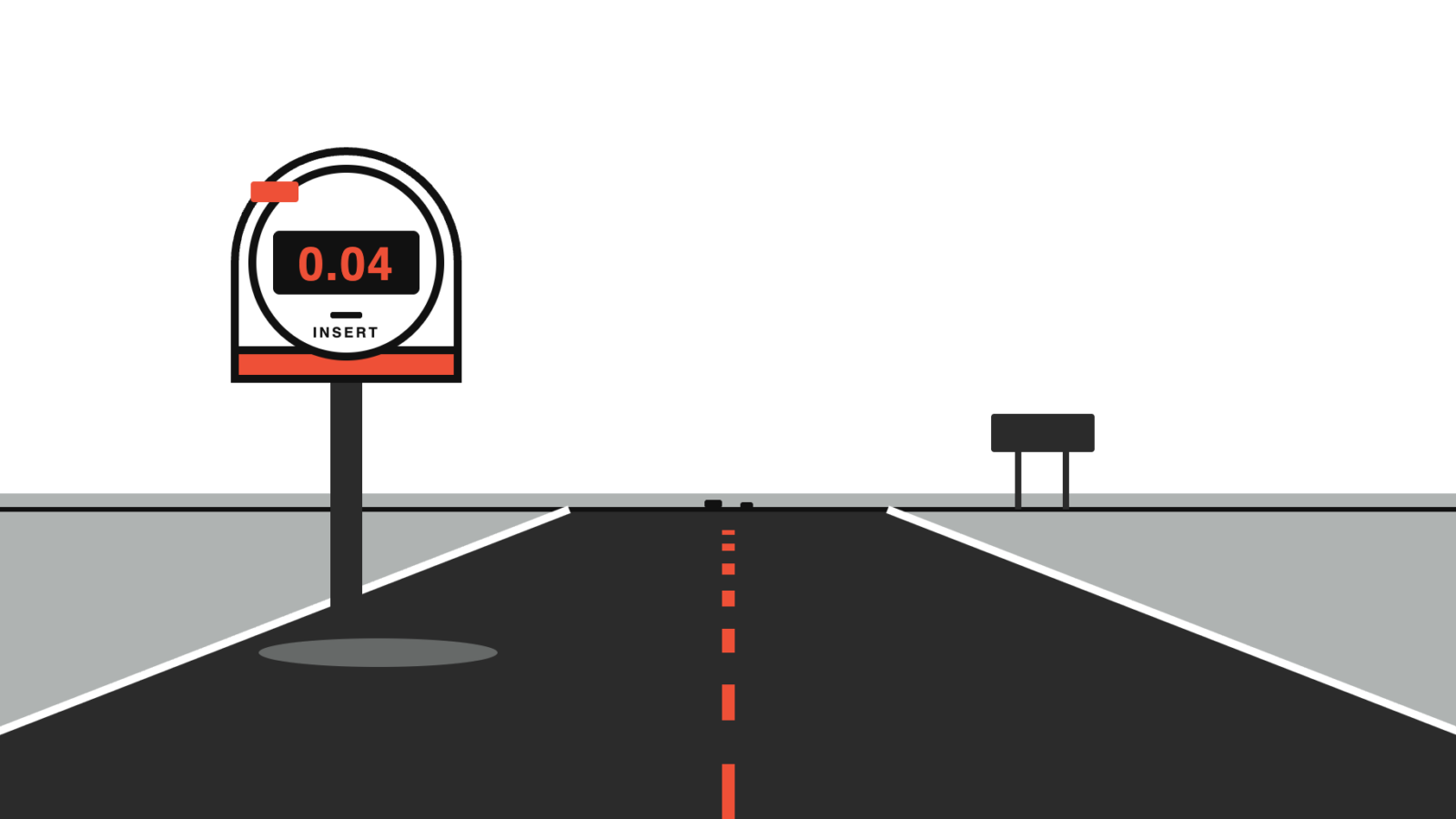
Congress found the broken meter this summer and installed a coin slot. The coin slot, a new federal EV fee, collects $12.4 billion over ten years.1 The hole it is meant to fill reaches $295 billion by 2036.2 That is four cents on the dollar, by the Congressional Budget Office’s own arithmetic.
The BUILD America 250 Act cleared the House Transportation and Infrastructure Committee 62 to 2 in May.3 It authorizes $580 billion over five years for surface transportation,4 and it is the first federal highway bill in a generation to attach a new charge to the vehicle rather than the fuel: an annual federal registration fee of $130 on electric vehicles and $35 on plug-in hybrids, collected by the states, escalating every two years from 2029.5 The bill’s sponsors projected $30 billion. CBO scored it at $17 billion gross and $12.4 billion net, and noted in passing that nothing in the bill actually requires the money to go into the Highway Trust Fund. CBO assumed it would.1
Parkonomics is not in the business of scoring highway bills. We are in the business of pricing access to infrastructure, and this bill is the clearest evidence yet that the federal government is drifting toward our business without having read the manual.
The federal EV fee: the meter, not the vehicle
We made the argument in Ghost Plates and it holds: the federal gas tax was the most successful user fee in American history, and its meter stopped. Eighteen and four-tenths cents per gallon, unchanged since 1993, collected on a proxy for road use that returns less every year as engines improve and returns zero for a vehicle with no tank. The Highway Trust Fund’s highway account runs out of money during 2028. The transit account runs out during 2027.1 Most of the taxes that feed both are scheduled to expire on September 30, 2028, all but 4.3 cents of them.2
Against that, a flat annual fee on the vehicles that broke the proxy is a reasonable emergency measure and an unserious funding model. Forty-one states already charge their own EV registration fees.4 Layer a federal one on top and an electric vehicle in most of the country will be paying twice for a road nobody has metered. The driver who covers 4,000 miles a year pays the same $130 as the driver who covers 40,000. A flat fee is what you charge when you have decided not to measure.
The per-mile user fee is in the bill, again
The same legislation reauthorizes the national per-mile user fee pilot through 2031, expands its scope to compare a road usage charge against the fuel tax for rural and urban drivers, adds a requirement to study interoperability between states, and directs the Secretary to run a public awareness campaign.6 The original pilot was authorized in 2021. The Bipartisan Policy Center notes the Department of Transportation never implemented it.4
So the bill contains both answers. The four-cent answer is mandatory and starts in 2028. The real answer is a pilot that has now been authorized twice and run zero times. Anyone who has watched a municipal parking program adopt license plate recognition after a decade of debating it will recognize the shape of this.
Where parking already is
Here is the part the bill’s authors are not saying, possibly because nobody in the room has run a garage.
A per-mile road charge requires four things: a credential that identifies the vehicle, a transaction that attaches a charge to a specific use, a reconciliation process the payer and the collector both trust, and a customer-facing interface that does not require a human at a booth. That is a parking access and revenue control system. It is the entire product.
A flat fee is what you charge when you have decided not to measure.
Andrew Sachs
Parking is the one sector of American transportation that has priced access by time and location, at the point of use, for a century, and has done it through every technology transition from the mechanical meter to the app. The interoperability problem the bill asks the Secretary to study is a problem parking operators solved for tolling and for reservation platforms years ago. The public awareness problem is the same one every city faces when it converts a free lot to paid. The privacy objection to mileage charging, that the government would know where you drove, is the same objection that greeted LPR, and it was answered the same way: a credential can attest that a vehicle used a facility without disclosing an itinerary.
The word “parking” appears in a $580 billion bill exactly once, in Section 1127, a $150 million per year discretionary grant program for commercial truck parking.7 Useful. Also a rounding error. The industry’s actual relevance to this legislation is not the line item. It is that the country is about to spend five years and a public awareness campaign rediscovering how to charge a vehicle for access, and the people who already know how are not at the table.
What the December 11 reauthorization date means
The Infrastructure Investment and Jobs Act expired at the end of September. The continuing resolution carries surface transportation programs to December 11.8 No Congress has reauthorized a highway bill on schedule, so December 11 is less a deadline than a reset: the extension after it, or the one after that, is where the revenue structure will be decided. The Senate has not released a bill. The EV fee, the pilot, and the funding split between them are all still in motion.
For operators, owners, and the cities that regulate them, that is the window. Not to lobby for the line item, but to make the case that the mileage pilot should be built on infrastructure that already exists rather than procured from scratch, and that the data model for a road charge should be compatible with the one the curb is already moving toward.
Five takeaways on the EV fee and the Highway Trust Fund
1. The EV fee is a placeholder.
$12.4 billion net over ten years against a Trust Fund balance CBO projects at negative $295 billion by 2036, with nearly $148 billion of the shortfall arriving by 2031.1 It buys time, not a model.
2. The mileage pilot is the only revenue idea in the bill that scales.
It has been authorized twice and run zero times. The reauthorization adds an awareness campaign; it does not add a deadline.
3. Double charging is now the default.
Forty-one state EV fees plus a federal one, none of them tied to use. Expect the fairness argument to shift from “EVs pay nothing” to “EVs pay twice.”
4. The PARCS stack is the road-charge stack.
Credential, transaction, reconciliation, self-service interface. The industry has the architecture the pilot needs; the pilot’s authors have not asked.
5. December 11 is a reset, not a deadline.
The revenue structure gets decided in the next extension, and the Senate has not spoken. The comment window is open.
Sources
- Congressional Budget Office, cost estimate letter on H.R. 8870, Highway Trust Fund effects, July 9, 2026. cbo.gov
- Congressional Budget Office, “The Status of the Highway Trust Fund in 2026,” June 16, 2026. cbo.gov
- National Association of Counties, “NACo Legislative Analysis: BUILD America 250 Act,” 2026. naco.org
- Bipartisan Policy Center, “The Next Big Infrastructure Law? How the BUILD America 250 Act Aims to Reshape IIJA,” 2026. bipartisanpolicy.org
- Committee for a Responsible Federal Budget, “Proposed EV Fee Could Raise $30 Billion,” May 18, 2026, with CBO update. crfb.org
- Holland & Knight, “A Closer Look at the BUILD America 250 Act,” May 2026. hklaw.com
- AASHTO, “Comprehensive Section-by-Section Analysis of BUILD America 250 Act,” June 2026, Section 1127. transportation.org
- National Association of Counties, “Congress passes short-term funding bill keeping federal government funded through Dec. 11,” September 2026. naco.org
 A
A