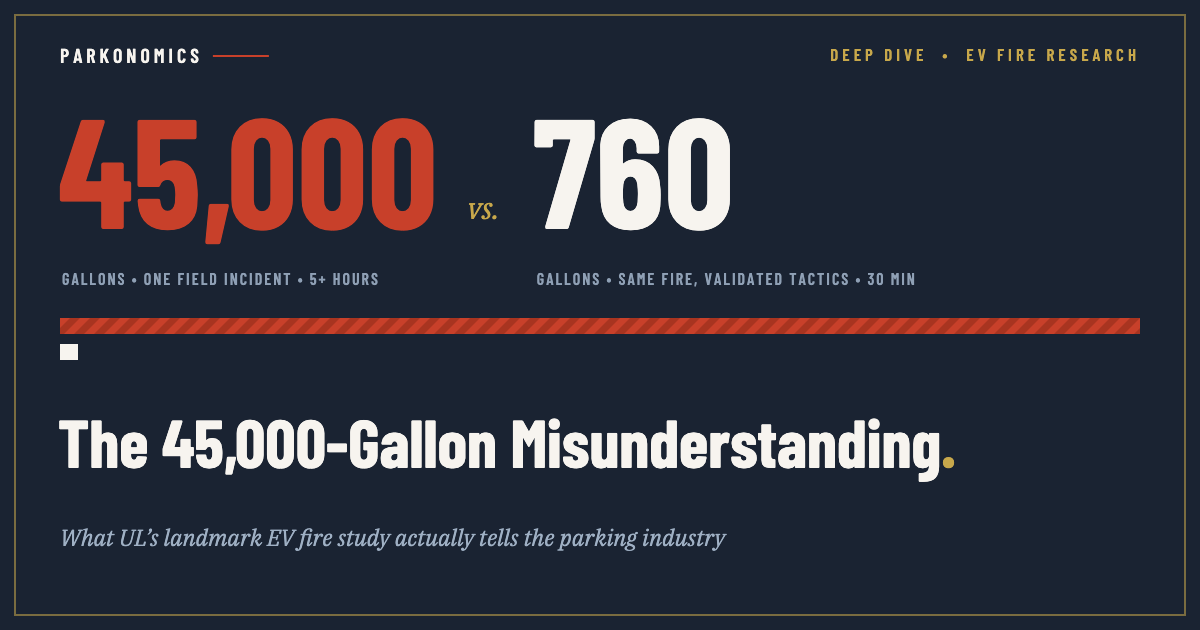
Here is a number that should focus the mind of every parking owner, operator, and asset manager in America: 45,000.
That is how many gallons of water a Tennessee fire department reportedly poured onto a single Nissan Leaf that caught fire on a fast charger in 2023. Crews were on scene for more than five hours. One compact electric vehicle, one charging station, and a water bill that would fill seven backyard swimming pools.
Now hold that number against this one: 760.
That is roughly how many gallons it took trained firefighters, in a controlled laboratory, to fully resolve a fire in a Ford Mustang Mach-E with a 91 kWh battery, the largest pack in the study, in under 30 minutes. Same class of fire. Same battery chemistry rolling through your garage every day. Two percent of the water, one tenth of the time.
The difference between those two numbers is not equipment. It is not water supply. It is knowledge, and until last week, that knowledge did not exist in validated, public form. On August 4, the Fire Safety Research Institute, part of UL Research Institutes, released the results of a three-year, 18-vehicle, full-scale burn program titled Full-Scale Electric Vehicle Fire Experiments and Recommendations for Fire Incident Response. It is the most comprehensive EV fire study ever conducted for the North American market, and it deserves to be read far beyond the fire service.
Because here is what the fire service already knows and the parking industry is about to learn: almost every one of this report’s findings runs through a parking facility. The vehicles burn in our structures. They charge on our equipment. They get towed to our lots. The one scenario in which an EV fire becomes something categorically different from a car fire, the report says plainly, is when it happens in a confined space. The report names that space. It is a parking garage.
Parkonomics read all 150 pages so you don’t have to. What follows is the translation.
1. The Study Nobody Can Dismiss
First, the credentials, because the fear narrative around EV fires has survived this long partly because credible data was so scarce.
Before this project, the entire global body of published vehicle burn research contained usable heat release data on just 17 electric vehicles, against 66 gasoline vehicles. Only one of those EVs was North American, and its battery had been removed before the test. Read that again: until this month, the number of intact North American EVs ever burned under instrumented laboratory conditions, with public data, was zero.
FSRI fixed that with a program of unusual scale. Eighteen vehicles, three gasoline and fifteen electric, burned to completion or suppression inside a 108-foot-square laboratory under a calorimetry hood, sitting on platform scales, wrapped in heat flux gauges and thermocouples, with air, water, surface, and protective equipment sampling running throughout. The fleet was the North American best-seller list: Tesla Model 3, Ford Mustang Mach-E, Chevy Bolt, Nissan Leaf, Hyundai Kona and Ioniq, with gasoline comparators sharing the same chassis where possible. Every battery was charged to 100 percent, the worst case. A 17-member technical panel reviewed the work, and it included the FDNY, the Los Angeles County Fire Department, the International Association of Fire Fighters, the International Association of Fire Chiefs, NIST, and, notably, Tesla, GM, and Ford at the same table.
The report is blunt about why it exists. “Uncertainty surrounding EV fire hazards,” the authors write, “has contributed to the rapid proliferation of misconceptions, sensationalized media coverage, and the introduction of unvalidated suppression products and tactics marketed specifically for EV fires.”
In other words: an entire cottage industry of EV fire panic, and EV fire products, grew up in a data vacuum. The vacuum is now closed.
2. The Myth Ledger
So what did 18 burning vehicles actually show? Sort the findings into what the study debunked and what it confirmed, because both columns matter to a parking operator.
Debunked: EVs burn hotter, longer, and more dangerously than gas cars. They do not. Across the free-burn experiments, EV fires matched gasoline fires in growth rate, peak size, and duration. The average burn duration for the EVs was actually lower. Every vehicle in the study, gas or electric, burned itself out in under 90 minutes with no intervention at all. The report’s conclusion could not be plainer: “no evidence was found that EVs burn hotter, or last longer than their conventional counterparts.”
The reason is intuitive once stated. The fuel that matters in a car fire is the cabin: the seats, foams, plastics, carpets, and trim. Those are virtually identical whether the drivetrain runs on electrons or octane. The single highest peak fire size in the entire study, 11.2 megawatts, belonged not to the biggest battery but to a modest 40 kWh Nissan Leaf. The 82 kWh Tesla peaked at less than half that.
Debunked: EVs catch fire more often. The report cites Highway Loss Data Institute insurance data showing that non-crash fire claims are slightly higher for the gasoline versions of the same vehicle models than for their electric counterparts, even after controlling for vehicle age. The perception gap is a media artifact. Every EV fire is a story; the roughly 170,000 gasoline vehicle fires North America logs every year are background noise.
Confirmed: the battery is a real and different problem. Here the report is equally unsentimental in the other direction. An EV traction battery is engineered to survive crashes and keep water out, with electrical isolation designed around packs running 300 to 800 volts. Those same virtues make it nearly impossible to extinguish from the outside. Once thermal runaway begins propagating through a pack, the report found suppression was ineffective “in effectively all cases.” In one test, firefighters flowed roughly 1,000 gallons directly at the underside of a burning pack with a specialized nozzle. The result: no meaningful reduction in battery temperature. The modules were actually hotter after the water stopped than before it started.
Confirmed, and this is the strategic pivot: the answer is patience, not water. The winning tactic in test after test was almost anticlimactic. Knock down the cabin fire, which took less than a minute and under 200 gallons with a standard handline. Then stop trying to extinguish the battery. Protect the surroundings, keep the cabin from reigniting, and let the pack burn itself out, which typically took another 5 to 20 minutes of flaming. Managed this way, incidents resolved in about half an hour on the water a single fire engine carries. The report calls copious water application to the battery “both ineffective and unnecessary.” A widely marketed water additive tested in the program showed no benefit over plain water.
That is the 45,000-gallon misunderstanding in a sentence. Nashville did not have a water problem. It had a doctrine problem, and now the doctrine exists.
3. The Blanket Surprise
If the study has a villain, it is not the battery. It is one of the most popular products sold to solve it.
EV fire blankets, large graphite-coated tarps deployed over a burning vehicle, have become a fixture of EV fire marketing, and more than a few parking facilities and fleet garages have bought them for peace of mind. The FSRI tests found they do work in a narrow sense: pull one over a burning car and the visible flames die quickly. The scene looks controlled.
Underneath is another story. The blanket does nothing to stop thermal runaway. In the tests, pack temperatures kept climbing past 700 degrees Celsius under blankets while the vehicle looked calm from the outside. Worse, the battery keeps venting flammable gas into the space beneath the fabric. The arithmetic is startling: for a 91 kWh Mach-E, the report calculates that venting just 1.1 percent of the battery’s energy content is enough to create an ignitable atmosphere under the blanket. Lift a corner to inspect, or to slide a nozzle underneath, and fresh oxygen meets accumulated fuel.
Across four blanket experiments, the program recorded four deflagrations, a backdraft, and a 20-foot fireball. Two of the deflagrations happened with no preceding manipulation whatsoever, minutes apart, at a vehicle nobody had touched. The report’s finding deserves quoting: “there were no discernible warning signs that directly preceded the deflagrations.” The smoke had visibly improved. The thermal camera showed nothing unusual. Then the blast.
This is not merely a laboratory curiosity. In September 2025 in Bangkok, firefighters deployed a blanket over a charging plug-in hybrid and experienced a vapor cloud explosion during the operation. In Colorado, vent gases from a hybrid in a residential garage detonated and threw the garage door 30 feet, nearly striking a fire officer. FSRI and the Fire Protection Research Foundation have jointly issued a safety advisory on blanket use.
The report’s verdict lands hard for anyone who has one hanging on a garage wall: “Misguided use of fire blankets may increase risk to responders. Water-based suppression is recommended as the default means of vehicle fire control.” And for our industry specifically: “it is inadvisable to use an EV fire blanket indoors or in confined spaces.”
If your facility’s EV emergency plan is a folded blanket in a storage closet, this report just rewrote your plan.
4. The Garage Chapter
Which brings us to the material this publication exists for. Scattered through the report’s discussion, conclusions, and tactical appendices is what amounts to an unwritten chapter about parking structures. Assemble the pieces and it reads like this.
Confinement is the multiplier. In open air, an EV fire is a car fire with a stubborn ember at the bottom. In an enclosed space, the calculus changes, because a battery in thermal runaway can vent flammable gas without flame, and that gas accumulates. The report instructs responders to treat a non-flaming, off-gassing EV “as an imminent battery fire with the potential to escalate to flash fire or explosion hazard if the vehicle is in a confined area where unburned gases can accumulate,” and then names the setting: “a space like a residential or commercial parking garage.” The tactical decision aid FSRI built for incident commanders asks its exposure question in three words: “Is the location inside?”
Sprinklers are the difference between an incident and a catastrophe. The report recounts a 2024 underground parking garage fire in which a Mercedes EQE’s vent gases deflagrated; 21 people were injured and roughly 70 vehicles were destroyed, an outcome the report notes was worsened by an inactive sprinkler system. Every parking operator deferring sprinkler maintenance now has a 70-car, 21-injury case study to bring to the budget meeting. Fire protection systems are not a compliance line item. In the EV era they are the structure’s primary defense while the fire department is still driving.
Sixteen feet is the new design number. From its heat flux measurements, the study derives a critical separation distance of 5 meters, about 16 feet: the range within which an adjacent vehicle or other combustible faces ignition-level thermal exposure from a burning EV, and the quarantine buffer recommended for fire-damaged vehicles afterward. A standard garage bay puts vehicles about three feet apart, which is nothing new; gasoline cars ignite their neighbors too. But 16 feet now gives designers and operators a validated figure for the decisions they control: where charging clusters sit relative to egress paths and structural members, how salvage and quarantine areas are laid out, and how much standoff a damaged vehicle needs at an impound or tow lot.
The fire follows the car home. The strangest property of EV fires is that they do not reliably end. Stranded electrical energy persists in damaged packs with no field-practical way to measure or discharge it. Industry incident data cited in the report puts reignition at about 13 percent of EV fire events. The documented outliers are remarkable: a vehicle that reignited 68 days after its incident, another that reignited after three weeks submerged in water. In FSRI’s own lab, a vehicle reignited half an hour after a fire blanket was removed, four hours post-fire, off a battery surface still at 350 degrees Celsius. The report’s guidance runs directly through our industry’s back lot: fire-damaged EVs should get an escorted tow, a pre-release inspection for heat, sounds, and smoke, and quarantine storage at least 16 feet from anything combustible. Movement itself, the jostling of a tow, can trigger reignition. Parking operators, tow contractors, and impound facilities are the second responders this report quietly deputizes.
Charging is where the exposures concentrate. The incident record threading through the report keeps returning to the same setting: the Nashville Leaf on a fast charger, a Jaguar charging in a Colorado residential garage, the Bangkok PHEV charging when it began to smoke. The report does not indict charging, and it should not; fire frequency data remains reassuring. But charging is the point where vehicles, high energy flows, and enclosed real estate meet, and it is the point where a facility operator actually controls policy: which levels chargers sit on, how far from egress, what the inspection cadence is, and what staff do in the first five minutes of a smoke report.
5. The Operator Playbook
Translated into action, the report suggests seven moves for anyone who owns or operates parking:
1. Audit the fire protection system this quarter. Working sprinklers separated the routine from the catastrophic in the report’s incident record. If the system is impaired, tagged, or overdue for inspection, that is now the most urgent item in the capital plan.
2. Retire the fire blanket, or restrict it to open air. If your facility bought blankets, understand what the research says: never indoors, never on a vehicle with battery involvement, never lifted or adjusted once deployed. For most garages the honest answer is that the blanket has no indoor role at all.
3. Pre-plan with your fire department. The report’s tactical decision aid is free and public. Invite the first-due company to walk the structure. Where are the hydrants and standpipes? Which levels have chargers? Where could a burning vehicle be isolated? A 30-minute walkthrough converts this study’s findings into your facility’s plan.
4. Write the off-gassing protocol. The dangerous EV in a garage is not necessarily the flaming one; it is the one hissing white vapor with no flame at all. Staff should know the signature: thick white or grey smoke that hugs the floor, a solvent-like odor, popping or hissing sounds. The response is not a fire extinguisher. It is evacuation, isolation, and a 911 call that says the words “electric vehicle” and “inside a parking structure.”
5. Site chargers with the 16-foot number in mind. Existing installations do not need panic retrofits; the frequency data does not support it. But every new installation is a free opportunity to think about separation from egress stairs, structural columns, and adjacent stalls, and ground-level or upper-deck placement with ventilation and apparatus access in mind.
6. Formalize the damaged-vehicle protocol. Any EV that has been in a fire, a flood, or a significant collision is a reignition candidate. It needs a designated quarantine area, open air, 16 feet of clearance, away from structures, and a tow contractor who knows the escort guidance. If your lot receives vehicles from towing partners, this belongs in the contract.
7. Use the evidence in the EV policy conversation. Some jurisdictions and boards have flirted with garage EV bans or charging moratoriums. This report is the strongest counterweight yet: UL-branded, fire-service-endorsed evidence that EVs do not burn more often, hotter, or longer than the gasoline cars garages have hosted for a century. The right response to this research is not exclusion. It is the short list above.
6. What We Still Don’t Know
Intellectual honesty requires the caveats. The burns were conducted in still laboratory air, on flat slabs, one vehicle at a time, with fires deliberately started at the battery. Real garages add slope, wind, adjacency, and delay. The study tested only NMC battery chemistry; the LFP packs now spreading through entry-level EVs produce a different gas profile and were out of scope. The largest battery burned was 91 kWh, while more than 30 models on sale now exceed 100 kWh. And on the question parking cares about most, mechanical ventilation of battery vent gas in enclosed structures, the report offers no guidance because none yet exists; federally funded research is underway.
That last gap is worth sitting with. The fire service now has a validated playbook for EV fires in the open. The playbook for EV fires inside buildings, where ventilation, sprinkler interaction, and structural exposure collide, is still being written. The parking industry, which owns those buildings, should be at the table while it is drafted, not reading about it afterward.
7. The Bottom Line
For fifteen years, the EV fire conversation has run on anecdote in both directions: viral videos of burning Teslas on one side, industry reassurance on the other, and almost no instrumented evidence in between. That era ended on August 4.
What the evidence says is neither alarming nor complacent. Electric vehicles are not rolling firebombs; by the insurance numbers they are modestly less fire-prone than the cars they replace, and when they do burn, they burn like cars. But the battery changes the shape of the incident in specific, manageable ways: it resists extinguishment, it vents flammable gas, it holds its energy for weeks, and every one of those properties matters most in exactly one kind of place, the enclosed, stacked, occupied structures where America keeps its cars.
Parking professionals spend careers explaining that a garage is not passive storage; it is managed infrastructure. This report makes that argument better than we ever have. The facilities that treat EV fire readiness as an access-management discipline, with maintained systems, trained staff, sited chargers, and a fire department that has walked the floors, will find the EV transition entirely survivable. The 45,000-gallon incidents will belong to the facilities that never read the research.
The report is free. Your fire marshal has already downloaded it. You should too.
Sources
Fire Safety Research Institute (UL Research Institutes), Full-Scale Electric Vehicle Fire Experiments and Recommendations for Fire Incident Response (DOI: 10.60752/102376.29066621), released August 4, 2026 — report, tactical decision aid, and underlying data available at no cost at fsri.org. Highway Loss Data Institute insurance claim data and EV FireSafe incident data as cited in the report. Parkonomics’ full breakdown of the 150-page report is available to readers on request.
 A
A