By Andrew Sachs, PTMP
A light that tells you nobody is driving is only useful if every car without a driver turns it on. This includes the critical role of cyan lights for autonomous vehicles.
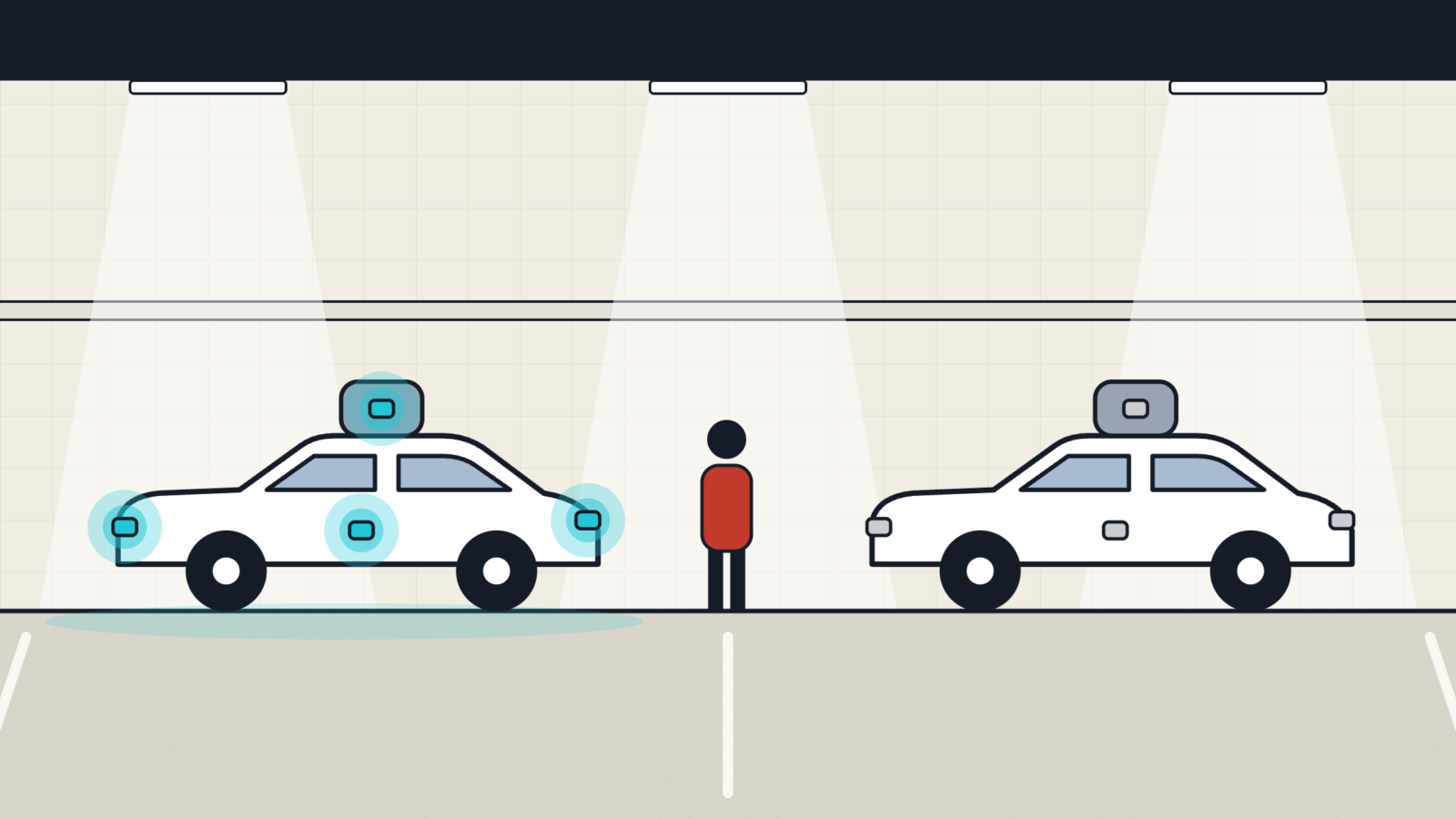
The National Highway Traffic Safety Administration has proposed changes to FMVSS No. 108, the federal lighting standard, that would let automated vehicles carry steady cyan marker lamps. The lamp has one job: to show that the vehicle is operating without the expectation that anyone inside is watching the road. This is essential for the advancement of cyan lights autonomous vehicles. The docket is NHTSA-2026-1519, and comments are due 30 days after the proposal appears in the Federal Register.
Most of the early coverage has focused on what the rule means for robotaxis without steering wheels. Parking has its own stake, and a sharper one, because the places where people and driverless vehicles share space at walking speed are mostly ours.
What the proposal actually says
- Optional, not required. A vehicle “may be equipped” with four to eight ADS marker lamps. NHTSA says it does not yet have enough information to show a safety need for a mandate.
- Steady cyan. The color is the blue-green range defined in SAE J578. NHTSA reasons that amber, red or white would carry no clear meaning, and that a steady, low-intensity cyan is distinguishable from the flashing, far brighter blue used by law enforcement.
- Visible from every side. At least one lamp must be visible from the front, each side and the rear, mounted no lower than 15 inches, inside or outside the vehicle.
- Brightness keyed to headlamps, not the clock. When headlamps are off, the lamps must be roughly five times brighter than when headlamps are on.
- One national color. NHTSA tentatively expects the rule to override state requirements that conflict with it, including parts of California’s existing marker lamp rules and color-limiting laws that would block a compliant lamp.
This is not entirely new. Mercedes-Benz received approval in California and Nevada in late 2023 to use turquoise marker lights on vehicles running its Drive Pilot system. The federal proposal would turn a state-by-state permission into a single national signal.
A dark lamp tells you nothing
Because the lamp is optional, the signal only works in one direction. A glowing cyan car is telling you something. An unlit car is not telling you it has a human driver. It might, or it might belong to a fleet that chose not to install the lamps.
For an attendant walking up to a stopped car at an exit lane, an enforcement officer at a loading zone, or a curb manager reviewing camera footage, that asymmetry matters. Every unlit vehicle still has to be treated as unknown. A voluntary signal is a reasonable first step for a regulator that wants more data before mandating anything. Operators should simply plan for a long period in which the light is present on some driverless vehicles and absent on others.
The lot is where intent matters most
NHTSA is asking for research on whether the lamps should be allowed to flash, including to signal a vehicle’s intended movement to pedestrians and other road users. Industry testing on communicative lighting has explored exactly this: lights that say “I see you” or “I am about to move.”
Highways are not where that question gets answered. Surface lots and garages are. Vehicles back out of stalls, creep toward gates, hesitate at ramps and pull to the curb, all at low speed and all surrounded by people on foot who are looking at phones, children or shopping carts. Parking owners and operators know these interactions better than anyone, and the docket would benefit from hearing it.
Questions worth putting in the docket
Garages are a demanding lighting environment: low ceilings, reflective concrete, columns that break sightlines, and vehicles that run with headlamps on indoors, which under the proposal means the lower brightness minimums apply. How visible is a steady cyan lamp under the cool white LED fixtures common in modern structures? That is an empirical question, and parking facilities are natural places to test it.
There is also an opportunity. A standardized color is something cameras can be trained to detect. If plate recognition and occupancy systems can reliably see cyan, an operator could separate driverless sessions from human ones for pricing, curb allocation and planning data without asking anyone to file a report. Whether that is practical depends on lamp intensity and placement, which is precisely what the proposal is setting now.
Finally, enforcement. When the light says no one is expected to be watching the road, the logic of who receives a curb citation, and how it is delivered, changes. A lighting rule cannot settle that, but it makes the question impossible to ignore.
Five takeaways
- Cyan would be the national signal for “no one is driving.” Four to eight steady lamps, visible from every side, optional for manufacturers.
- Optional means one-way. A lit lamp is information. An unlit lamp is not proof of a human driver, so operations should treat dark vehicles as unknown.
- Parking is the test bed for intent signaling. Low speed, dense foot traffic and constant maneuvering make lots and garages the most relevant setting for NHTSA’s question about flashing lamps.
- A standard color is a data opportunity. If cameras can detect it, operators could identify driverless sessions automatically.
- Comment while the window is open. Docket NHTSA-2026-1519 accepts comments for 30 days after Federal Register publication. Facility data on visibility and pedestrian behavior is exactly the evidence NHTSA says it lacks.
What we still do not know: whether manufacturers will install a lamp they are not required to carry, how cyan reads under garage lighting, and whether NHTSA will allow flashing once it sees the research. The first answer belongs to the automakers. The other two are questions parking can help answer.
 A