By Andrew Sachs, PTMP
Eight disciplines. None of them is parking.
Three of the country’s most respected transportation research institutes have formed a consortium to help public agencies figure out artificial intelligence. The National AI Consortium for Transportation (NAICT) brings together the Texas A&M Transportation Institute, the University of Michigan Transportation Research Institute and UC Berkeley’s Institute of Transportation Studies. It describes itself as academic and non-commercial, with nothing to sell and evidence to share.
That posture is worth more than it sounds. Most AI education reaching parking and transportation agencies today arrives with a sales deck attached. A neutral broker that starts from the agency’s questions instead of a vendor’s roadmap is rare, and useful.
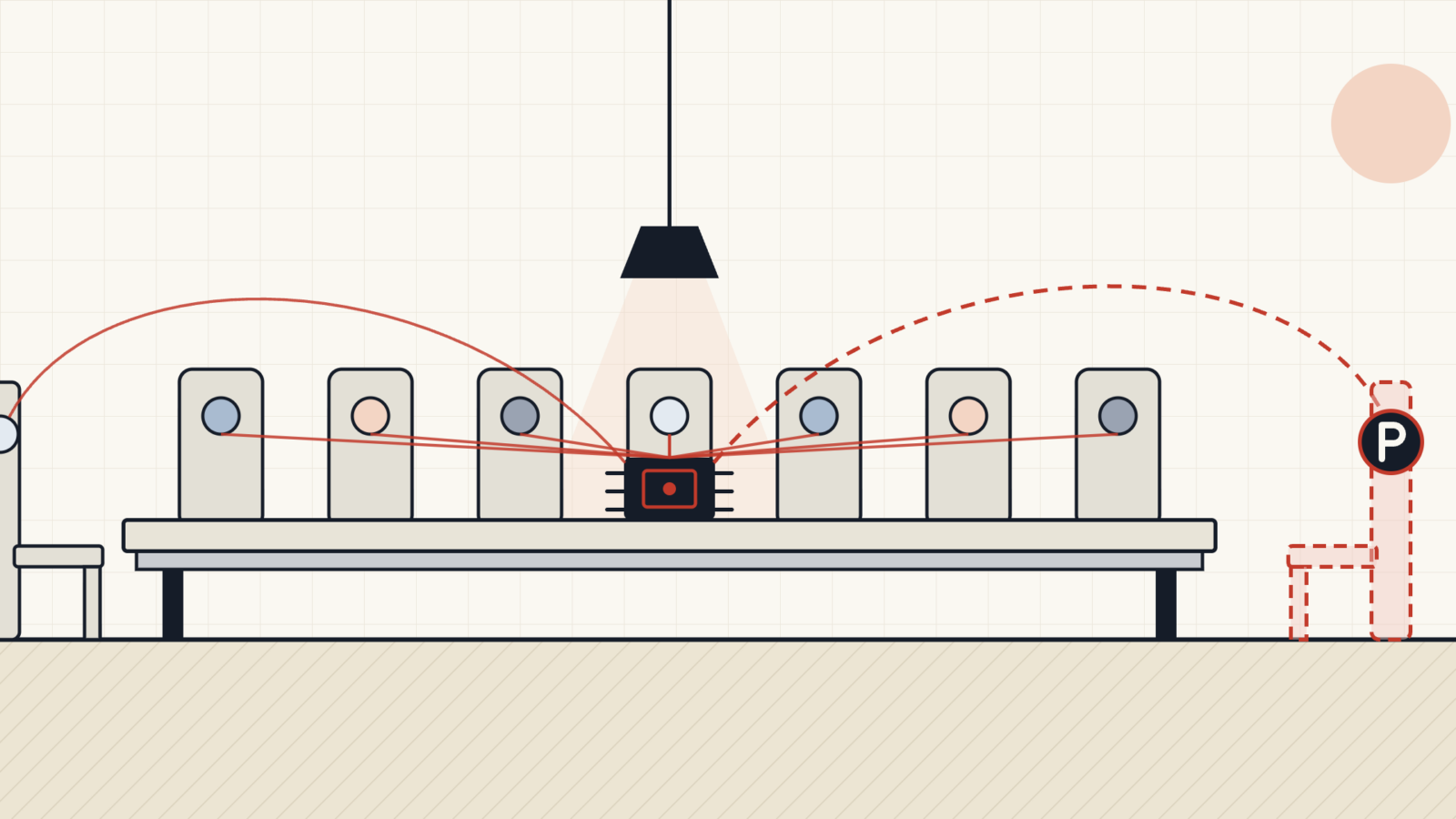
NAICT’s draft course model sorts training by five workforce tiers, from executives down to everyday AI literacy for all staff, and by eight disciplines: planning, design, construction, maintenance, operations, safety, asset management and business support. Parking and curb management do not appear as a lane of their own.
Nobody should read that as a slight. The model is explicitly a draft for discussion, and the consortium is in a listening phase, with sessions running from this fall through January 2027. NAICT says what it hears at those sessions will set its priorities. So the gap is an opening, not a verdict. If parking wants a lane, parking has to show up and ask for one.
Parking already runs AI in production
Much of the transportation AI conversation still lives in pilots: near-miss detection, pavement condition scoring, signal timing. Parking is further down the road. Plate recognition reads vehicles at gates and on enforcement routes every day. Occupancy models drive guidance signs and apps. Pricing engines adjust rates. Citations increasingly begin with a camera rather than an officer. These systems are bought and operated by municipal parking authorities, universities, hospitals, airports and private operators, and they touch ordinary people’s wallets directly.
That makes parking a natural test bed for exactly the governance questions NAICT wants to answer. Who verifies accuracy, and how often? What happens when the model is wrong and a resident receives a ticket? What does the agency actually own: the data, the model, or only a subscription?
The informed buyer problem is a parking problem
NAICT’s governance pillar promises procurement guidance and evaluation frameworks so that every agency can become an informed buyer. Parking knows this problem well. For years, access and revenue control was bought from the hardware catalog: pick a vendor, inherit its architecture. Owners get better results when they define operational requirements first and let software capabilities, not equipment lists, shape the design.
AI raises the stakes on that discipline. An agency that cannot state what a plate read system must do, how its accuracy will be measured, and what happens when it fails is not buying a tool. It is buying a black box with a service contract.
Trustworthy means testing the assumption, not just the read rate
“Trustworthy AI” is the consortium’s headline. In parking, trust has a specific failure mode. Most of the industry now treats a license plate as identity. A camera that correctly reads a cloned or fraudulent plate is technically accurate and operationally wrong. Any evaluation framework that scores only read accuracy will miss that entirely. The useful question is whether the system’s underlying assumption holds, and what second factor confirms it when it does not.
Two front doors, both open now
NAICT positions itself as a complement to the Federal Highway Administration’s AI Deployment Center of Excellence, which is anchored by a national pooled fund study and is building a five-year national AI roadmap. Both efforts describe themselves as practitioner-driven. Both are collecting input right now. Windows like this rarely stay open long, and the priorities set in the first year tend to stick.
Three questions to bring to a session
- Where does the curb sit? Operations, safety or business support? The answer decides who gets trained, and parking staff could easily fall between the lanes.
- Will evaluation frameworks cover enforcement-grade AI? When a model error becomes a citation, a boot or a tow, the accuracy bar and the appeal process matter as much as the algorithm.
- Can procurement guidance address data ownership and portability? Agencies need to switch vendors without losing years of occupancy, transaction and enforcement history.
Five takeaways
- A neutral broker has arrived. NAICT is academic and non-commercial, built by TTI, UMTRI and ITS Berkeley to help agencies evaluate, deploy and govern AI.
- Parking is not yet a named discipline. The course model is a draft, and the listening sessions are where that changes.
- Parking has standing. Plate recognition, occupancy prediction, pricing and camera enforcement are production AI with direct public consequences today.
- Informed buying starts with requirements. Define what the system must do and how it will be measured before looking at any catalog.
- Show up. Sign up at naict.org, attend a session before January, and bring the three questions above. The FHWA center is taking input too.
What we still do not know: how NAICT will be funded over time, which disciplines it will build first, and whether parking practitioners will be in the room when those choices get made. That last one is up to us.
 A