The question from York
A few years ago I was at a parking conference in York, Pennsylvania, giving a talk on how to put EV charging into a garage without wrecking its economics. Sizing the service, managing the load, not overbuilding for a demand curve that had not arrived. Then a hand went up in the back.
“What about those rolling blackouts you have in Los Angeles?”
I live in Los Angeles. I stood there a beat longer than a speaker should, because the honest answer was that we had not had rolling blackouts in a while. Demand was climbing, not mainly because of EVs, and the lights had stayed on. The questioner was not wrong to ask. He was working from a real event with a stale date on it, and about to make a decision about chargers in his own facility based on it.
The number
What he remembered was August 2020. A record heat wave, a Stage 3 emergency declared by the California Independent System Operator, and hundreds of thousands of households dark in rotating outages. At that moment, according to CAISO, the grid had less than 100 megawatts of battery storage available.1
What he had not heard was what happened next. California is rebuilding its grid around storage. The battery fleet is now more than 17,000 megawatts, per CAISO’s own spokesperson in the Los Angeles Times this week.1 The state has not issued a Flex Alert, the public plea to turn things off, since 2022. It has not rotated an outage since 2020.2
This August was the hottest on record in California. Long Beach hit 107 degrees, Escondido hit 112, and on September 9 demand passed 50,000 megawatts, within about 2,000 of the all-time record and well above the 46,844 in CAISO’s own resource adequacy forecast for the summer.3 The grid blew through that number and never asked anyone for anything.
Store at noon, spend at six
The York audience pictured the grid as a fixed bucket that EVs were about to overflow. That was a reasonable picture in 2020. It is the wrong picture now, because the bucket is being rebuilt around a different idea.
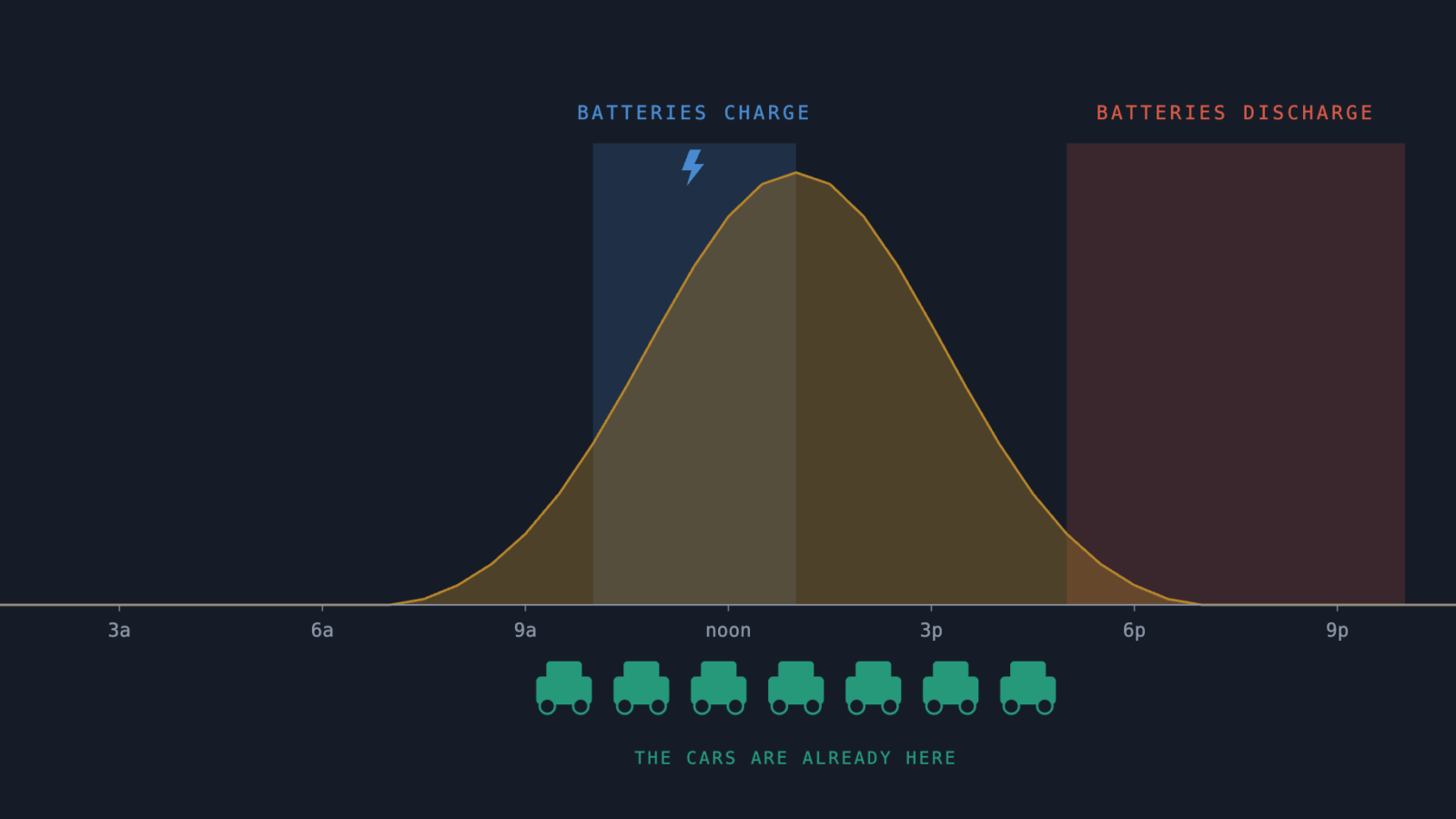
California has so much solar at midday that the operator throws it away, a practice the industry calls curtailment. This spring CAISO curtailed nearly 2 gigawatts more solar over the noon peak than a year earlier,5 and in May the state ran on more than 50 percent solar for an entire month, the first large power system anywhere to do so.6 Batteries charge in that window, when wholesale prices crater, and discharge between roughly 5 and 9 p.m., the net peak, when the sun is gone and the air conditioners are not.4
The grid did not solve its peak problem by building more supply for the worst hour of the worst day. It solved it by moving energy in time.
Here is why that matters to anyone who owns a garage. EV charging is the one big new load that can be told when to drink. And the parking industry is where that load sits still for eight hours a day.
The bigger picture, briefly
The grid does need modernizing, and it would if not a single EV ever plugged in. The national five-year forecast for peak demand growth is now 166 gigawatts through 2030, more than six times what the same forecasters expected in 2022. Data centers are roughly 55 percent of that growth. EV charging shares a 20 percent slice with every other kind of electrification combined.7 And per the Department of Energy, 70 percent of the country’s transmission and power transformers are more than 25 years old.8
The question from York conflated the oldest problem on the grid with its newest, and most schedulable, load.
Five takeaways for parking
1. Charge at noon, not at six.
Workplace, campus, hospital, and transit-station garages sit on the right side of the duck curve. Cars arrive at nine and leave at five, exactly when the grid is discarding solar. Residential and multifamily garages sit on the wrong side: arrival at six is the one window the battery fleet exists to cover. The time-of-use rates already say this. The California Energy Commission’s own category for workplace and multifamily chargers is “shared private,” and it says the state needs 1.01 million public and shared chargers by 2030.11 Most of those are parking.
2. A garage negotiates once. Two thousand homeowners negotiate two thousand times.
The CEC’s bidirectional charging roadmap, published in March, lists the barriers: interoperability, equipment cost above $10,000, interconnection under Rule 21, and unsettled compensation.10 Every one of those is a line item for a 2,000-stall operator and a dead end for 2,000 driveways. A report from GridLab, Kevala, and E3 last month says the next grid asset “is already in our driveways, homes, and businesses.”13 It does not say parking structures. It should.
3. Selling power back to the grid is a promise, not yet a market.
The modeling is impressive. The CEC’s 2030 scenario has 2.3 million EVs available to discharge in a given week, for 4.1 to 5 gigawatts of peak reduction.10 GridLab says enrolling 10 percent of the state’s EVs by 2036 would yield 9 gigawatts for 12 hours, a third of California’s long-duration storage target.13 But those are projections. The marketplace that would pay a parked car for its electrons, vehicle-to-grid in the trade’s shorthand, does not exist today in any substantial form: compensation is unsettled, interconnection is slow, the hardware is expensive. We have a long way to go, if we ever arrive. One-way managed charging works now, and it is the part of the value a garage can actually collect.
4. Retired EV batteries are becoming grid batteries instead of waste.
The half of the York question nobody asked: what happens to all those batteries? A pack leaves a car at 70 to 80 percent of original capacity, when range has degraded enough to annoy a driver. A stationary battery does not care about range.14 Redwood Materials, which says it recovers about 70 percent of the country’s used batteries, runs a 12 megawatt microgrid in Nevada on retired GM packs,16 commissioned another 7.2 megawatt-hours at a GM plant in June, and has roughly 10,000 more GM packs set aside for the same purpose.15 B2U Storage Solutions, out of Lancaster, California, has 24 megawatt-hours of retired GM packs bidding into the Texas market for well under $200 per kilowatt-hour.17 Second-life batteries are a small share of grid storage today, but the loop is closing: the car that charged in your garage this decade may be holding up the grid next decade, and what it cannot hold gets recovered as material for the pack after that.
5. The bill is demand charges, not electrons, and the clock is running.
At a commercial charging site, demand charges can be the largest line on the electric bill. PG&E and SDG&E have moved their EV rates to a kilowatt subscription rate. Southern California Edison has suspended demand charges on its EV rates through 2029, with a return dated January 1, 2030.18 An operator installing chargers in Southern California today is designing for a tariff that expires in three years. An automated load management system is how you meet that date. The full treatment is in Plugging In Wisely.19
What we still do not know
The lithium-ion fleet is a four-to-six-hour resource, so a long, cloudy heat event still leans on gas.2 The Moss Landing fire of January 2025 is the reference event for any battery energy storage system inside an enclosed structure, and NFPA 855 and the fire marshal come before the tariff. Second-life packs have to stay ahead of new cells that already average about $117 per kilowatt-hour worldwide,17 and the big wave of retiring EV batteries does not arrive until the early 2030s.
But the next time someone asks about the blackouts in Los Angeles, the answer is this. California solved it by moving electricity in time. The parking industry is where the cars sit still. Whether the grid ever pays for that is an open question. Whether a garage can charge them at the right hour is not.
Sources
- Clara Harter, “The surprising reason California survived record summer heat without blackouts,” Los Angeles Times, Sept. 11, 2026
- Hayley Smith, “California invests big in battery energy storage and leaves rolling blackouts behind,” Los Angeles Times, Oct. 17, 2025
- California ISO, 2026 Summer Loads and Resources Assessment
- California ISO, 2024 Special Report on Battery Storage, May 29, 2025
- Grid Status, “Batteries Boom but Solar Slides in CAISO,” June 10, 2026
- Dan McCarthy, “California was mostly solar-powered in May, a global first,” Canary Media (citing Ember), July 31, 2026
- Grid Strategies, National Load Growth Report, December 2025
- U.S. Department of Energy, Grid Deployment Office, Transmission Division overview, 2022
- U.S. Department of Energy, 2026 Draft National Transmission Needs Study, July 9, 2026
- California Energy Commission, Bidirectional Charging Roadmap, March 2026 (via EVinfo)
- California Energy Commission, AB 2127 Electric Vehicle Charging Infrastructure Assessment
- California Energy Commission, “California Surpasses 2.5 Million ZEV Sales,” January 2026
- GridLab, Kevala, and E3, “Unlocking California’s Flexible Load: A Durable Blueprint for Affordability and Reliability,” Aug. 18, 2026 (via T&D World)
- IEEE Spectrum, “Second Life EV Batteries Quietly Back Up the Grid,” July 2, 2026
- Electrive, “GM and Redwood expand partnership with second-life battery storage project,” June 10, 2026
- TechCrunch, “GM teams up with Redwood Materials to power data centers with EV batteries,” July 16, 2025
- KPRC, “Used electric vehicle batteries find new life bolstering the Texas grid,” Feb. 24, 2026
- EV Ready Energy, “Demand Charges Aren’t Going Away, They’re Being Restructured,” 2026
- Parkonomics, “Plugging In Wisely,” 2026 edition
 A
A