The $26 Billion Question No One Will Answer
Ask any LA Metro official what happens to the potentially up to 2,700 borrowed buses after the Paralympic closing ceremony, and watch the verbal gymnastics begin.
“We’re evaluating options.” “Ridership patterns will determine service levels.” “The Games will demonstrate the demand for enhanced service.” Translation: We have no idea, and we’re hoping you won’t notice until 2029.
This is the dirty secret of LA’s Olympic transportation strategy. The infrastructure is being built. The Purple Line will probably open on time. The buses will presumably run during the Games. LA will probably avoid operational embarrassment when the world’s cameras arrive in 2028.
And then?
Then the buses head home to Denver, Phoenix, and Sacramento. Then the 10,000 temporary workers’ contracts expire. Then the 100+ miles of bus-only lanes face “evaluation” by city councils who never wanted them in the first place. Then, if history is any guide, Los Angeles returns to precisely what it was before, only now with billions in debt for infrastructure that briefly demonstrated what could have been.
Parts 1-4 of this series provided the analysis: the 172% cost overrun rate, the forensic autopsies of Athens and Rio, the conditions that made Barcelona exceptional, and the verdict on LA’s trajectory. This final installment offers something different: a specific, action-oriented blueprint outlining WHO must make each decision, WHEN each decision must be made, WHAT blocks progress, HOW to build coalition pressure, and ACCOUNTABILITY mechanisms.
The Decision Calendar
Olympic transportation success will not be determined during the Games. It will be determined in the 30 months before and the 24 months after.
2026: The Year They Hope You’re Not Paying Attention
Q1 2026: Purple Line Section 1 opens. Metro FY2027 budget process begins, this is the window for post-Games service commitments. Critical decision point: Metro Board must decide which bus-only lanes will be permanent. Current status: No public list exists. No decision timeline announced. The default is reversion to car traffic.
Q2 2026: LAX Automated People Mover opens (June). Metro Board adopts FY2027 budget: the last pre-Games budget cycle. Critical decision point: LAWA Board must adopt curbside management policy. Current status: LAWA has built a $5.5 billion system with no pricing policy announced. The APM will open, and Angelenos will continue driving to the terminal curb because it’s free.
Q3 to Q4 2026: GETS staffing recruitment must be substantially complete. Bus borrowing agreements finalized. Park-and-ride site selection. Mobility hub construction begins. Critical decision point: 2029 Assessment must be commissioned NOW if baseline data collection is to be meaningful. Current status: Not commissioned. Not discussed.
2027: The Year of Maximum Anxiety and Minimum Decision-Making
Purple Line Section 2 opens (Q2 2027). FY2028 budget process: must include post-Games service level funding. Current status: The budget process will be consumed by last-minute Games preparation. Post-Games planning will be deferred as “premature.”
Q4 2027: Purple Line Section 3 to Westwood/UCLA must open. This is the most critical deadline, it serves the Olympic Village. If it slips, Metro scrambles with bus replacements while the world watches. Section 3 is 73% complete. Every major Metro project in memory has faced delays. There is essentially no margin for error, and no Plan B that doesn’t involve embarrassment.
2028: The Year of Operational Triumph and Strategic Amnesia
January to June: Final testing and rehearsals. TDM campaign launches. Critical decision point: Post-Games service levels must be publicly committed before Games begin. Once the Games end, attention evaporates. Commitments made during the spotlight have political weight. Commitments deferred to “after we assess ridership” are commitments that will never be made.
July to August: The Games. Olympics July 14-30, Paralympics August 15-27. Peak transit operations: 1 million+ extra daily trips. Prediction: Operational success. The trap: Operational success during the Games is not the same as lasting legacy. The 1984 Games were operationally successful too.
September to December: The Moment of Truth. Bus surge wind-down. Borrowed buses return to home agencies. Temporary staff contracts end. This is where Rio failed. TransOlimpica operated during the Games. Then the money ran out, the maintenance was deferred, and today 46 stations are shuttered. Current status: No conversion plan. No service level commitment. The default is dissolution.
The Power Map
Decisions are made by people. Accountability requires names.
Stephanie Wiggins, LA Metro CEO
The most powerful unelected transportation official in America’s second-largest city. Wiggins controls what gets proposed; the Board controls what gets approved. Her staff recommendations drive outcomes. The question she must answer: “Will you recommend to the Board that post-Games service levels be committed before the Games begin, with funding identified?” A “yes” moves the needle. A “we’re evaluating” is a “no.”
Mayor Karen Bass, Metro Board Chair
Sets the agenda. Convenes meetings. Has the power to ensure post-Games service commitments are on the agenda. Has one vote. The question she must answer: “Will you use your position as Metro Board Chair to put post-Games service commitments on the agenda before the Games begin, or will you let staff defer the question until attention has moved elsewhere?”
Justin Erbacci, LAWA CEO
Runs an airport that is spending $5.5 billion on infrastructure designed to move passengers out of the terminal loop, and has announced no policy to actually incentivize that behavior. His current answer, effectively, is hope. That’s not a strategy; it’s a prayer.
The Key Swing Votes
On the Metro Board, three County Supervisors have direct constituent stakes: Janice Hahn (South Bay/LAX), Lindsey Horvath (Westside/Purple Line), and Holly Mitchell (South LA/K Line). If these three demand post-Games service commitments as a condition of their votes on Olympic-related items, commitments will happen. If they defer to staff recommendations, nothing will happen.
The Coalition That Needs to Form
No single actor can guarantee success. Politicians respond to organized pressure, not white papers. Success requires a coalition of stakeholders with aligned interests who can create sustained pressure on decision-makers.
Six groups share aligned interests but lack coordination: major employers along transit corridors (UCLA, Cedars-Sinai, Century City, Sony, Disney), environmental and sustainable transportation advocates (Move LA, Streets For All, Climate Resolve), transit rider unions and advocacy groups (ACT-LA, Bus Riders Union), labor unions (ATU Local 1277, SEIU), tourism and hospitality industry, and real estate and development community (ULI, BOMA, TOD developers).
These stakeholders share aligned interests but lack coordination. Each advocates for their specific priorities; none focuses on the integrated Olympic legacy question. Without coordination, diverse stakeholders will continue advocating in silos while the critical decisions slip by unaddressed. The politicians will play the groups against each other, promise everything to everyone, and deliver nothing to anyone.
Recommendation: Form an “LA28 Mobility Legacy Coalition”, convened by Move LA or similar neutral party (not Metro, not LA28, both have conflicts). The coalition develops a shared platform of specific asks, coordinates testimony at Metro Board meetings, produces joint media statements, tracks decision-maker commitments, and publishes quarterly report cards.
Decision-by-Decision Implementation
For each of the eight decisions from Part 4, the implementation path is specific: who must decide, when, what “yes” looks like, and how to make it happen.
Decision #1: Commit to Post-Games Service Levels
Decision-maker: LA Metro Board. Deadline: Q2 2028 (before Games begin). What “yes” looks like: Board resolution committing to specific service level floors for Olympic corridors through FY2031, with funding identified. Not aspirational language: specific frequencies, specific hours, specific funding. What blocks it: Budget constraints, uncertainty about ridership, political risk, staff preference for flexibility.
Decision #2: Make Bus-Only Lanes Permanent
Decision-maker: Metro Board + individual city councils. Deadline: Q1 2026. What “yes” looks like: Published list identifying which lanes will be permanent. Default is permanence; reversion requires affirmative justification. What blocks it: Local opposition to lane reductions, business concerns about parking.
Decision #3: Price Curbside Access at LAX
Decision-maker: LAWA Board of Airport Commissioners. Deadline: Q2 2026 (with APM opening). What “yes” looks like: Tiered pricing: free via APM/transit, $5-10 pickup via ITF, $20-30 terminal curb access. Or: prohibit private vehicles from the horseshoe entirely and connect remote loading to terminals via APM. What blocks it: Political resistance, TNC lobbying, bureaucratic inertia.
Decision #4: Convert Park-and-Ride Sites to TOD
Decision-maker: Metro Board + individual city councils. Deadline: 2029-2030. What “yes” looks like: Pre-commitment to TOD evaluation for each site post-Games. RFQ process. Housing targets tied to Metro’s 10,000-unit goal.
Decision #5: Establish Clear Success Metrics
Decision-maker: Metro CEO and Board. Deadline: Q4 2026. What “yes” looks like: Published metrics dashboard with specific targets. Independent evaluation commissioned. Baseline data collection begins now.
Decisions #6-8
#6: Protect Measure M: Formal accounting separation between Olympic-specific expenditures and Measure M allocations. The 40-year program should not be sacrificed for the 3-year sprint. #7: Invest in Demand Management: Permanent real-time information systems, employer programs, and communication platforms that outlast the Games. #8: Plan the 2029 Assessment Now: Commission independent assessment design with baseline data collection beginning immediately.
The Accountability Scorecard
Politicians respond to scorecards. Voters remember grades.
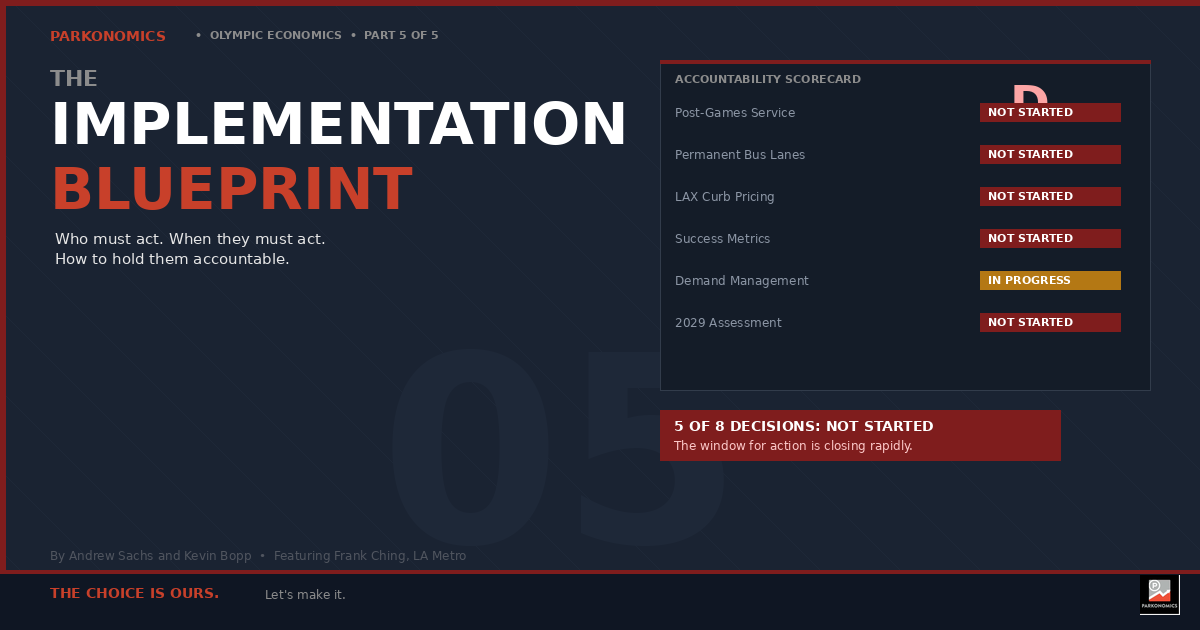
Five of eight decisions show no action with deadlines approaching. Two show some progress. One is too early to evaluate. Current overall grade: D-.
Parkonomics commits to publishing quarterly updates to this scorecard through 2030. Decision-makers will be graded. Voters will know who delivered and who punted.
What You Can Do
Attend Metro Board Meetings. The Board meets monthly, typically the fourth Thursday. One Gateway Plaza, Los Angeles. Livestream at board.metro.net. Written comments to [email protected]. Two minutes of public comment, multiplied by twenty people making the same ask, is more powerful than a hundred-page report that no one reads.
Contact Your Representatives. Mayor Karen Bass: [email protected]. Your LA County Supervisor: bos.lacounty.gov. Your City Council member: lacity.org/government/elected-officials.
Use Specific Asks. “I urge you to support a Metro Board resolution committing to specific post-Games service floors on Olympic corridors, with funding identified, before the Games begin. Vague promises to ‘evaluate afterward’ are not commitments, they are deferrals.”
Join Advocacy Organizations. Move LA (movela.org), Investing in Place (investinginplace.org), Streets For All (streetsforall.org), ACT-LA (act-la.org).
The Final Word: The Choice Is Ours
The infrastructure being built, the Purple Line, the K Line, the Regional Connector, the LAX APM, will serve genuine demand with or without the Olympics. These are good investments. They will produce lasting value.
But the difference between “good investments that produced some improvement” and “transformational investments that changed how LA moves” lies in the eight decisions this series has identified. Those decisions have not been made. The agencies responsible have not committed to making them. The political pressure to force action has not materialized.
That can change.
This blueprint shows who must decide, when they must decide, and how to hold them accountable. The coalition that needs to form can form. The decisions that need to be made can be made. But only if people demand it.
The politicians will not do this on their own. They will attend ribbon-cutting ceremonies, declare operational success during the Games, and quietly let everything revert to the status quo once attention has moved elsewhere. That is the path of least resistance. That is what will happen unless organized pressure forces a different outcome.
The Olympics are coming whether LA is ready or not. The question is whether, 30 years from now, Angelenos will look back at 2028 as the moment Los Angeles finally became a 21st-century mobility leader, or as another chapter in the endless, Sisyphean story of a region that spent billions to stay exactly the same.
The infrastructure is being built. The money is being spent. The only question is whether we demand lasting value for it, or accept another generation of missed opportunities.
The choice is ours. Let’s make it.
Frequently Asked Questions
What is the Parkonomics Accountability Scorecard?
The Accountability Scorecard tracks progress on all 8 critical decisions identified in this series. Each decision is graded: NOT STARTED (no action, deadline approaching), IN PROGRESS (active work underway), COMMITTED (public commitment made), COMPLETE (implemented), or FAILED (deadline passed without action). As of the initial assessment, 5 of 8 decisions are NOT STARTED, yielding an overall grade of D-. Parkonomics will publish quarterly updates through 2030.
Who are the key decision-makers for LA’s Olympic transportation legacy?
Stephanie Wiggins (Metro CEO) controls what gets proposed to the Board. Mayor Karen Bass (Metro Board Chair) controls the agenda. Justin Erbacci (LAWA CEO) controls LAX curb policy. Casey Wasserman (LA28 Chairman) has convening power. On the Metro Board, three County Supervisors have direct constituent stakes: Janice Hahn (South Bay/LAX), Lindsey Horvath (Westside/Purple Line), and Holly Mitchell (South LA/K Line). If these three demand post-Games service commitments, commitments will happen.
What is the LA28 Mobility Legacy Coalition?
A proposed coalition of six stakeholder groups that share aligned interests but currently advocate in silos: major employers, environmental groups, rider advocates, labor unions, tourism/hospitality, and real estate developers. Convened by a neutral party like Move LA (not Metro or LA28, which have conflicts). The coalition would develop a shared platform, coordinate Metro Board testimony, produce joint media statements, and publish quarterly report cards tracking whether decision-makers delivered on commitments.
How can I get involved?
Attend Metro Board meetings (4th Thursday monthly, One Gateway Plaza, or livestream at board.metro.net). Submit written comments to [email protected]. Contact Mayor Bass ([email protected]) and your County Supervisor (bos.lacounty.gov). Join advocacy organizations: Move LA (movela.org), Streets For All (streetsforall.org), Investing in Place (investinginplace.org), ACT-LA (act-la.org). Use specific asks: politicians ignore vague support but remember specific demands.
What happens if these decisions aren’t made?
Without action: borrowed buses return home and service levels fall (the Rio trap). Angelenos revert to cars the moment the closing ceremony ends (the 1984 repeat). Bus-only lanes revert to car traffic. Park-and-ride sites remain surface parking forever. No one is held accountable because no metrics were established. LA joins Athens, Rio, Montreal, and Sochi in the losers’ bracket: billions spent, nothing lasting, and a generation of Angelenos convinced that transit “just doesn’t work here.”
Sources
 A
A