The Moment of Truth
We have now examined the historical record of Olympic transportation investment across three parts: the economic patterns that predict success and failure (Part 1), the forensic autopsies of Athens, Rio, Montreal, and Sochi (Part 2), and the specific conditions that enabled Barcelona’s exceptional transformation (Part 3).
It’s time to render a verdict on Los Angeles.
This verdict will disappoint both boosters and critics. The boosters want validation that LA’s $26 billion investment will transform the region into a transit-oriented, sustainable, 21st-century mobility leader. The critics want confirmation that the Olympics are another boondoggle, enriching contractors while taxpayers foot the bill.
The evidence supports neither narrative. LA’s Olympic transportation strategy is neither destined for success nor doomed to failure. It is, instead, genuinely contingent: dependent on decisions yet to be made and commitments yet to be tested.
The Ledger: What’s Actually Being Built
Let’s be precise about the current state of LA’s Olympic transportation portfolio.
Completed ($5.9 billion): The K Line (Crenshaw/LAX, $2.1B, opened October 2022), Regional Connector ($1.8B, opened June 2023), and LAX Consolidated Rent-A-Car facility ($2.0B, opened 2023). All three pass the fundamental test: they serve genuine demand with or without the Olympics.
On Track ($13.6 billion): Purple Line Sections 1-3 ($10.3B total, 73-98% complete, completion Q1 2026 through Q4 2027) and the LAX Automated People Mover ($3.34B, June 2026). These projects represent the core of LA’s Olympic transit legacy. The Purple Line to Westwood is the single most important project, it serves the Olympic Village and the densest transit corridor in the region.
Delayed (Post-Games): C Line Extension to Torrance (2030-33), East San Fernando Valley Light Rail (2035), Southeast Gateway Line (2035), Sepulveda Transit Corridor (2030s). These projects were originally part of “Twenty-Eight by ’28” but could not meet the deadline.
Cancelled: The Inglewood Transit Connector ($2.4B): a $2.4 billion automated people mover connecting the K Line to SoFi Stadium. Federal funding was stripped; local funding was denied. The replacement, dedicated bus lanes and mobility hubs, is a significant downgrade in permanent infrastructure but may actually be more appropriate: event venue connectivity is precisely the kind of spectacle-serving investment that failed in Rio.
Temporary: The bus surge (2,700 buses, $700M to $1B), 10,000+ temporary staff, 15 staging depots, 100+ miles of bus-only lanes, and 25 park-and-ride sites. This is the terra incognita of LA’s Olympic transportation strategy: significant investment with uncertain lasting value.
The Funding Gaps No One Wants to Discuss
This funding gap manifests in three specific ways.
Gap #1: The Inglewood Problem. The Inglewood Transit Connector’s collapse was not a planning failure. It was a funding failure. The project was technically feasible and operationally sound. It died because the money wasn’t there. The “bus-based approach” that replaced it costs a fraction of the original APM but provides a fraction of the permanent value.
Gap #2: The Bus Surge Uncertainty. The Games Enhanced Transit Service requires $700 million to $1 billion for a bus surge that, by design, disappears after the Games. No funding source has been announced for converting surge capacity into permanent service improvements. If LA runs 2,700 buses effectively for 30 days, it proves the region can operate a world-class bus network. If that capacity evaporates the moment the Games end, the demonstration proves nothing lasting.
Gap #3: The Maintenance Cliff. Every transit agency faces a choice between capital expansion and maintenance of existing systems. The Olympic deadline intensifies this dynamic. Post-Games, the region will have a larger network with the same maintenance challenges.
The Risk Matrix
HIGH RISK: Post-Games Service Collapse. Borrowed buses return home. Temporary staff contracts end. Service levels fall. The “transit-first Olympics” is remembered as a one-time event rather than a transformation. Without a plan for service level maintenance, this risk is essentially guaranteed to materialize.
HIGH RISK: Mode Shift Reversion. Angelenos use transit during the Games because they have to. The Games end. They return to cars. This is exactly what happened in 1984. Traffic demand management worked brilliantly during the Games. Then it ended, and LA remained the car capital of America.
MEDIUM RISK: Timeline Slippage. The Purple Line Section 3 misses its Q4 2027 deadline. The Olympic Village lacks direct rail access. Every major Metro project in recent history has faced delays.
MEDIUM RISK: Cost Escalation Crowding Out. Olympic-adjacent costs escalate. Resources flow toward deadline-driven projects at the expense of non-Olympic priorities. This is the Montreal trap.
LOWER RISK: Operational Failure During Games. This risk is actually well-managed. Metro has three years to prepare and strong incentives. The risk is not that the Games will fail operationally; it’s that operational success won’t translate to lasting change.
The Parkonomics Playbook: Eight Decisions That Determine Success
Based on everything we’ve learned, here are the eight decisions that will determine whether LA’s $26 billion Olympic transportation bet produces Barcelona-style transformation or Rio-style regret.
Decision #1: Commit Now to Post-Games Service Levels. The bus surge is not a plan; it’s a logistics operation. A plan specifies what happens when the logistics end. Metro should announce specific service level commitments for post-Games operations on key corridors, with funding sources identified. Without this commitment, the bus surge is a $1 billion expenditure with zero lasting value.
“It will leave a long-term legacy and benefit the constituents in the long term. Infrastructure investment and also the software have to be parallel.”
Frank Ching, LA Metro
Decision #2: Make Bus-Only Lanes Permanent. The 100+ miles of bus-only lanes being installed for the Games represent significant infrastructure investment. LA should identify now which lanes will become permanent transit facilities. The default should be permanence; reversion should require affirmative justification.
Decision #3: Price Curb Access at LAX. Without pricing that directs passengers toward the APM and away from the terminal curbs, the $5.5 billion Landside Access Modernization Program will be underutilized. The Olympics provide perfect political cover for implementing tiered pricing: free access via APM, premium fees for terminal curb use.
“Less free parking, more profitable. That’s what Parkonomics should be about. Parking is not free.”
Frank Ching, LA Metro
Decision #4: Convert Park-and-Ride Sites to Transit-Oriented Development. The 25 planned park-and-ride sites represent significant land commitments at transit-accessible locations. After the Games, these sites should be evaluated for TOD potential rather than remaining surface parking lots.
Decision #5: Establish Clear Metrics for Success. You cannot manage what you don’t measure. Ridership targets: +15-20% permanent increase over 2027 baseline within 3 years. Mode shift targets: +5-10% transit/active share in Olympic corridors. Service reliability: 95%+ on-time performance maintained post-Games. TOD delivery: 10,000 housing units near new stations by 2035.
Decision #6: Protect Measure M from Olympic Cannibalization. Measure M is a 40-year, $120 billion program. The Olympics occupy 3 years. Metro should establish formal accounting separation between Olympic-specific expenditures and Measure M allocations.
Decision #7: Invest in Demand Management Infrastructure. LA’s 1984 success was built on demand management. These tools are even more powerful in 2028 thanks to technology. Metro should invest in permanent demand management infrastructure: real-time information systems, employer partnership programs, dynamic pricing tools.
Decision #8: Plan the 2029 Assessment Now. One year after the Games, Metro should conduct a rigorous, independent assessment of Olympic transportation legacy. This assessment should be designed now, with baseline data collection beginning immediately.
The Verdict
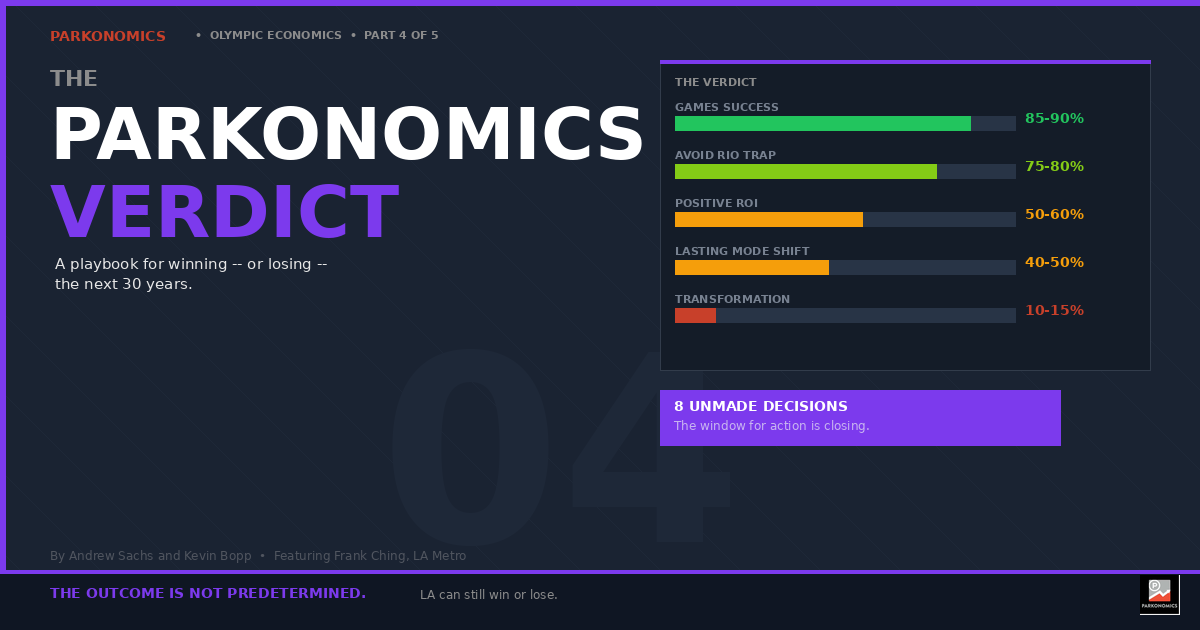
Probability that the Games operate successfully: 85-90%. LA has done this before. The 1984 Games were operationally excellent.
Probability that LA achieves lasting mode shift (+5% or more transit share in Olympic corridors): 40-50%. This requires service levels to be maintained post-Games, which requires decisions that haven’t been made.
Probability that LA achieves “Barcelona-style” regional transformation: 10-15%. LA lacks the conditions that enabled Barcelona: dense urban form, existing transit culture, waterfront transformation opportunity, and political consensus.
Probability that Olympic investments produce positive long-term ROI: 50-60%. This depends heavily on the eight decisions outlined above.
Probability that LA avoids the “Rio trap”: 75-80%. LA’s “no-build” venue philosophy and focus on the Purple Line corridor suggest the region has learned from Olympic failures.
“Visitor from Europe, from Asia, from different part of the world, they’re very adaptive to this lifestyle, this mobility lifestyle. People from East Coast, from New York, from DC, from Boston, very adaptive to this lifestyle. How do you make that contagious to make people in Los Angeles can adapt that and get that mindset?”
Frank Ching, LA Metro
The word “contagious” is inspired. Olympic visitors and volunteers, millions of people already comfortable with transit, become vectors for behavioral change, demonstrating to Angelenos that transit works. If LA can make that demonstration stick, it wins.
The Final Word: An Open Letter to the Powers That Be
To LA Metro’s Board, the Mayor’s Office, the LA28 Organizing Committee, and the voters of Los Angeles County:
You have committed $26 billion to a bet on the future of mobility in Los Angeles. This is the largest transportation investment in the region’s history. The stakes are not the 17 days of Olympic competition. The stakes are the 30 years that follow.
The evidence from Olympic history is clear: cities that use the Games as an instrument for pre-existing plans succeed. Cities that let the Games become the goal fail. Barcelona used the Olympics; Rio was used by them. The difference is not luck, resources, or political will. The difference is discipline: the discipline to ask, before every investment, “Who uses this on a Tuesday in 2035?”
“I think that’s a very strong point. Learn from what not to do also. That’s also another powerful thing… we can leave the legacy behind.”
Frank Ching, LA Metro
LA has made good decisions so far. The Purple Line serves genuine demand. The Regional Connector improves the entire network. The LAX APM closes a gap that should have been closed decades ago. These investments will produce value regardless of how the Olympics unfold.
But LA has also deferred decisions that will determine whether good investments produce lasting transformation. The post-Games service-level question remains unanswered. The bus lane permanence question is unanswered. The park-and-ride conversion question is unanswered. The LAX curb pricing question is unanswered.
The window for these decisions is closing. Every month that passes without answers is a month of uncertainty that undermines planning, investment, and behavior change.
The Olympics are coming whether you’re ready or not. The question is whether, 30 years from now, Angelenos will look back at 2028 as the moment Los Angeles finally became a 21st-century mobility leader, or as another chapter in the endless, Sisyphean story of a region that spent billions to stay exactly the same.
The choice is yours. Make it.
Frequently Asked Questions
What is the Parkonomics verdict on LA’s Olympic transportation strategy?
The outcome is genuinely contingent, not predetermined. Probability of successful Games operations: 85-90%. Probability of lasting mode shift: 40-50%. Probability of Barcelona-style transformation: 10-15%. $19.5 billion in permanent infrastructure passes the “Tuesday 2035” test, but 8 critical decisions remain unmade. The gap between operational success and lasting legacy is where the real stakes lie.
What are the eight decisions that will determine success?
(1) Commit to post-Games service levels. (2) Make bus-only lanes permanent. (3) Price curb access at LAX. (4) Convert park-and-ride sites to transit-oriented development. (5) Establish clear success metrics. (6) Protect Measure M from Olympic cannibalization. (7) Invest in demand management infrastructure. (8) Plan the 2029 assessment now. Three of these are rated “critical”, without them, the bus surge is a billion-dollar expenditure with zero lasting value.
What is the biggest risk to LA’s Olympic transportation legacy?
Post-Games service collapse. The bus surge is explicitly temporary: 2,700 borrowed buses that return to their home agencies after the Games. Without a plan for converting surge capacity into permanent service improvements, this $700M to $1B expenditure produces zero lasting value. The second-highest risk is mode shift reversion: exactly what happened after the 1984 Games, when demand management worked brilliantly for 17 days and then stopped.
How much of LA’s Olympic investment is fully funded?
Only 5.2% of LA Metro’s $3.3 billion Olympic project list was fully funded as of late 2024. The completed projects ($5.9B) and on-track projects ($13.6B) have secured funding, but Olympic-specific enhancements, the bus surge, and temporary infrastructure face funding gaps. The Inglewood Transit Connector collapsed entirely due to funding failure: federal funding stripped, local funding denied.
What are the success metrics LA should track?
Ridership: +15-20% permanent increase over 2027 baseline within 3 years of the Games. Mode shift: +5-10% transit/active transportation share in Olympic corridors. Service reliability: 95%+ on-time performance maintained post-Games. TOD delivery: 10,000 housing units near new stations by 2035. Cost variance: final costs within 50% of current projections (ambitious by Olympic standards).
Sources
Olympic Economics
- Flyvbjerg, B., Budzier, A., & Lunn, D. “Regression to the Tail: Why the Olympics Blow Up.” Environment and Planning A, 2021.
- Zimbalist, A. Circus Maximus: The Economic Gamble Behind Hosting the Olympics. Brookings, 2015.
- Muller, M. “The Mega-Event Syndrome.” Journal of the American Planning Association, 2015.
Mobility Economics
- Duranton, G. & Turner, M.A. “The Fundamental Law of Road Congestion.” American Economic Review, 2011.
- Graham, D.J. “Agglomeration, Productivity and Transport Investment.” JTEP, 2007.
- Chatman, D. & Noland, R. “Transit Service, Physical Agglomeration and Productivity.” Urban Studies, 2014.
LA-Specific
 A
A