The Most Dangerous Words in Urban Planning
“We’re going to be the next Barcelona.”
This phrase has been uttered by Olympic boosters in Athens, Beijing, London, Rio, Sochi, Tokyo, Paris, and now Los Angeles. It is the universal justification for massive public expenditure, the trump card played when economists point out that Olympic investments rarely produce positive returns.
Barcelona 1992 has become urban planning’s equivalent of the moon landing: proof that transformational achievement is possible, invoked to justify every subsequent mission regardless of whether the conditions for success exist.
Here’s the problem: almost no one who cites Barcelona actually understands why it worked.
The standard narrative goes something like this: Barcelona hosted the Olympics, invested in infrastructure, transformed its waterfront, and became a global tourism destination. Therefore, any city that hosts the Olympics and invests in infrastructure will transform itself and become a global tourism destination.
This reasoning commits a logical fallacy so basic it has a Latin name: post hoc ergo propter hoc: “after this, therefore because of this.” The fact that Barcelona succeeded after the Olympics does not mean the Olympics caused Barcelona to succeed.
The real Barcelona story is more complicated, more instructive, and more sobering for LA’s prospects than the simplified version suggests.
What Actually Happened: The Pre-Olympic Foundation
Barcelona’s transformation did not begin with the Olympic bid. It began 16 years earlier.
In 1976, the year Montreal was drowning in Olympic debt, Barcelona’s metropolitan planning authority adopted the Pla General Metropolita, a comprehensive urban development framework that identified the city’s key deficiencies and established a long-term vision for addressing them. The plan called for opening the city to the sea, completing a ring road system, extending the metro, creating new public spaces, and rehabilitating the historic city center.
These were Barcelona’s priorities in 1976. The Olympic bid came in 1986: a full decade later. When Barcelona won the right to host the 1992 Games, the city didn’t need to invent a transformation strategy. It had one. The Olympics became the accelerant for plans that already existed, not the cause of plans being created.
This distinction is crucial. Barcelona’s Mayor Pasqual Maragall stated the philosophy explicitly: “We weren’t organizing the Games, we were using them to change the city.”
Consider the contrast with Rio. When Rio won the 2016 bid, the city scrambled to develop a transportation strategy that could justify the investment. The TransOlimpica corridor was designed for the Olympics, connecting venues rather than serving pre-existing demand. Barcelona’s ring roads, by contrast, had been in the planning documents since 1976. The Olympics didn’t create the need; they accelerated the response.
Maragall’s Coalition
Barcelona’s transformation is often attributed to visionary planning. Less often discussed: the political coalition that made that vision implementable.
Pasqual Maragall was not an autocrat. He was mayor of a city within Spain’s complex federal structure, leading a Socialist administration in a region with strong nationalist sentiment. His authority was constrained. His success depended on building a coalition that could sustain investment across political cycles.
The coalition Maragall assembled included the business community (who saw Olympic success as European commercial positioning), the Catalan regional government (who saw it as a demonstration of Catalan competence), labor unions (who supported the construction jobs), neighborhood associations (who had fought for public space and transit for decades), and the academic and professional community (architects and planners who provided technical legitimacy).
This coalition outlasted Maragall’s tenure. When he left office in 1997, his successors inherited not just infrastructure but a political coalition committed to sustaining it. Investment continued because the stakeholders who benefited remained organized and vocal.
Contrast this with Athens, where no comparable coalition existed. When the financial crisis hit, there was no organized constituency defending Olympic investments. The stadiums decayed because no one fought for their maintenance.
The question for LA: Is anyone building this coalition? Metro has stakeholder outreach. LA28 has sponsor relationships. Environmental groups have advocacy campaigns. But is there a coordinated coalition focused specifically on Olympic transportation legacy: a coalition that will persist beyond 2028 and hold decision-makers accountable for sustained investment?
As of this writing, the answer is no. Part 5 will outline what that coalition could look like and how it could form.
The Numbers Behind the Narrative
Let’s be specific about what Barcelona invested and what it received.
Total public and private investment between 1987 and 1992: approximately €8 billion (adjusted for inflation). The Olympic organizing committee budget was €900 million. Transportation infrastructure included 78km of new ring roads, metro extensions adding 10 stations, and airport terminal expansion. Urban transformation encompassed 5km of waterfront reclaimed from industrial use, 150 hectares of new beaches, and 200 new public spaces.
Compare this with Athens, which built elaborate new venues for sports like kayaking and beach volleyball that Greece had no intention of supporting after the Games ended. Or Sochi, which constructed $8.3 billion worth of transportation infrastructure connecting Olympic venues rather than population centers.
The returns have been extraordinary. Direct economic impact: €7 billion. Wider economic benefits: €18.6 billion (estimated). Tourism grew from 1.7 million visitors in 1990 to 12 million in 2019. Unemployment fell from 18.4% in 1986 to 9.6% in 1992. Hotel rooms grew from 10,000 to 65,000. Barcelona received the Royal Institute of British Architects Gold Medal in 1999: the first time awarded to a city rather than an individual architect.
These numbers are real, and they explain why Barcelona has become the aspirational benchmark. But the numbers alone don’t explain why it worked. For that, we need to understand the specific conditions that enabled success.
The Five Conditions for Barcelona’s Success
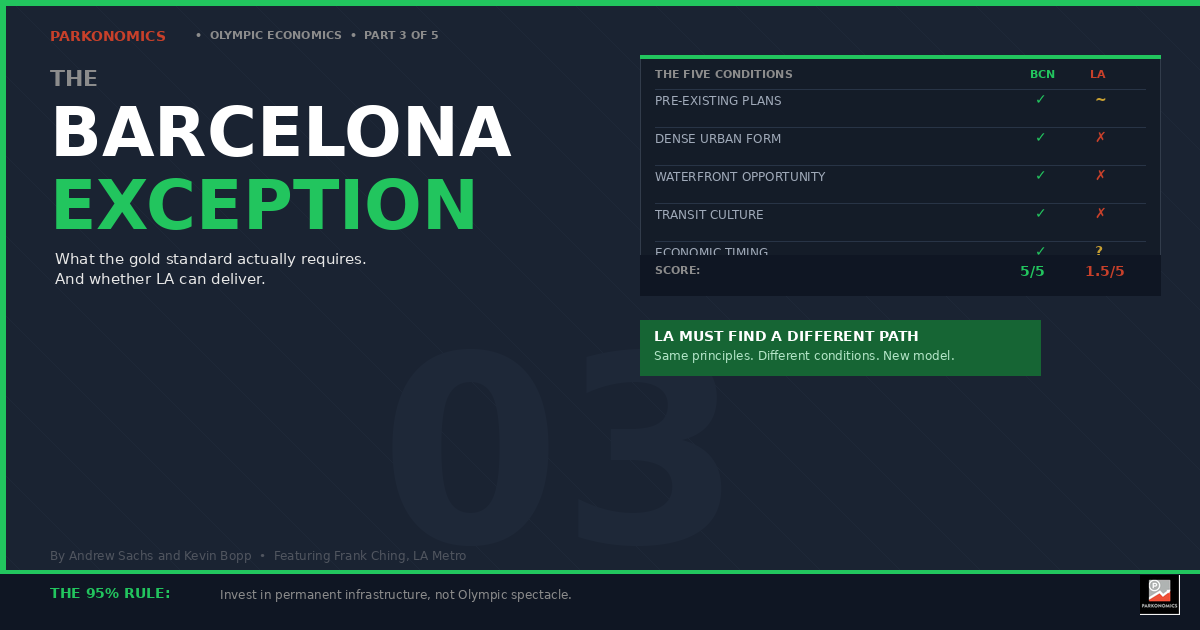
Academic analysis of Barcelona’s Olympic legacy, particularly work by economists like Holger Preuss and urban planners like Manuel de Sola-Morales, identifies five conditions that enabled the city’s transformation. These conditions are not universal. They may not be replicable.[1]
Condition 1: Pre-Existing Plans with Political Consensus
The 1976 Pla General Metropolita was not just a planning document. It represented a political consensus about Barcelona’s future that spanned ideological lines. When the Olympic bid succeeded, there was no debate about what to build, only about how fast to build it.
LA’s Condition: Partial. LA has Measure M, a 40-year funding commitment approved by voters in 2016. This provides political consensus on transit investment in general. But the specific projects in “Twenty-Eight by ’28” were selected partly based on Olympic timelines rather than systematic prioritization.
Condition 2: Dense, Walkable Urban Form
Barcelona is a compact, high-density city built around a 19th-century grid designed explicitly for walkability and public transit. Population density in the central city exceeds 16,000 people per square kilometer.
LA’s Condition: Unfavorable. Greater Los Angeles’s population density is approximately 3,200 people per square kilometer: one-fifth of Barcelona’s. The region’s sprawling, car-oriented development pattern was designed around the automobile.
Condition 3: Waterfront Transformation as Centerpiece
Barcelona’s most visible Olympic achievement was reclaiming 5km of industrial waterfront and converting it to beaches, public space, and mixed-use development. This transformation was visually dramatic: a “before and after” that any visitor could immediately appreciate.
LA’s Condition: Limited. LA doesn’t have a comparable waterfront transformation opportunity. LA’s Olympic transformation must come through network effects and mode shift rather than dramatic place-making.
Condition 4: European Public Transit Culture
Barcelona’s Olympic investments were additive to an existing transit culture. Their metro had operated since 1924; residents were already accustomed to public transportation as a primary mode.
LA’s Condition: Unfavorable. LA Metro ridership is down 21% from its 1985 peak. The region’s car culture is deeply embedded in land use patterns, cultural expectations, and household economics.
Condition 5: Timing and Economic Context
Barcelona hosted the Olympics during an economic expansion, with Spain’s integration into the European Community providing additional tailwinds.
LA’s Condition: Uncertain. The 2028 Games arrive amid economic uncertainty: inflation, interest rates, post-pandemic structural changes. The January 2025 wildfires have created competing demands for construction resources.
The Uncomfortable Truth About Replicability
Let’s count the conditions. Barcelona succeeded with five conditions in its favor. LA enters the Olympics with perhaps one-and-a-half.
This doesn’t mean LA will fail. It means LA cannot succeed by copying Barcelona’s model. The conditions are too different. LA must find a different path to success: one suited to its actual circumstances rather than to an idealized vision borrowed from a European city with fundamentally different urban DNA.
What LA Can Learn From Barcelona
The Barcelona model isn’t entirely inapplicable. The principles that enabled success can translate even when the conditions differ.
Principle 1: Use the Games, Don’t Be Used By Them. This is Barcelona’s central lesson. Frank Ching frames LA’s approach in precisely these terms: “We are leveraging what we have to deliver with new rail lines, with connector with the airport, with new programs, TDM programs, and mobility hubs to change the atmosphere of mobility, mode change, mobility behavior.” The keyword is “leveraging.”
Principle 2: Invest in Permanent Infrastructure Over Spectacle. Barcelona’s 95% allocation to permanent infrastructure is the model. LA’s “no-build” philosophy for venues follows this principle.
Principle 3: Connect Networks, Don’t Create Islands. Barcelona’s ring roads completed a network. LA’s Regional Connector follows this model, it integrates the A, E, and L lines into a unified system.
Principle 4: Maintain What You Build. Athens’s sporting venues decayed while its metro thrived because Greece maintained what it used daily and abandoned what it didn’t. LA must plan now for post-Olympic maintenance of any temporary infrastructure that should become permanent.
The London Lesson: Partial Success Is Possible
If Barcelona is unattainable, London 2012 may offer a more realistic model.
London achieved genuine transformation in a specific geography, the Lower Lea Valley around Stratford, without claiming to transform the entire city. The Olympic Park converted 2.5 square kilometers of contaminated industrial land into a functional new district. Transport for London investments (46% Jubilee Line capacity increase, DLR extensions, eventual Elizabeth Line integration) served the transformation zone while also benefiting the broader network.[4]
London’s results were mixed. The Olympic Park area saw property values increase 71% between 2005 and 2016. But University of Portsmouth research spanning 2001-2022 found the boost was “slight and short-lived” and that the local community was not necessarily the main benefactor due to migration and gentrification.
The London Takeaway: Transformation is possible without Barcelona-level conditions, but it will be geographically concentrated, distributional effects will be uneven, and the results will be contested. LA should not expect uniform regional transformation; it should expect, at best, specific corridors and districts that benefit significantly while others see little change.
The Mobility Hub Innovation: LA’s Potential Barcelona Moment
If LA has one opportunity to create a Barcelona-style transformation without Barcelona’s conditions, it may lie in the mobility hub concept: a distinctly American innovation that Ching and his team have been developing as Metro’s answer to the first/last mile problem.
“Right now we are permanently building five mobility hubs, but we are also looking at a total of 22 mobility hubs throughout our system,” Ching explains. “Mobility Hub is something interesting. Infrastructure construction is only stage one. Stage two is programming. What do you put in the mobility hub? Then the last piece is operating stage three.”
This three-stage framework, infrastructure, programming, operations, represents a maturity of thinking that previous Olympic cities lacked. Barcelona built infrastructure; LA is thinking about the entire ecosystem.
“I have agencies tell me, I’m not gonna name who, mobility hub, parking is a mobility hub, just relabel parking into mobility hub. No, that’s not true,” Ching insists. “Mobility hub actually not only the real estate and asset platform, but also has a digital platform now these days, has a virtual platform.”
The key insight: mobility hubs can create the transit culture that LA lacks by making the experience of not driving more attractive than the experience of driving. Barcelona had an existing transit culture; LA must manufacture it through superior experience design.
Seoul and Tokyo: Alternative Models
Seoul 1988 achieved dramatic transit transformation because South Korea was industrializing rapidly and had centralized political authority to execute large infrastructure programs. The metro expanded from 1 line covering 9.5km to 4 lines covering 115.3km: a 12-fold increase in a decade. Today, Seoul has a 38% transit mode share, compared with 30% for cars, with 65% of 32 million daily trips on public transit.[6]
But Seoul’s conditions were unique: rapid economic growth, strong state capacity, and a city rebuilding after war damage. LA has none of these conditions.
Tokyo 2020 offers a more relevant model. Rather than building major new infrastructure, Tokyo used the Games as a catalyst for comprehensive accessibility improvements. Railcar accessibility reached 71.2%, step-free buses 56.4%, and revisions to the Barrier-Free Act created a lasting legislative legacy.[7] Tokyo’s approach: improve what exists rather than build what’s new. This is closer to what LA might realistically achieve.
The Realistic LA Scenario
Based on the evidence from Barcelona, London, Seoul, and Tokyo, here’s a realistic assessment of what LA can achieve.
Achievable: Completion of key transit corridors (Purple, K, Regional Connector) that will serve genuine demand for decades. Improved network integration. Demonstration during the Games that LA can manage traffic through demand management. Long-lasting mode shift in corridors with good transit service. Enhanced LAX connectivity.
Unlikely: Regionwide transformation of travel behavior. Significant reduction in car dependence across greater LA. Dramatic mode shift in areas without high-quality transit service. Permanent capture of the Olympics-era bus surge capacity.
Unknown: Whether successful Games operations translate to sustained political support. Whether demonstration effects change cultural perceptions of transit. Whether TOD around new stations materializes at projected levels. Whether post-Games service levels can be maintained.
The Critical Variable: What Happens After the Closing Ceremony
Barcelona’s transformation was not complete when the Olympic flame was extinguished. It continued for three decades. The city maintained investment in transit, continued developing the waterfront, and sustained the momentum created by the Games.
LA’s greatest risk is not what happens during the Olympics. The infrastructure will probably be ready. The buses will probably run. The Games will probably be operationally successful: LA already proved this in 1984.
The risk is what happens after. Will the bus surge convert to permanent service improvements, or will borrowed buses go home? Will park-and-ride sites serve lasting demand? Will demonstration effects during the Games translate to sustained ridership growth, or will Angelenos return to their cars the moment the closing ceremony ends?
Barcelona had political leadership committed to sustained transformation. Mayor Maragall continued championing urban investment throughout the 1990s. His successors maintained the vision.
LA’s political environment is fragmented, with competing jurisdictions, limited mayoral authority, and a voter base that has historically been skeptical of transit investment. Measure M provides long-term funding, but funding without sustained political commitment is not sufficient.
The Barcelona exception required not just smart investment but also sustained commitment. That commitment is the variable LA has not yet demonstrated.
Someone needs to convene that coalition. Part 5 will identify who could do it and how.
Frequently Asked Questions
Why is Barcelona considered the gold standard for Olympic transformation?
Barcelona 1992 is the most successful case of using the Olympics to transform a city. The numbers are extraordinary: €900 million in organizing costs generated €18.6 billion in wider economic benefits. Tourism grew 7x (1.7M to 12M visitors). Unemployment fell from 18.4% to 9.6%. The transformation persisted for three decades. But the key distinction is that Barcelona used the Olympics to accelerate a pre-existing urban plan (the 1976 Pla General Metropolita) rather than creating a plan for the Olympics. The city directed 95% of spending to permanent infrastructure, not sporting venues.
What are the five conditions that enabled Barcelona’s success?
(1) Pre-existing plans with political consensus: the 1976 metropolitan plan provided a shared vision. (2) Dense, walkable urban form: 16,000 people per square kilometer. (3) Waterfront transformation opportunity: 5km of industrial waterfront to reclaim. (4) European public transit culture: the metro had operated since 1924. (5) Favorable economic timing: Spain’s EU integration provided tailwinds. LA has perhaps 1.5 of these 5 conditions, which means it cannot replicate Barcelona’s model and must find a different path.
Can LA replicate Barcelona’s success?
Not by copying Barcelona’s model. LA’s population density is one-fifth of Barcelona’s. LA lacks a comparable waterfront transformation opportunity. LA’s car culture is deeply embedded where Barcelona had an existing transit culture. However, the principles that enabled Barcelona’s success, using the Games rather than being used by them, investing in permanent infrastructure over spectacle, connecting networks rather than creating islands, and maintaining what you build, are transferable. LA must apply these principles in a way suited to its actual circumstances.
What is Maragall’s coalition and why does it matter for LA?
Mayor Pasqual Maragall assembled a coalition of business leaders, the Catalan regional government, labor unions, neighborhood associations, and the academic community, all unified around the Olympic transformation vision. This coalition outlasted his tenure, ensuring sustained investment for decades. LA lacks an equivalent coalition focused on Olympic transportation legacy. Metro has stakeholder outreach, LA28 has sponsors, and environmental groups have advocacy campaigns, but no one has convened these groups around the integrated question of what happens after 2028. Part 5 of this series will outline what that coalition could look like.
What are mobility hubs and why are they important for LA’s Olympic strategy?
Mobility hubs are Frank Ching’s three-stage innovation: (1) infrastructure, physical construction of multimodal facilities, (2) programming, determining what services go in (transit connections, micro-mobility, EV charging, ride-share, digital platforms), and (3) operations: sustained service delivery. Metro is building 5 permanent hubs with 22 more planned. The key insight is that mobility hubs can create the transit culture LA lacks by making the experience of not driving more attractive than driving. Barcelona had existing transit culture; LA must manufacture it through superior experience design.
What is the most realistic outcome for LA’s Olympic transportation strategy?
Achievable: completion of key transit corridors (Purple Line, K Line, Regional Connector), improved network integration, successful Games operations, and lasting mode shift in corridors with good service. Unlikely: regionwide transformation of travel behavior, significant car dependence reduction, or permanent capture of bus surge capacity. Unknown: whether demonstration effects change cultural perceptions, whether TOD materializes, and whether political support for transit investment is sustained after the Games end.
Sources
Barcelona
- Marshall, T. “Urban Planning and Governance: Is there a Barcelona Model?” International Planning Studies, 2000. 5(3): 299-319.
- Casellas, A. “Las limitaciones del ‘modelo Barcelona.'” Scripta Nova, 2006. 10(194).
- Preuss, H. The Economics of Staging the Olympics. Edward Elgar, 2004.
London
Seoul/Tokyo
- Seoul Metropolitan Government, “Public Transit Mode Share Analysis” (2023).
- Japan Sports Agency, “Tokyo 2020 Accessibility Legacy Report” (2022).
Cross-Cutting
 A
A