01
The Three-Car Family That Won’t Change
Picture a family in Naperville, Illinois. Dad commutes 50 minutes on I-88 to a job in the Loop in the family’s newer sedan. Mom needs the SUV for school runs and travel soccer tournaments in Wheaton before heading to work. The 17-year-old high-schooler and the 22-year-old, still living at home while finishing her studies at College of DuPage, share the household’s third car, a well-worn Honda Accord. The latter two vehicles are juggled back and forth between mom’s work commitments, on-campus classes, running errands, and everything else teenagers and twentysomethings need a car for.
Four people. Three vehicles. Exposed to roughly $35,000 in annual car ownership costs, more than two hours of combined daily windshield time, and enough stress to fuel a cardiologist’s retirement fund. Without noticing, they have become a small transportation agency: three vehicles, four users, competing schedules, no dispatcher.
And the awkward vehicle sharing doesn’t loosen the family’s commute habits. It hardens them. The 17-year-old waits an extra hour for the Accord rather than take the bus two stops over. And the bus is basically right there, available to lighten to commute load, but still entirely overlooked. The 22-year-old rearranges a class schedule around a sibling’s part-time job shift rather than consider a bike. Scarcity of cars doesn’t produce multimodal thinking. It just produces better logistics around the car.
The conventional planning response to this family is predictable: convince them to take Metra, ride bikes, and consolidate trips. Run an awareness campaign. Maybe a transit subsidy. Perhaps a shaming infographic about carbon footprints, which will be seen by exactly none of them.
Here’s the uncomfortable truth: the folks in this particular household are unlikely to change commute patterns. And that’s okay.
The three-car family in Naperville, or their counterparts in Katy, Texas, or Alpharetta, Georgia, or Scottsdale, Arizona, is not the audience for transformational transportation planning. Their habits are calcified. Their infrastructure is built. Their lives are optimized around the automobile in ways that make “just take the train” laughably impractical.
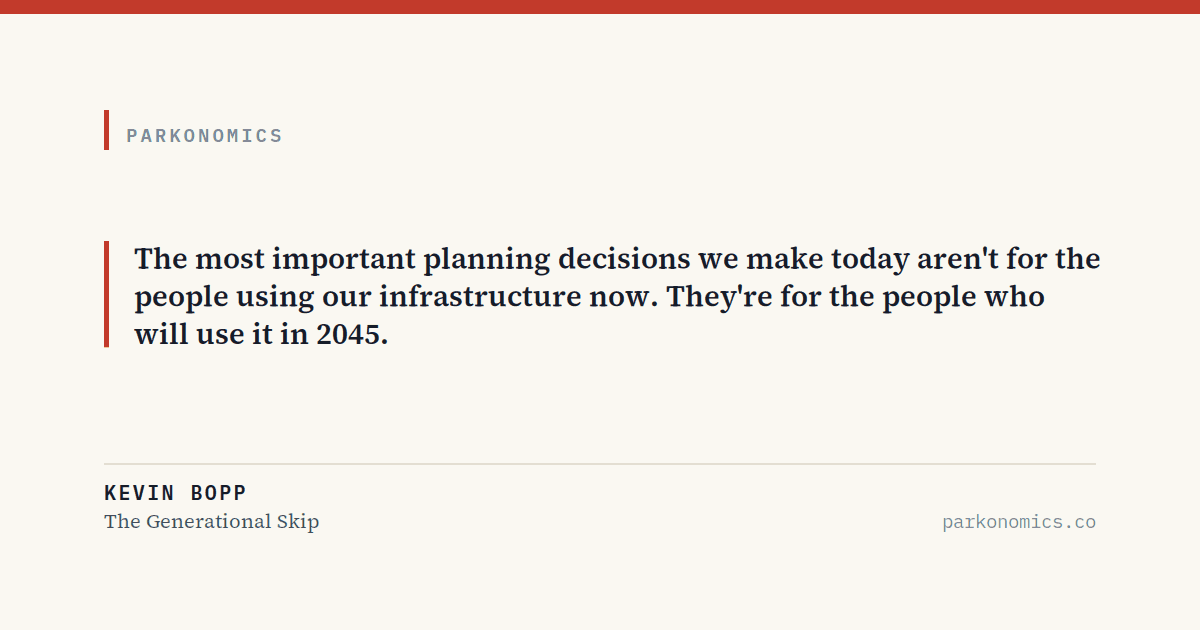
The most important planning decisions we make today aren’t for the people using our infrastructure now. They’re for the people who will use it in 2045.
That doesn’t mean the three-car family is permanently out of reach for transit programs. It means they are not the primary lever, and they won’t be moved by a subsidy check or a clever ad campaign aimed at them directly. If they bend at all, it will be because someone they raised showed them a better way first.
This is the Generational Skip, and it’s among the most important concepts in urban planning that almost nobody is talking about.
One more thing before we go further, since it colors everything that follows. Andrew Sachs, Frank Ching, and I are parking and mobility professionals. Andrew founded Parkonomics and runs Gateway Parking Services; Frank is a transportation planner who has spent decades on mobility systems. Between us, we’ve spent decades building garages, running systems, and consulting on how people actually get around. We don’t think driving is shameful, we don’t think owning a car is some civic failure, and we don’t think parking is the villain of this story. It’s difficult to villainize your own résumé. What we believe, and what grounds this whole article, is narrower:
Healthy, vibrant cities are built around people, not cars. And a city worth living in gives its residents real, practical choices for how they can get to work, school, or a ballgame instead of just one option dressed up as freedom. Everything that follows is a case for choice; it’s not a case against the car.
02
The Cost of What We’ve Built
Before we can talk about building something different, we need to understand the scale of what car dependency costs us.
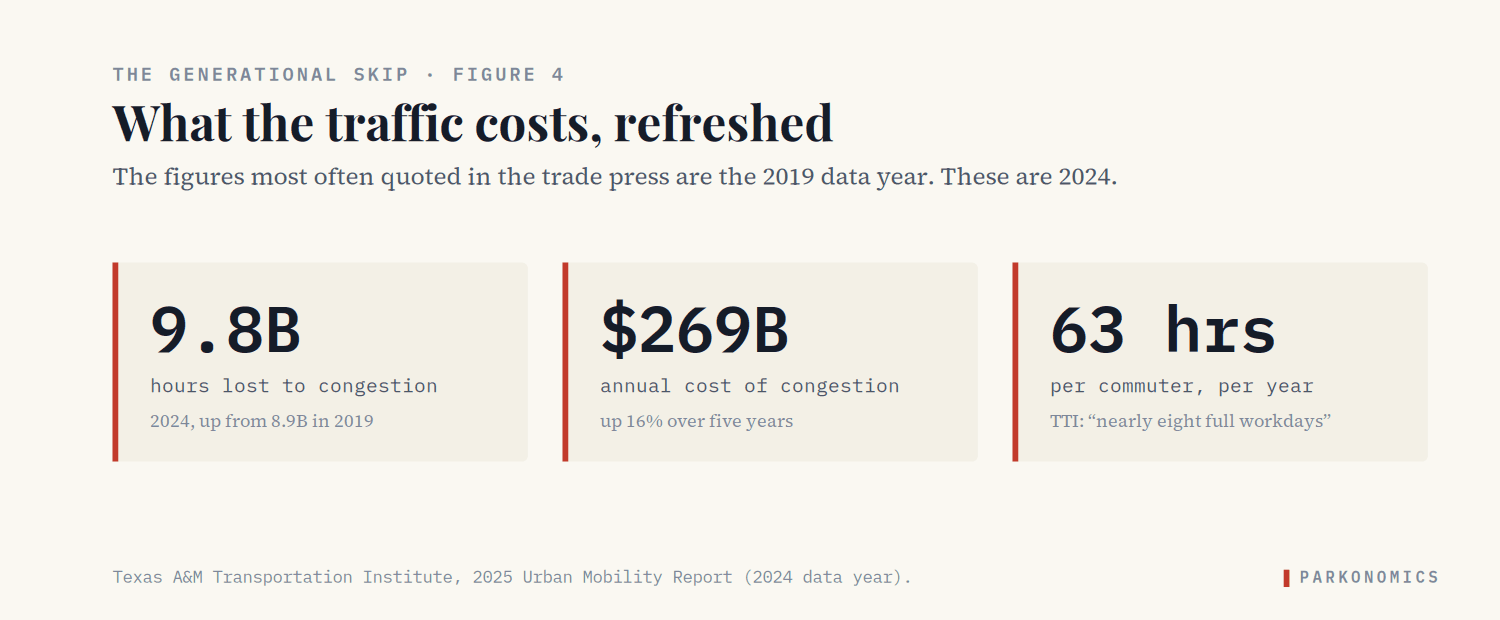
The productivity hemorrhage. According to the Texas A&M Transportation Institute, American commuters lost 9.8 billion hours to traffic congestion in 2024, up from 8.9 billion in 2019. That is nearly five million full-time jobs worth of labor simply evaporating into brake lights and exhaust fumes. The economic cost now runs to $269 billion a year. For the average commuter in Chicago or Atlanta it works out to 87 hours annually, and in Houston 77. Call it two work weeks a year spent going nowhere. Time that could be spent with family, on creative pursuits, or simply not white-knuckling a steering wheel while blood pressure climbs.
The severed community. The interstate highway system didn’t just move cars. It destroyed neighborhoods. The Dan Ryan Expressway carved along the edge of Chicago’s Black Belt, displacing an estimated 12,000 African American residents by the Chicago Urban League’s count and creating a concrete barrier that still defines the city’s racial geography sixty years later. I-45 severed Houston’s Fourth Ward, the Freedmen’s Town settled by formerly enslaved people in 1866, from downtown. Robert Moses’s Cross-Bronx Expressway displaced an estimated 40,000 to 60,000 people and turned thriving communities into urban wastelands.
These weren’t accidents. They were policy choices. And the communities that were severed didn’t just lose mobility. They lost economic connectivity, social cohesion, and generational wealth that has never been recovered.
The land use tax. Here’s a number that should stagger anyone who thinks about urban economics. Metropolitan Phoenix has 12.2 million parking spaces for 4.04 million residents. Three spaces for every person. Four and a third for every registered vehicle. Roughly a tenth of the entire region’s land, given over to storing cars. Roadway alone accounts for about a quarter of the land in America’s urbanized areas, and parking piles another tenth on top of that. Land that produces no tax revenue, houses no families, employs no workers, and generates no economic activity beyond the storage of depreciating metal boxes.
None of that was decided. Since 1960 Phoenix has added 10.9 million parking spaces and 3.41 million people. Three new spaces for every new resident, built one lot at a time, one code requirement at a time, until the region had paved over its own prosperity and called it progress.
These problems didn’t develop overnight. They developed across generations. Children watching parents, teenagers getting licenses as rites of passage, young families buying homes where “good schools” meant “requires two cars.” And these challenges will only be solved across generations with multiple levers implemented and promoted.
The Idea
The Generational Skip
A planning philosophy built on how habits actually form.
03
The Generational Skip Defined
The Generational Skip is a planning philosophy built on a simple insight from behavioral economics: habits formed in early adulthood tend to persist for life.
After age 25 or 30, transportation behaviors become remarkably sticky. The person who bought their first car at 18 and has driven daily for 15 years isn’t going to suddenly start taking the bus. Not because the bus is bad. Not because they’re stubborn or stupid or don’t care about the environment. But because driving has become automatic, a behavior so deeply encoded that it requires no conscious decision-making at all.
Most of us have arrived at work with no memory of the drive. That isn’t a character flaw. It’s the habit doing the driving, which ought to unsettle us more than it does.
This is how habits work. The neural pathways are laid down, the routines are established, and change requires enormous conscious effort sustained over long periods. For most people, that effort simply isn’t worth it when the existing system, however suboptimal, works well enough.
But here’s the flip side: if habits formed in early adulthood persist, then the most leveraged intervention point isn’t the 45-year-old commuter on the Eisenhower Expressway. It’s their 12-year-old who is open to engaging with different commute alternatives.
My colleague Frank Ching, the transportation planner I mentioned at the top, put it to me this way: “Ask young people today, do you want a new iPhone or laptop, or do you want a car? Guess what their answer is.”
For Gen Z and Gen Alpha, the smartphone is the freedom device. It’s the portal to social life, entertainment, commerce, and connection. The car, which for their parents and grandparents represented independence and adulthood, is increasingly seen as an expensive, stressful obligation. Something you might need, but not something you want. This is drastically different from how young people perceived cars for the past 60 years. Getting one’s drivers license was among the most anticipated rites of passage in American life, and it directly correlated to freedom.
This shift in values creates an opening. But openings close. The 16-year-old who sees cars as optional will, by 35, have formed permanent habits one way or another. If we haven’t built the infrastructure for car-free or car-light living by the time they’re making housing decisions and career choices, we’ll have lost them, and we’ll have to wait for the next generation to try again.
Every dollar spent trying to convert a middle-aged suburban commuter might be better spent creating an ecosystem where their grandchildren never need a car in the first place.
That’s not the same as saying the three-car family is unreachable forever. It’s saying the message won’t land coming from an agency. It lands coming from their own kid. As I’ve argued elsewhere, the best marketing for transit doesn’t come from transit. It comes from the people who ride it. Inside a household, that principle gets sharper: a grandchild who takes the train without a second thought makes a more persuasive case for transit than any ad campaign could build, because the trust is already there. The lever on the three-car family isn’t a policy. It’s proximity to someone who already changed.
Do you want a new iPhone or laptop, or do you want a car? Guess what their answer is.
Frank Ching
04
Evidence from the Field
The Generational Skip isn’t theoretical. It’s already happening, in some places by accident, in others by design.
The Decline in Youth Licensure
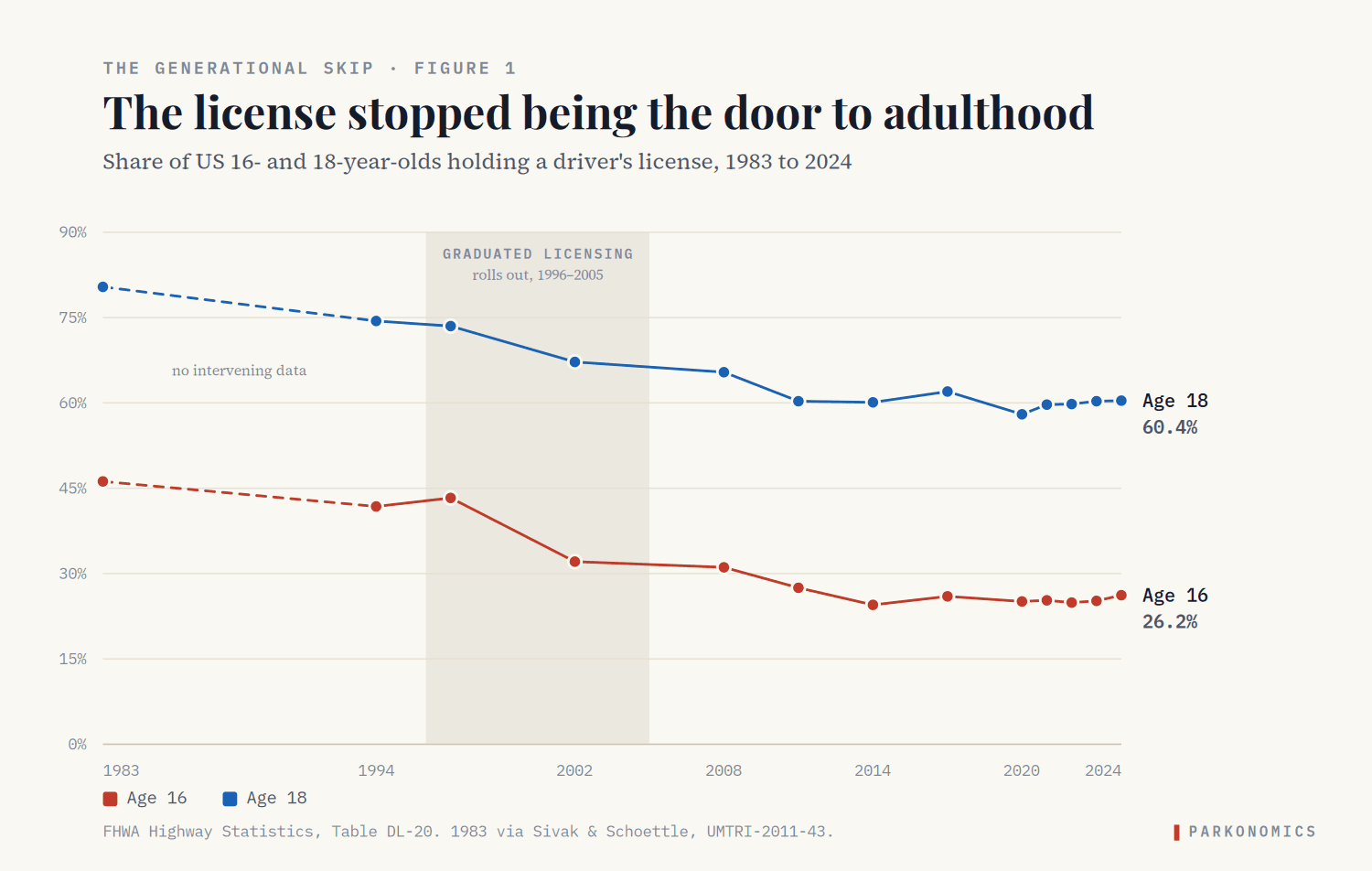
In 1983, 46 percent of 16-year-olds in the United States held a driver’s license. By 2024 the figure was 26 percent. Among 18-year-olds, licensure fell from 80 percent to 60 percent over the same period.
Two honest caveats belong with those numbers. Graduated licensing laws rolled out across the states between roughly 1996 and 2005, and they changed what being licensed at 16 legally means, so some of the steepest part of the decline is regulatory rather than behavioral. And the 16-year-old figure bottomed out around 2014 and has been broadly flat since. The collapse is real. It is not still accelerating.
The other reasons are multiple: the rise of ride-hailing services, increased urbanization among young adults, and, critically, the smartphone. Getting a license used to be the gateway to social life. Now that gateway is in your pocket.
The pattern shows up internationally too, though the youth-specific data is thinner than it is usually made to sound. In Japan, the share of households owning no car rose from 18 percent in 2010 to 26 percent in 2019, and roughly 80 percent of young non-owners still hold a license, which suggests the shift is about wanting a car rather than being able to drive one. In Germany, license holding among the under-30s has edged down while the vehicle fleet skews older, with the sharpest car-free effects concentrated in metro areas rather than spread evenly across the country.
This isn’t a blip. It’s a structural shift in how young people think about mobility.
College Towns as Living Laboratories
Universities have become unintentional laboratories for car-free living. No institution that has restricted student parking has publicly reported losing enrollment over it, though it is worth saying plainly that nobody has studied the question properly. What these campuses report instead is behavioral adaptation and increased social engagement across peers.
At the University of Wisconsin-Madison, undergraduates living on campus are effectively ineligible for a campus parking permit, and they navigate one of the country’s more challenging climates without one, carrying those habits into early careers. Ohio State’s students have had unlimited access to Columbus transit since a 1997 student referendum put a COTA fee on every student account, which is a generation of Columbus residents who know how to use public transportation. Worth noting for a parking audience that OSU did not choose transit instead of parking: in 2012 it leased its entire parking system to QIC for 50 years and $483 million up front, which is a different bet entirely. Georgia Tech sits in Midtown Atlanta, an otherwise car-dominated metropolitan area, with MARTA’s Red and Gold lines at its doorstep, a campus shuttle system, and discounted student transit passes at $50 a month. Students there can and do live without a car in an American city for four years. That experience rewires assumptions about what’s possible.
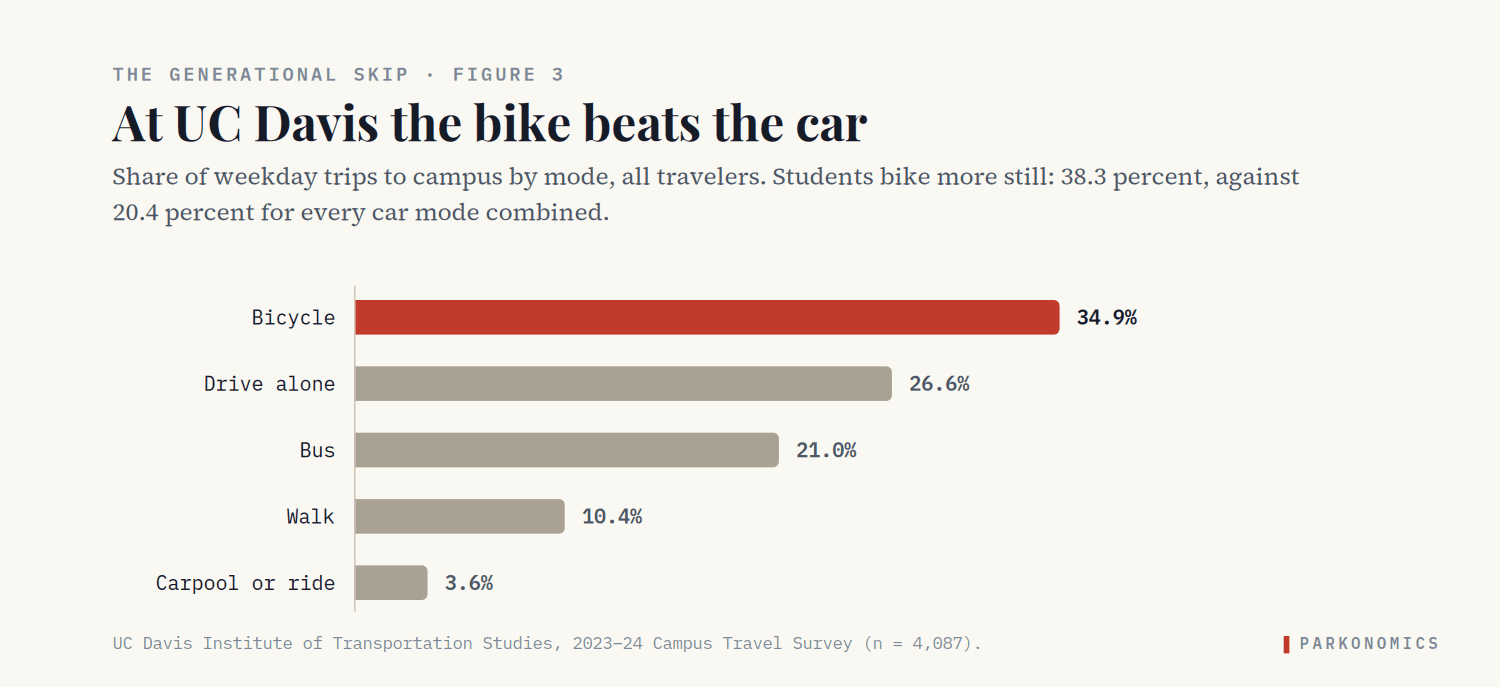
UC Davis has achieved something genuinely remarkable. Bicycles account for 34.9 percent of weekday trips to campus, against 26.6 percent for driving alone and 30.2 percent for all car modes combined. Among students the gap is wider still: 38.3 percent by bike against 20.4 percent by car. Students don’t bike because they’re environmental activists. They bike because the infrastructure makes it the obvious choice, and because parking a bike takes eleven seconds. When they graduate, many continue cycling, not out of principle, but out of habit.
The Micro-Mobility Generation
For users under 30, scooter and bike-share trips are normalized in a way they never will be for their parents. Divvy bikes in Chicago, Capital Bikeshare in Washington, the various dockless scooter services that have colonized Sun Belt downtowns. These aren’t curiosities for young users. They’re just transportation.
The key insight isn’t that young people are more virtuous. It’s that they came of age in an environment where these options existed as normal parts of the urban landscape. Their parents see a Lime scooter and run a rapid internal risk assessment. Their children see one and run a rapid internal math problem.
Habits form around what exists. Build the infrastructure, and the habits follow.
The Playbook
Building the Future Before It Arrives
Five ways to set the default for the commuters of 2045.
05
The Enticing Opportunity Framework
Understanding the Generational Skip is only useful if it translates into actionable planning decisions. Here’s a framework for building the future before the future arrives.
Build the Network Before the Demand
This is the counterintuitive heart of generational planning: if you wait for ridership to justify investment, you’ll never capture the next generation.
The criticisms of “build it and they will come” mentality are well-known and often valid. Plenty of transit lines have been built to nowhere, serving theoretical future development that never materialized. But the Generational Skip reframes the timeline. Building today for users in 2035 is fundamentally different from building today for users in 2025.
Consider Chicago’s Red Line Extension, which broke ground in April 2026 and is projected to reach the Far South Side by 2030. A college freshman moving to Chicago in 2031 will form their mental map of the city around the existence of that line. A young professional choosing between Pullman and Bridgeport will factor in direct L access. The infrastructure shapes the default. Whether it gets finished on that timeline is a separate question; roughly $2 billion in federal funding for the project is currently frozen and in litigation, which is its own argument for why generational planning is hard.
The same logic applies to the CTA’s planned expansion and Metra’s modernization efforts. Every investment that exists before the next generation makes housing and career decisions becomes part of their baseline assumptions about how a city works.
Design for Life Transitions
The most powerful intervention points in transportation behavior are life transitions: the moments when existing routines are disrupted and new habits must form regardless.
These windows include ages 16-18 (first independent mobility decisions), 18-22 (college, first apartments, early careers), and 25-32 (first homes, first children, career establishment). During these periods, people are actively forming new routines rather than maintaining old ones.
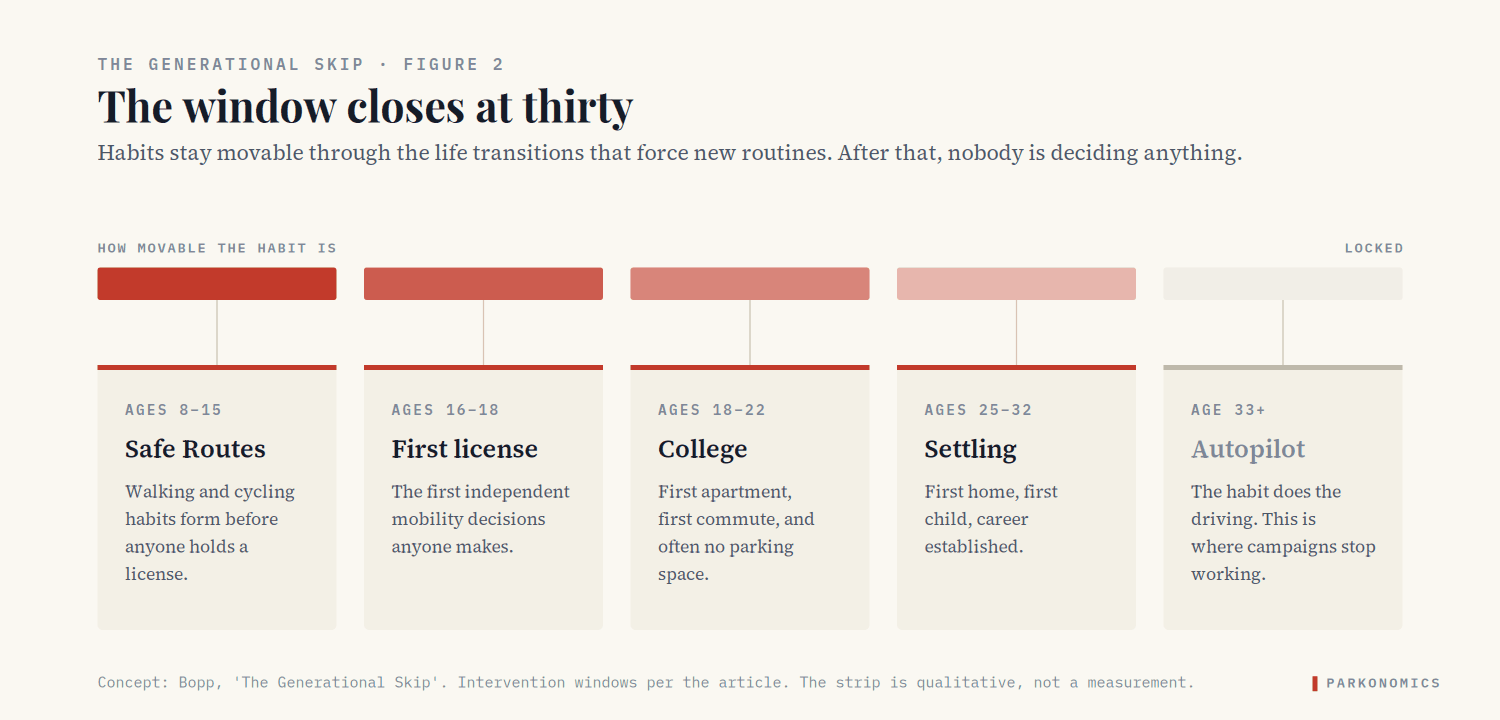
Safe Routes to School programs create cycling and walking habits at age 8 that persist at 28. First-mile and last-mile solutions at universities create transit defaults that carry into careers. These aren’t minor interventions. They’re generational investments.
The “default car” problem is particularly acute at the housing transition. In most American suburbs, from DuPage County outside Chicago to Fort Bend County outside Houston to Cobb County outside Atlanta, the first apartment a young person rents assumes they have a car. The parking space is included. The nearest grocery store is two miles away. The bus stop, if it exists, is a 15-minute walk and runs once an hour.
Change the development patterns, and you change the default.
Make Non-Ownership Economically Rational
The total cost of car ownership is invisible to most American households. Monthly payments are salient, but insurance, maintenance, depreciation, fuel, parking, and registration costs disappear into the general flow of expenses.
AAA puts the average annual cost of owning a new vehicle at $11,577. That is actually down about $700 from the year before, which is worth saying out loud rather than reaching for a bigger number. For a three-car household it still comes to nearly $35,000 a year, more than many families spend on housing. But because these costs are distributed and normalized, they don’t feel like a choice. They feel like a fact of life.
Making car costs visible is a first step. But the more powerful intervention is creating alternatives that are not just cheaper, but genuinely better for certain use cases. Not better in theory. Better in practice. Faster, more convenient, less stressful.
For a generation raised on Spotify and Netflix, the ownership model itself may seem increasingly antiquated. You don’t buy CDs anymore. You subscribe to music. You don’t buy DVDs. You stream. The idea of sinking $30,000 into a depreciating asset that sits parked 95 percent of the time, requires constant maintenance, and can be summoned with an app anyway may simply not compute for people who came of age in the subscription economy. We rent our music, our television, our software, and increasingly our office space. The car is the last thing we insist on buying outright, and it’s the one that loses the most value on the drive home.
Re-read that paragraph and think you about your personal spending habits and those of the people around you. If access to the types of transportation we wanted could reasonably avoid vehicle ownership, how would that change things?
Cultural Infrastructure Matters
It’s not enough to build bike lanes if cycling is coded as “poor” or “dangerous” or “for those people.” Physical infrastructure must be accompanied by cultural infrastructure: the stories, images, and social signals that make non-car transportation aspirational rather than merely acceptable.
Copenhagen and Amsterdam didn’t become cycling cities just because they built bike lanes. They built a culture where cycling was normal, attractive, and high-status. Businesspeople in suits cycle to meetings. Parents transport children by cargo bike. The infrastructure enabled the behavior, but the culture made it desirable.
Chicago’s 606 Trail offers a local example. The elevated trail didn’t just create a transportation corridor. It made cycling cool in neighborhoods where it hadn’t been before. The trail became a social destination, a place to see and be seen, a marker of neighborhood desirability. That’s cultural infrastructure.
Let the Next Generation Do the Convincing
Entrenched habits in the current generation are not entirely immovable. They are just unlikely to move because of anything an agency does directly. They move because of proximity to someone the entrenched commuter already trusts.
Picture the Naperville family again. Dad isn’t going to abandon the sedan for his Loop commute. But when his college-age kid takes the Metra downtown for a Cubs game and reports back that it was faster, cheaper, and there was an open seat the whole way, Dad tries it himself the next time traffic on I-88 backs up past the Eisenhower split. He doesn’t become a transit rider. He becomes a man with an opinion about the Metra, which is further than most campaigns ever get him.
That’s the type of relevant experience that might nudge change for an entrenched adult: not conversion, but the occasional exception, unlocked by someone in their own house who already made the switch look easy. It won’t move regional mode-share numbers on its own. But it does something a planning campaign can’t. It plants proof that the alternative works, from a source the parent already trusts, at a moment when a comparison is unavoidable.
None of this contradicts the core argument. The three-car family still isn’t where the infrastructure dollars should go first. But the softening, when it happens, is worth watching for, and worth designing for, by making sure the next generation’s transit experience is good enough to brag about at the dinner table. That is a higher bar than most agency marketing has ever been asked to clear.
Habits form around what exists. Build the infrastructure, and the habits follow.
Kevin Bopp
06
The Long Game: 2045 and Beyond
What does success look like? Imagine Naperville in 2045.
The grandchildren of today’s three-car family might own one vehicle, for trips to Wisconsin, maybe, or for hauling supplies from Costco. Or they might own none at all. Not because they’re making a sacrifice. Not because they’re ideologically committed to sustainability. But because the alternatives for commuting and navigating daily tasks are simply better for how they live.
The Metra station is a 10-minute bike ride or a 5-minute autonomous shuttle from their home. The downtown has been redesigned around walkability rather than parking. Their children take the bus to school because the bus is convenient, safe, and what their friends do. Car ownership, for this family, is what horse ownership is for us. Something some people do, for specific purposes, but not a baseline requirement for participation in modern life.
The reclaimed land tells part of the story. Parking structures in downtown Houston converted to housing. Surface lots in suburban Phoenix becoming parks and infill development. The strip mall parking deserts of Schaumburg redeveloped into mixed-use neighborhoods where people can live, work, and shop without moving a car. The “land use tax” partially refunded.
The reconnected communities tell another part. The neighborhoods severed by highway construction in the 1960s, from Chicago’s Black Belt to Houston’s Fourth Ward to Miami’s Overtown, reconnected by boulevard conversions and transit investments in the 2030s, thriving economically and socially by the 2050s.
None of this is automatic. None of it is guaranteed. Which raises the accountability question: how do we measure progress on a 25-year strategy when elected officials serve four-year terms and planners are judged on ribbon-cuttings?
Leading indicators exist. Youth licensure rates. Mode share among workers under 30. Housing permits near transit. Bikeshare and scooter trips per capita. These metrics won’t tell you if you’ve succeeded, but they’ll tell you if you’re on track, or if the next generation is being lost to car dependency while you wait for the big projects to complete.
07
The Patience Paradox
The Generational Skip is the hardest sell in planning.
The political challenge is structural. Elected officials serve four-year terms. Generational planning requires 25-year horizons. The politician who breaks ground on a transit project will likely be retired or dead by the time its success or failure becomes clear. This is a difficult thing to put in a campaign brochure. The incentives favor ribbon-cuttings over outcomes, announcements over accountability.
The professional challenge is similar. Planners are judged on projects completed, not on the transportation habits of children who haven’t yet been born. The metrics that matter for career advancement, grants won, projects delivered, budgets managed, are almost entirely disconnected from the metrics that matter for generational change.
And yet.
The decisions we make today will determine whether our grandchildren inherit functional cities or paved-over parking lots masquerading as communities. Whether they spend their hours in traffic or in productive activity. Whether the neighborhoods destroyed by highway construction are reconnected or remain severed. Whether the land use tax continues to compound or begins to be refunded.
The three-car family in Naperville won’t lead this change, and neither will their counterparts in Sugar Land or Marietta or Scottsdale. Decades of policy, infrastructure, and cultural messaging have made the automobile not just their transportation mode but their way of life, and no subsidy check or awareness campaign aimed at them directly will undo that. To expect a policy lever to convert them outright is to misunderstand how habits work and how deeply car dependency has been engineered into American existence. But habits aren’t quite as impervious to a trusted messenger already living under their roof. The push, if it comes, won’t come from an agency. It will come from the kid who took the train and can’t stop talking about it.
But their grandchildren are watching. They’re forming their first impressions of what a city is, what transportation means, what freedom looks like. They haven’t yet decided that a car is a requirement for adulthood. They haven’t yet internalized the assumption that mobility means a steering wheel and a monthly payment.
What are we building for them?
By the Numbers
- 46% → 26%: Share of 16-year-olds with driver’s licenses, 1983 to 2024
- 80% → 60%: Share of 18-year-olds with driver’s licenses, 1983 to 2024
- 9.8 billion: Hours lost to traffic congestion in the U.S., 2024
- $269 billion: Annual economic cost of congestion, 2024
- 3: Parking spaces per resident in metropolitan Phoenix
- $11,577: Average annual cost of owning a single new vehicle, 2025
- ~25%: Share of land in America’s urbanized areas given to roadway alone, before parking
The 25-Year Test
Before approving any major transportation investment, ask: Who will use this in 2050?
If the answer is “the same people using it today,” reconsider the investment.
If the answer is “people who haven’t yet formed their transportation habits,” you may be building something transformational.
Sources
Texas A&M Transportation Institute. 2025 Urban Mobility Report (2024 data year). https://mobility.tamu.edu/umr/
Federal Highway Administration. Highway Statistics, Table DL-20, 1994-2024. https://www.fhwa.dot.gov/policyinformation/statistics/2024/dl20.cfm
Sivak, M. & Schoettle, B. (2011). Recent Changes in the Age Composition of Drivers in 15 Countries. University of Michigan Transportation Research Institute, UMTRI-2011-43. (Source for the 1983 licensure figures.)
AAA. Your Driving Costs, 2025 Edition (September 2025). https://newsroom.aaa.com/
Hoehne, C.G., Chester, M.V., Fraser, A.M. & King, D.A. (2019). “Valley of the sun-drenched parking space: The growth, extent, and implications of parking infrastructure in Phoenix.” Cities 89, 186-198. https://doi.org/10.1016/j.cities.2019.02.007
Guerra, E., Duranton, G. & Ma, X. (2024). “Urban Roadway in America: The Amount, Extent, and Value.” Journal of the American Planning Association. https://doi.org/10.1080/01944363.2024.2368260
Shoup, D. (2011). The High Cost of Free Parking, revised edition. APA Planners Press. (Source for vehicles being parked roughly 95 percent of the time.)
UC Davis Institute of Transportation Studies (2024). Results of the 2023-24 Campus Travel Survey. https://rosap.ntl.bts.gov/view/dot/83829/dot_83829_DS1.pdf
Baker Institute for Public Policy, Rice University. Houston’s Freeways: Who Was Displaced and Why? https://www.bakerinstitute.org/
Caro, R.A. (1974). The Power Broker: Robert Moses and the Fall of New York. Knopf. (Source for Cross-Bronx Expressway displacement.)
Chicago Transit Authority. Red Line Extension Project. https://www.transitchicago.com/rle/
Japan Automobile Manufacturers Association. Passenger Car Market Trends Survey, FY2023. https://www.jama.or.jp/
infas / DLR for the German Federal Ministry of Transport. Mobilität in Deutschland, MiD 2023.
Ohio State University. Parking Lease and COTA Fees. https://ap.osu.edu/parking and https://registrar.osu.edu/
Trust for Public Land / Chicago Park District. The 606.
Kevin Bopp is a co-founder of Parkonomics and [TITLE] at [FIRM], a full-service parking management and mobility consulting firm. He has spent two decades at the intersection of parking, transit, and real estate development, including the first commercial deployment of independent autonomous vehicles on public streets in an American urban core, the first U.S. demonstration of an infrastructure-based automated valet parking system, and an employee commute program recognized by the World Economic Forum in 2019. This article expands on concepts introduced in the Parkonomics series on LA’s Olympic transportation strategy and “Nobody Cares About Your Bus Lane,” available at parkonomics.co.
[EDITOR TO KEVIN: the two bracketed fields above need your current title and firm. Everything else in this bio is verified.]
 K
K