
Investigation • Urban Mobility • Airport Economics
The $30 Billion Insult: LAX Is Spending Billions to Fix the Wrong Problem
How a “Parkonomics” strategy — charging for access, not just parking — is the only way to activate LA’s new multi-billion-dollar mobility hubs, save LAWA’s budget, and prevent a global embarrassment at the 2028 Olympics.
Key Takeaways
- LAX’s gridlock is not an engineering problem — it is an economics problem. LAWA gives away its most scarce, valuable resource (terminal curb space) for free, creating a textbook tragedy of the commons.
- LAWA is spending $1.5–1.9 billion on new flyovers and ramps that will induce more traffic into the same unpriced, chaotic terminal curbs. This is a 20th-century solution to a 21st-century problem.
- LA has already built a $5.5 billion solution — the LAMP system and Automated People Mover — that is physically capable of solving the problem. It is a sleeping giant that policy has failed to activate.
- A three-tier “Parkonomics 2.0” access pricing model — free at mobility hubs, premium at the terminal curb — would instantly eliminate looping and curb-squatting behavior without punishing anyone.
- Dallas/Fort Worth, London Heathrow, JFK, and Newark all already charge for terminal curb access. The claim that “no US airport does this” is false.
- The 2028 Olympics are a forcing function: LA has a non-negotiable deadline to solve this before the world’s cameras arrive. The window to act is closing.
Table of Contents
The Horseshoe of Insanity
We have all felt it. It’s an existential dread unique to Los Angeles, a slow-motion paralysis that begins the moment you exit the 405. It’s the Los Angeles Airport (LAX) Central Terminal Area (CTA) — a 1.5-mile, U-shaped purgatory known simply as “the horseshoe.” It’s the “kiss-and-fly” drop-off that turns into a 45-minute hostage situation. It’s the “quick” pickup that becomes an hour-long odyssey of looping the terminals, your eyes darting between the gridlocked traffic and the texts from your passenger, who is now, somehow, at a different terminal.[1] It’s the packed, meandering LAX-it shuttle, a “solution” so loathed it has become the “bane of travelers’ existence.”
This daily chaos is the shared pain of millions. And here is the $30 billion insult: Los Angeles World Airports (LAWA) is in the midst of the largest public works project in the city’s history, and its flagship “solution” for traffic is destined to fail.[3]
The problem is not a lack of roads. The problem is a lack of pricing.
The gridlock at LAX highlights a fundamental economic failure — a classic “tragedy of the commons” from the 1950s unfolding in real time. LAWA is giving away its most scarce, valuable, and congested resource — terminal curb space — for free. Because it’s free, it is overused to the point of breakdown. In response, LAWA is spending between $1.5 billion and $1.9 billion on a network of new flyovers and ramps to “manage” this traffic.[4] This is the great misdirection.
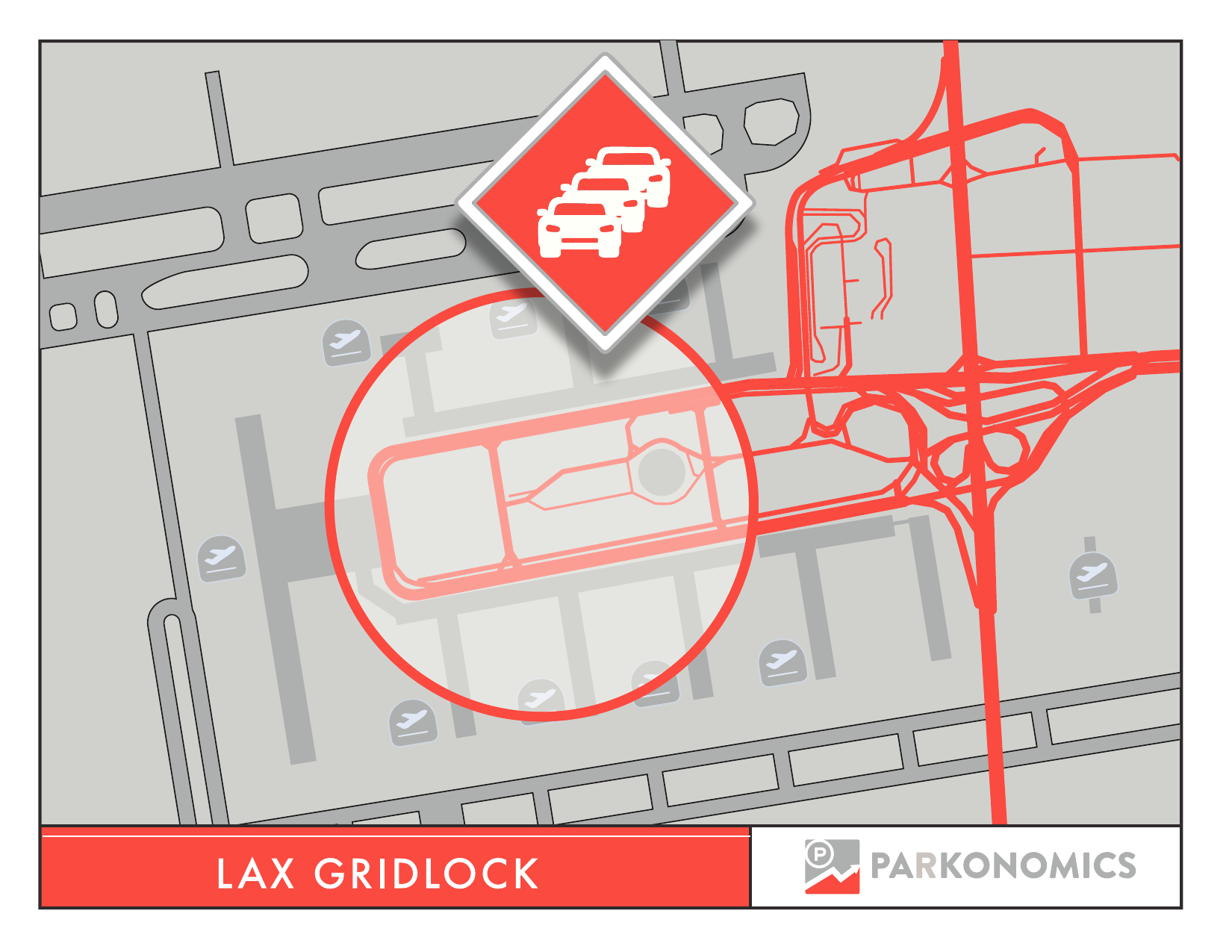
The CTA Horseshoe — where billions of dollars in vehicles go to circle endlessly, for free
The $1.9 Billion Miscalculation
If you’ve driven near LAX recently, you’ve seen the monolithic concrete pillars rising from the earth. This is the Airfield and Terminal Modernization Program (ATMP), a $1.5 to $1.9 billion project to build 4.4 miles of new elevated roadways, bridges, and flyovers.[8] The stated goal is to “better manage traffic” by separating airport-bound vehicles from the local traffic perpetually choking Sepulveda Boulevard.[9]
This is the 21st-century equivalent of widening the 405 Freeway — and it will have the same result. It is a textbook case of induced demand. A growing chorus of residents, transportation advocates, and experts has been screaming this from the sidelines, telling commissioners directly that the project “won’t work.”[5] These new flyovers are just a more efficient, multi-billion-dollar vehicular funnel. They will dump more cars, more quickly, into the same saturated, unpriced, and chaotic terminal curbs.
The gridlock isn’t a mysterious force of nature. It is the direct, predictable result of two human behaviors — both perfectly rational responses to a flawed economic system:
Looping — endless, zero-cost circling of drivers waiting for a passenger. You’re 15 minutes early, so you enter the horseshoe and just keep driving, sometimes for an hour, because it costs you nothing.
Curb-Squatting — TNCs, limos, and private cars idling at the curb, creating a wall of vehicles that blocks all flow. They do it because the risk of a ticket is low and the cost of idling is zero.
These are not bad drivers. They are rational economic actors responding to a flawed system. When a resource is free, it is overused to the point of collapse.
The Sleeping Giant: LA’s $5.5 Billion “Unactivated” Solution
Here is the exquisite irony: while LAWA’s left hand is building a road to nowhere, its right hand has already built a masterpiece. The Landside Access Modernization Program (LAMP) is not just a train; it is a fully integrated, state-of-the-art central piece of a mobility hub specifically designed to move the vast majority of pick-ups and drop-offs out of the Central Terminal Area.[7]
Its spine is the Automated People Mover (APM) — a 2.25-mile, fully-electric elevated train with six stations, running 24/7, with trains every two minutes, capable of moving 10,000 passengers per hour.[20] This spine connects to purpose-built hubs: the ITF-East as the new “front door” for private traffic connecting to the regional rail system; the ITF-West as the permanent, high-tech hub for TNCs and taxis;[23] and the ConRAC Facility, expected to eliminate more than 3,200 daily shuttle bus trips from the airport loop alone.[24]
However, LAWA has developed a $5.5 billion solution that, as it currently stands, relies on little more than hope to activate. The new infrastructure enables the solution, but it doesn’t incentivize it. It is a $5.5 billion “on” switch that no one has a mandate to flip.
The Parkonomics 2.0 Solution: The Brain for the $30 Billion Body
Our “Parkonomics” model is the economic brain that instantly activates the new infrastructure. It’s a non-punitive, 3-tiered system that gives passengers clear, rational choices — and gives politically risk-averse officials the cover they need to flip the $5.5 billion switch.
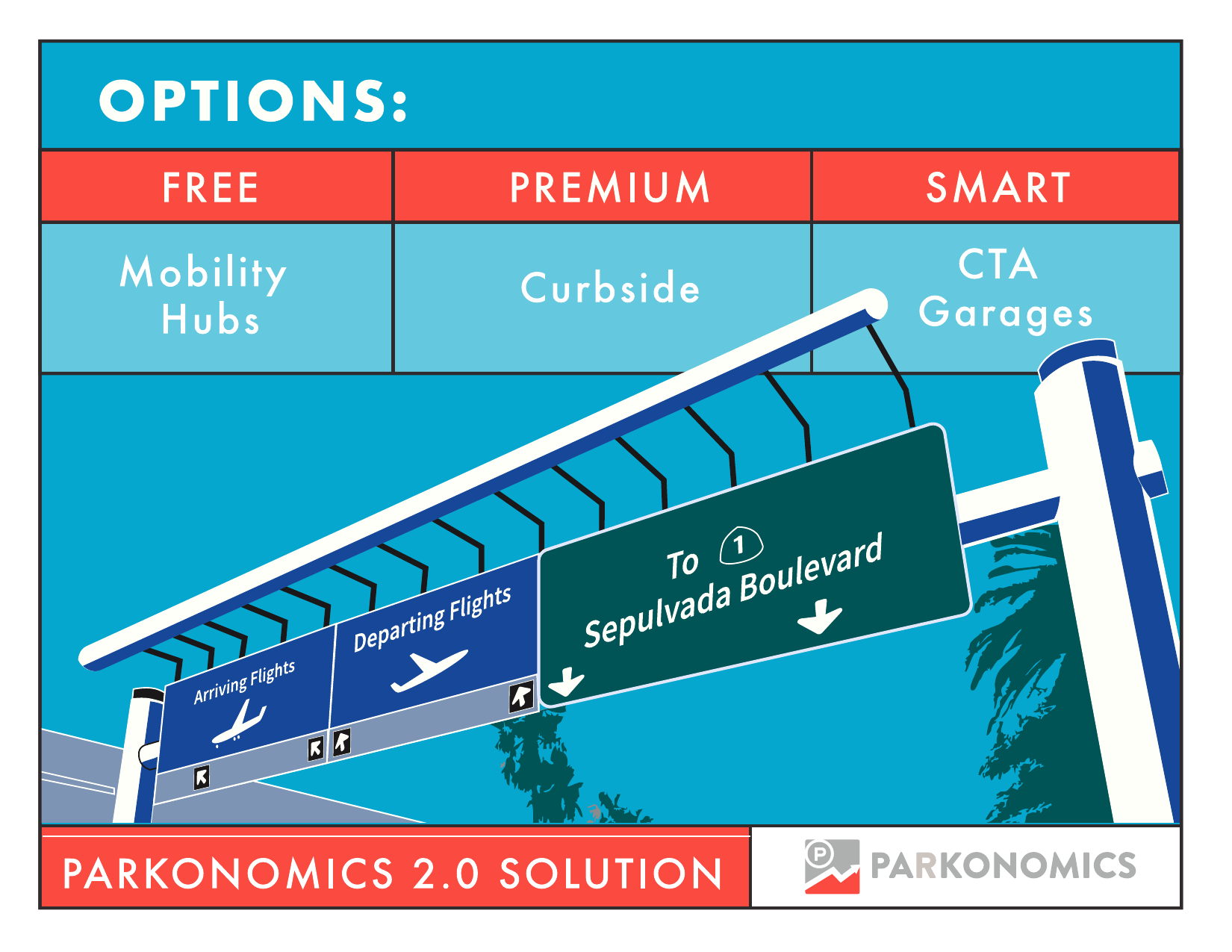
Parkonomics 2.0: The 3-tier access model that activates the $5.5B LAMP investment
This pricing model is a finely tuned machine for eliminating inefficient behavior. Looping is instantly killed — why would any rational person circle for 45 minutes and pay $15 when they can wait at the free cell phone lot or park in the garage for less? Curb-Squatting is instantly killed — the TNC driver now faces an escalating $5 penalty for every 15 minutes they idle at the curb. The garages become “waiting rooms,” moving thousands of stationary vehicles from flow lanes into storage and clearing the horseshoe for its only intended purpose: active loading and unloading.
Debunking the Excuses of the Unimaginative
Critics will warn of logistical nightmares, regulatory hurdles, and unprecedented complexity. We reject that cynicism. The technology required — Automatic Number Plate Recognition (ANPR/LPR) — is not novel.[33] It is the same technology already operational in California’s Express Toll Lanes in Orange County and the HOT lanes in San Diego.[35]
The claim that “no other US airport does this” is demonstrably false. The primary precedent is Dallas/Fort Worth (DFW) — a massive hub in a car-loving state — which already charges all vehicles for terminal access.[39] London Heathrow implemented a Terminal Drop-Off Charge for the explicit purpose of reducing congestion. New York’s JFK and Newark already charge TNCs Airport Access Fees of $1.75–$2.50 per trip.[42]
| Airport | Model | Fee Structure | Free Alternative |
|---|---|---|---|
| DFW | Time-based curb access | $2.00 for 8–30 min on-premises | Yes |
| LHR (Heathrow) | Terminal drop-off charge | Per-visit fee, rising annually | Yes |
| JFK / EWR | TNC access fee | $1.75–$2.50 per TNC trip | Yes |
| LAX (proposed) | Universal curb access fee | $5 entry + $5/15 min; $0 at hubs | Yes — Free APM |
| LAX (current) | None | $0.00 — free-for-all | No policy |
The final hurdle is political. “Congestion pricing” is a politically toxic phrase. So don’t call it that. Call it a “Premium Access Fee” or a “Curbside Convenience Surcharge.” The new, high-quality standard must be the free APM and ITF system. Academic research shows that while initial opposition to such systems is common, majority support often emerges once the public experiences the practical benefits.
The $100 Million Motive and the Olympic Forcing Function
This policy isn’t just about traffic. It’s about financial survival. LAWA is a self-funding enterprise, and historically, its “cash cow” has been parking — contributing approximately $108 million to $125.6 million annually in Calendar Year 2019.[48] That massive, reliable revenue stream is under direct threat from the rise of TNCs, which have cannibalized traditional parking and rental car revenue.
Under normal circumstances, a policy like this would suffer a death by a thousand cuts in committee. But Los Angeles has a unique, one-time, non-negotiable deadline: the 2028 Summer Olympic and Paralympic Games. The Olympics are what is known in policy as a “date certain event.” This event, which is expected to attract 10–15 million ticketed spectators and the world’s media to Los Angeles, is a powerful forcing function. The imperative to “be ready for the Olympics” provides the political justification to bypass business as usual. The current gridlock is not just an inconvenience — it will be a global humiliation.
Will LA seize this window — or risk global embarrassment on live television, broadcast to billions?
The Courage to Be Rational
The infamous gridlock at LAX is an economic problem, not just an engineering one. The current approach is trying to solve a market failure with more concrete, which is the definition of insanity. For years, bureaucratic inertia has been the enemy of common sense. In 2020, the Los Angeles City Council passed a motion to study incentives for transit use. LAWA reportedly “verbally rejected” it.[36] Their excuse? There was “no direct transit access to the airport making it hard to verify” who should get an incentive.
That excuse is now officially, and expensively, obsolete.
The entire $5.5 billion LAMP is a massive, physical verification system. The APM, with its dedicated stations for private cars (ITF-East) and TNCs (ITF-West), is the verification system. LAWA’s own planners designed the infrastructure to support this precise policy. But the infrastructure is a body without a brain. The “Parkonomics” access fee is the brain.
The solution is not theoretical. It is proven, precedented, and technologically feasible. The technology exists. The precedent is set. The financial need is urgent. The 2028 Olympics provide a non-negotiable deadline and the necessary political will. The time for studies, delays, and half-measures is over. It’s time to activate the system we’ve already built — and give Angelenos the world-class, gridlock-free airport they have paid for.
Frequently Asked Questions
The “horseshoe” refers to the 1.5-mile U-shaped roadway in LAX’s Central Terminal Area (CTA), designed in the late 1950s for a fraction of today’s passenger volume. It is the primary pick-up and drop-off zone for all terminals. Because access to the curb is completely free and enforcement of idling is minimal, the roadway is chronically overused. Drivers loop the horseshoe for up to an hour waiting for passengers (because it costs nothing), and TNCs and private vehicles idle at the curb indefinitely (because there is no financial penalty for doing so). This is a textbook tragedy of the commons: a scarce resource priced at zero is consumed to the point of collapse.
The Landside Access Modernization Program (LAMP) is a $5.5 billion infrastructure investment that includes the Automated People Mover (APM) — a 2.25-mile elevated electric train with six stations — as well as the ITF-East and ITF-West mobility hubs for private vehicles and TNCs respectively, and the ConRAC consolidated rental car facility. The LAMP physically separates different user groups and provides a high-quality, free alternative to the terminal curb. The problem is that while the infrastructure enables better behavior, it doesn’t incentivize it. Without a financial cost to using the terminal curb, millions of Angelenos trained by car-centric culture will continue to choose the “one-seat” curbside ride over the multi-step APM process. The infrastructure is a body without a brain — the Parkonomics pricing model is the brain.
The Parkonomics model is specifically designed to be non-punitive by providing a genuinely high-quality, zero-cost alternative. No one is forced to pay — the free APM from the ITF hubs provides a time-guaranteed, comfortable journey to every terminal. The fee applies only to those who choose the premium service: direct curbside access. This is the same logic as charging for express lanes while keeping regular lanes free, or charging for checked baggage while carry-on remains free. Moreover, the system is more equitable than the current arrangement: right now, the curb is “free” for wealthy private car users and business travelers while everyone else waits in buses and shuttles. The Parkonomics model prices the premium correctly and uses the proceeds to fund the infrastructure that serves everyone.
Yes. Dallas/Fort Worth International Airport (DFW) — a major hub in a deeply car-centric state — already charges all vehicles for terminal access using a time-based model. JFK and Newark charge TNCs airport access fees of $1.75–$2.50 per trip. London Heathrow implemented a Terminal Drop-Off Charge specifically to reduce congestion and incentivize its free public transit alternative. The claim that “no US airport does this” is false, and the international precedent makes the policy even more defensible. LAX’s version would simply be more comprehensive and more equitable, applying to all vehicle types rather than targeting TNCs exclusively.
The Olympics function as what policy analysts call a “date certain event” — a fixed, immovable deadline that compels action on decisions that would otherwise languish indefinitely. LA’s LAX gridlock problem has been studied, debated, and deferred for decades. The 2028 Games, which are expected to bring 10–15 million ticketed spectators and the world’s media to Los Angeles, create an unavoidable forcing function: the current gridlock will be a global embarrassment broadcast live to billions of viewers. That political reality gives LAWA officials the cover to implement pricing that would otherwise face the death of a thousand objections. The window to implement, test, and refine the system before the Games is already narrow. Every month of delay shortens it further.
Sources
- Reddit/r/LosAngeles — “The worst airport I’ve ever been to”
- Reddit/r/transit — LAX People Mover begins testing
- LAist — LAX People Mover delay, grand jury report
- GHNNC — LAX votes to build new $1.5 billion road ahead of 2028 Olympics
- Urbanize LA — Vehicular access at LAX set for major shakeup
- MyNewsLA — LAWA board OKs $1B for LAX road expansion
- California Transportation Commission — LAMP presentation, May 2024
- MyNewsLA — LAWA board OKs $1B for LAX road expansion
- MyNewsLA — LAWA board OKs $1B for LAX road expansion
- MyNewsLA — LAWA board OKs $1B for LAX road expansion
- GHNNC — LAX votes to build new $1.5 billion road
- GHNNC — LAX votes to build new $1.5 billion road
- GHNNC — LAX votes to build new $1.5 billion road
- UCLA Arrowhead Symposium — Airport access proceedings, 2004
- Urbanize LA — Vehicular access at LAX set for major shakeup
- Reddit/r/LAMetro — Congestion pricing at LAX Airport
- Urbanize LA — Here’s a look at LAX’s new ground transportation hubs
- Urbanize LA — Here’s a look at LAX’s new ground transportation hubs
- Urbanize LA — LAX new ground transportation hubs / APM
- Wikipedia — LAX Automated People Mover
- FDCorp — LAX Automated People Mover project
- Metro Magazine — LA Metro unveils LAX Transit Center
- Wikipedia — LAX Automated People Mover (ITF-West)
- Wikipedia — LAX Automated People Mover (ConRAC)
- Reddit/r/LAMetro — How much will the LAX Metro Transit Center change things?
- AscendInMotion — Can I pick up at LAX for free?
- California Transportation Commission — LAMP presentation
- Urbanize LA — LAX new ground transportation hubs
- FDCorp — LAX Automated People Mover
- NerdWallet — LAX airport parking guide
- Urbanize LA — Vehicular access at LAX set for major shakeup
- Urbanize LA — LAX new ground transportation hubs
- Wikipedia — Automatic Number Plate Recognition (ANPR)
- JES Publication — ANPR System research
- FHWA — Congestion pricing examples in the US
- LA City Clerk — 2020 motion on LAX transit incentives
- Urbanize LA — Vehicular access at LAX
- Urbanize LA — Vehicular access at LAX
- DFW Airport — Parking rate adjustments
- RAC — Drop-off fees soar at UK airports
- Iowa State InTrans — Airport drop-off and pickup charges
- Newark Airport — Taxi, car, and van service fees
- DWU Consulting — DOT LAX ruling on airport fees
- DWU Consulting — DOT LAX ruling
- Governing — Congestion pricing in Los Angeles and New York
- UCLA Luskin — Taylor on public opposition to congestion pricing
- LA City Clerk — 2020 resolution on LAX
- LAWA — FY2023 Annual Financial Report
- BlackCarNews — Airport access fees at JFK, LGA, Newark
- LAist — LAX People Mover delay
- California Transportation Commission — LAMP presentation
- California Transportation Commission — LAMP presentation
- California Transportation Commission — LAMP presentation
- MyNewsLA — LAWA board OKs $1B for LAX road expansion
- California Transportation Commission — LAMP presentation
- LA Metro — 2028 Games transportation planning
- Reddit/r/LAMetro — LAX officials vote unanimously to build new road
- Reddit/r/LAMetro — LAX officials vote unanimously to build new road
- Urbanize LA — LAX new ground transportation hubs
- Wikipedia — LAX Automated People Mover
- FHWA — Congestion pricing examples in the US
- DFW Airport — Parking rate adjustments / global precedents comparison
- LA City Clerk — 2020 resolution on LAX parking facility
- California Transportation Commission — LAMP presentation