The Audit: Starting With What You Have
Whereas new construction offers a blank canvas for future-proof design, the vast majority of our parking inventory consists of existing facilities. Retrofitting these structures for the future presents unique challenges, yet they are far from insurmountable. The key lies in a strategic, phased approach that shrewdly prioritizes the most impactful upgrades — ensuring relevance without reinvention.
The crucial first step is a thorough audit of the existing infrastructure. Is the electrical system robust enough for substantial EV charging expansion? Is the conduit ample for cutting-edge data cabling? Is there enough clear space to implement license plate recognition (LPR) technology? A detailed facility assessment illuminates critical limitations and informs a savvy capital improvement plan.
The audit discipline that matters most is sequencing by dependency. A facility with insufficient electrical service at the panel level cannot scale EV charging regardless of how many chargers it procures or how much it spends on installation. A facility with inadequate conduit cannot expand its data infrastructure affordably. These foundational constraints must be resolved before operational technology investments are made — not in parallel with them, and certainly not after.
A Phased Approach to Upgrading
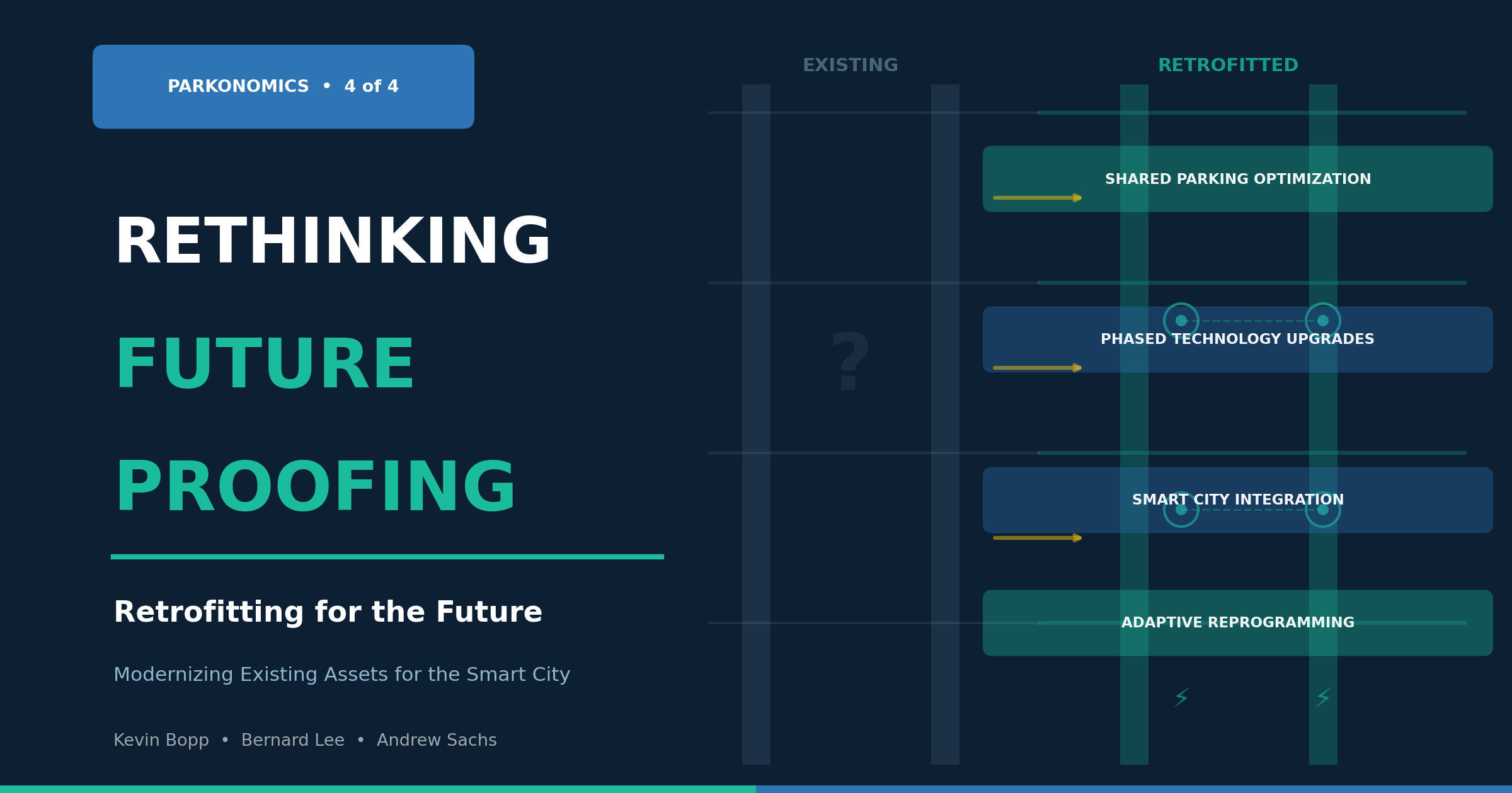
From a completed audit, upgrades can be implemented incrementally — beginning with foundational enhancements such as a new fiber optic backbone or upgraded electrical service, then progressing to user-facing technologies including LPR or advanced parking guidance systems. This pragmatic evolution transforms legacy assets into dynamic, intelligent components of the modern mobility ecosystem.
The phasing logic is not arbitrary. Phase 1 items are prerequisites: without an open-API PARCS platform, third-party integrations are impossible. Without a fiber backbone, cloud-based systems cannot maintain reliable connectivity. Without electrical pre-loading, EV expansion requires utility re-coordination at each step rather than a simple electrician call. Getting Phase 1 right makes every subsequent investment cheaper and faster to execute.
Retrofit programs that fail typically try to do too much at once, or start with user-facing features before the foundational infrastructure is in place to support them.
Phase 2 upgrades — LPR, smart lighting, initial EV deployment, operational analytics — are where the facility begins generating the data and revenue that justify the foundational investment. Phase 3 upgrades — advanced wayfinding, TNC zone configuration, MaaS integrations, EV scale-up — are where that data and infrastructure enable genuinely new revenue streams and competitive differentiation.
Operations and the SaaS Imperative
A future-proof parking facility is more than a well-designed building. It is a living operation that can adapt to the ever-changing needs of its users. This requires a management philosophy that embraces technology, leverages data, and relentlessly prioritizes a seamless customer experience.
Central to this adaptive approach is the embrace of cloud-based SaaS platforms. Moving beyond rigid on-premise servers, cloud systems offer unparalleled flexibility and scalability. Software updates can be pushed remotely, new features integrated without major hardware overhauls, and connections to third-party platforms simplified — allowing operators to stay at the cutting edge of technology without proprietary lock-in.
An adaptive operational strategy is equally essential to meet the new demands posed by the influx of EVs, the rise of transportation network companies, and emerging logistics models. This readiness translates to continuously monitoring EV charging station utilization and scaling capacity as demand surges. It means creating dedicated, intelligently managed zones for TNC pickups and drop-offs that prevent street-level congestion. It also includes the foresight to allocate space for novel uses — secure lockers for package delivery, staging areas for delivery bots — transforming the garage into a dynamic urban logistics hub.
Turning Data Into Decisions
In this digital age, data is paramount, and modern parking facilities are veritable data wells. Every transaction, entry, exit, and online reservation generates a wealth of user behavior information. The true value lies in transforming this raw data into actionable insights through business intelligence platforms.
These tools empower operators to analyze usage patterns, track revenue trends, and pinpoint optimization opportunities. Questions such as “Is a particular level underused during specific hours?” or “Could dynamic pricing smooth out demand peaks?” can be answered with precision, leading to a proactive and strategic operational approach rather than reactive management.
The compounding effect of structured data collection is significant. A facility that has been generating and retaining operational data for two to three years has an analytical foundation for pricing decisions, capital planning, and partnership negotiations that a facility without that data cannot replicate — regardless of how sophisticated its technology is at the point of deployment. Starting to collect structured data is therefore one of the most valuable early actions in any retrofit program, even before the systems that will use that data are in place.
The Human Element
In the midst of all this technological change — the rise of autonomous vehicles, advanced wayfinding systems, digital credentialing, and complex data analytics — it is remarkably easy to overlook the most crucial, yet often underestimated, component: the human element. The staff members of a parking facility remain the frontline ambassadors of the customer experience.
A truly future-proof operation understands that cutting-edge technology is only as effective as the people who manage it. This necessitates significant, ongoing investment in training that prepares personnel not just to operate new systems but also to anticipate and adapt to evolving user behaviors. Staff should be trained on new software and hardware mechanics, but also — critically — on how to troubleshoot common issues with a digital-first mindset, provide high-quality customer service in an increasingly automated environment, and guide users through unfamiliar processes.
The ability of facility staff to seamlessly adapt, troubleshoot, and facilitate tech-driven experiences is paramount to a facility’s success. Even as technology evolves, the human touch remains a cornerstone of a positive and efficient parking experience. A facility that deploys sophisticated technology without investing equivalently in staff capability will consistently underperform the technology’s potential.
Integrating With the Smart City
The parking facility of the future will not be an island. It will be a fully integrated node within a citywide mobility network — driven by seamless data exchange, robust connectivity, and a new spirit of collaboration between the public and private sectors.
The rise of Mobility as a Service (MaaS) platforms — which integrate ride-sharing, public transit, micro-mobility, and future autonomous shuttles into a single, seamless service — presents a significant opportunity for parking operators. By actively sharing real-time data on parking availability and dynamic pricing with these platforms via open APIs, parking facilities can become a key, integrated component of a user’s entire end-to-end journey. This symbiotic relationship provides a powerful new channel for attracting customers and maximizing utilization. It also strategically positions the parking facility as a vital, indispensable piece of the broader urban mobility puzzle.
Cities are actively seeking ways to manage their transportation networks more effectively. Real-time, granular data on parking availability — collected through advanced guidance systems and LPR technology — can power dynamic signage on city streets, guiding drivers to available spaces and reducing the congestion that cruising for parking generates. This kind of public-private data collaboration increasingly defines which operators are treated as strategic infrastructure partners and which are treated as commodity providers.
The Lifecycle Mindset
This is not about making a perfect prediction about the future. It is about designing for change itself. For too long, parking structures have been viewed as static, depreciating assets — a necessary but uninspired component of the real estate portfolio and the urban fabric. Now is the time to see them for what they can be: dynamic, intelligent, and valuable mobility assets that are central to the functioning of our cities.
Achieving this outcome requires a new way of thinking — a lifecycle approach that considers both the initial construction and the ongoing evolution of the facility. By embracing flexibility in design, investing in a robust digital infrastructure, and fostering a culture of adaptability in operations, parking facilities can be not just ready for the future but actively shaping it.
The series has traced this lifecycle from the first shovel in the ground to the ongoing management of an existing asset. The common thread across all four articles is the same: the decisions that determine a facility’s long-term relevance are made earlier than most developers and operators think, cost less than assumed when made proactively, and cost far more than expected when deferred. The time to act is before the facility needs to change — not after it already has.
Frequently Asked Questions
Where should a retrofit program start?
Always with an audit, not a wish list. Before any capital commitment, assess the four foundational systems that determine everything else: electrical service and panel capacity, conduit availability for data cabling, the existing fiber or network backbone, and the current PARCS platform. These systems are prerequisites for every subsequent upgrade. A facility with insufficient electrical service at the panel level cannot scale EV charging regardless of charger procurement. A facility with a proprietary PARCS platform cannot integrate with third-party reservation systems regardless of how good those systems are. The audit reveals the actual constraint; the capital plan follows from that.
How much does a phased retrofit typically cost vs. replacing everything at once?
A phased approach is almost always cheaper in total than wholesale replacement, for two reasons. First, Phase 1 investments (electrical, fiber, PARCS) enable Phase 2 and Phase 3 at marginal cost — the infrastructure is already in place. Second, phasing allows later-phase decisions to be informed by actual operational data rather than projections. A facility that deploys Phase 1 and collects utilization data for 12 months will make much better decisions about EV charger count and wayfinding system selection than one making those decisions in a vacuum. Wholesale replacement also requires operational disruption during the changeover period that phased upgrades largely avoid.
What is the most common mistake in parking retrofit programs?
Starting with Phase 3. The most common failure pattern is deploying user-facing features — wayfinding systems, dynamic pricing displays, TNC zones — without the foundational infrastructure to support them reliably. A wayfinding system fed by unreliable occupancy sensors produces data that is wrong often enough to damage user trust. Dynamic pricing without a cloud-based PARCS platform that can process real-time rate changes creates manual workarounds that consume staff time. The technology underperforms, the investment case weakens, and subsequent phases lose organizational support. Starting with Phase 1 infrastructure feels less exciting than deploying visible technology, but it is what makes the visible technology work.
How does MaaS integration generate revenue for a parking operator?
Primarily through demand capture and yield optimization. A facility that shares real-time availability and pricing with navigation platforms and MaaS apps reaches users who are planning their trip before they leave — capturing demand that would otherwise go to the first facility they find on arrival. Pre-arrival reservations, enabled by space-level occupancy data, generate committed revenue from users who would otherwise remain unbooked. Dynamic pricing, triggered by real-time demand data, optimizes yield during peak periods without requiring manual rate management. Each of these revenue mechanisms depends on the same underlying data infrastructure. The investment in that infrastructure is, in effect, the investment in all of these revenue streams simultaneously.
Is the goal of future-proofing to predict which technologies will win?
No — and this is perhaps the most important reframe in the entire series. The goal is not to predict correctly; it is to design for change itself. A facility that has invested in foundational infrastructure flexibility — adequate electrical capacity, open-API systems, modular data architecture — can absorb new technology without major capital disruption, on whatever timeline that technology actually arrives. A facility that has bet precisely on one technology trajectory is exposed if that trajectory shifts. The parking industry has learned this lesson repeatedly: facilities built around specific mechanical or software platforms have consistently faced expensive replacements when those platforms became obsolete. The hedge against an unpredictable future is not prediction — it is optionality.
Sources
- Bopp, K., Lee, B., and Sachs, A. “Parkonomics: Retrofitting for the Future.” Urban Land, Urban Land Institute, February 10, 2026. urbanland.uli.org
 A
A